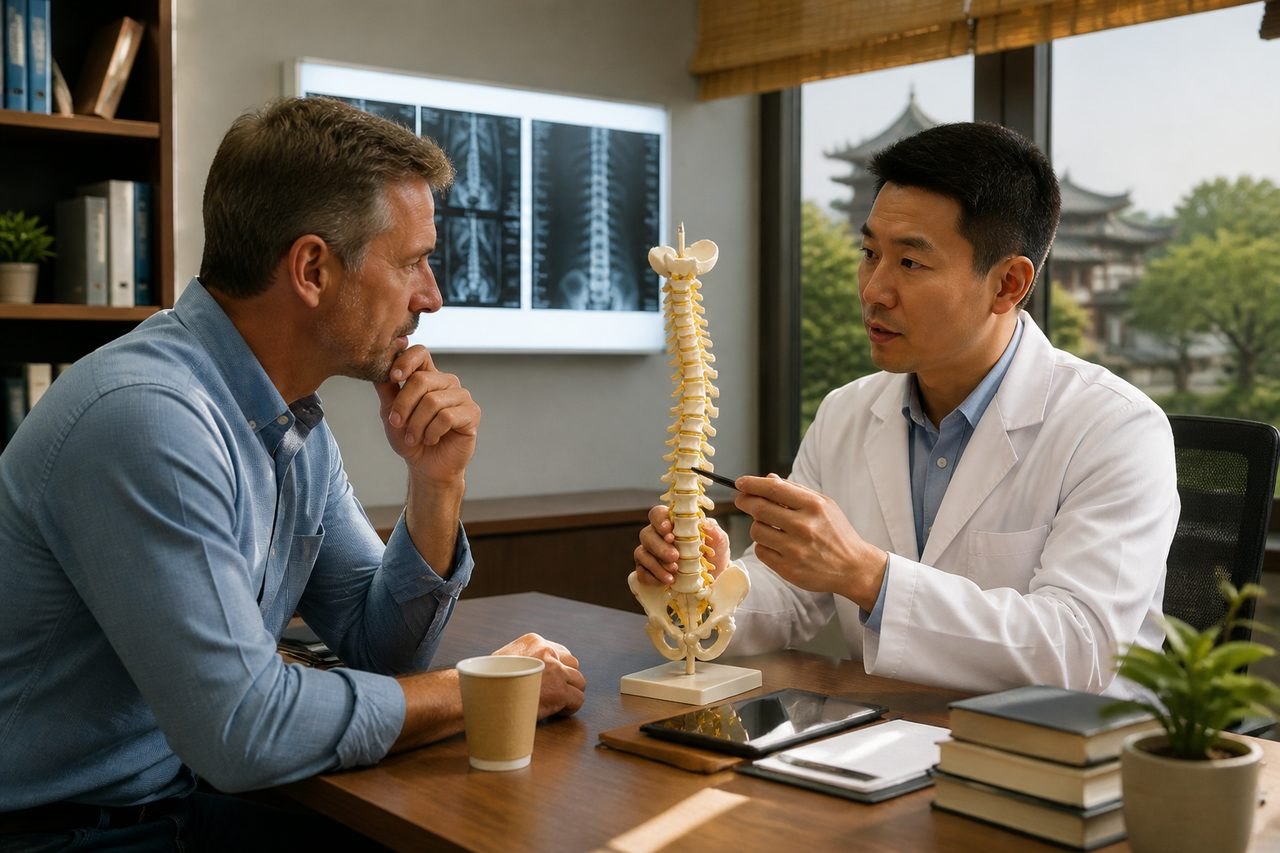
What old imaging can and cannot settle
Patients often arrive with a folder of MRI films, CT scans and X-rays taken months or years earlier, and assume the main task is to hand them over. Those records are genuinely useful. They show the shape of your discs, the state of the facet joints, alignment, and how your spine has changed over time. A clinician can compare an older study with a newer one and see whether a problem is stable or progressing.
What old imaging cannot do is answer the suitability question on its own. Lumbar artificial disc replacement replaces a damaged disc with a prosthesis, and it is not suitable for every patient with back pain. The reasons lie partly in things a scan does not capture well: how your pain behaves, whether it follows a disc-related pattern, how your muscles and movement have adapted, and whether other structures in the spine are also involved. A scan taken before a change in symptoms may describe anatomy that no longer matches your current problem.
This is why a new assessment is not a repeat for its own sake. It is a different kind of question. The older file says what was there. The new assessment asks whether replacement is the right operation for this person at this level now, or whether another approach fits better.
The level question: which disc, and how many
The single most important thing a new assessment clarifies is the level. A lumbar disc is identified by its position in the spine, and the operation is planned for a specific level or levels. If your pain comes from one disc and the plan addresses another, the result will not match the goal. If two levels are involved, the surgeon has to decide whether replacing both is appropriate or whether the pattern points elsewhere.
Old imaging helps here because it shows the level in a fixed frame. But the level that matters is the one that explains your symptoms, and that is a clinical judgement. It combines the scan with where you feel pain, what movements provoke it, what your neurological examination shows, and sometimes what a targeted injection reveals. A disc that looks worn on an old scan may be silent; a disc that looks only mildly changed may be the source.
Before you travel, it is reasonable to ask which level is being considered and why. If the answer is vague, or if the level has changed between conversations, that is worth resolving before any commitment. The treating hospital decides suitability, and the level is part of that decision.
Motion preservation: what the assessment is really testing
Artificial disc replacement is often described as motion-preserving, in contrast to fusion, which joins vertebrae. That contrast is real, but it is not a simple advantage. Whether motion preservation is appropriate depends on the state of the structures around the disc, especially the facet joints at the back of the spine. If those joints are already significantly worn, preserving motion at the disc may not deliver the benefit you expect.
A new assessment therefore looks at more than the disc. It considers the whole segment: the disc, the facets, the ligaments, alignment and stability. It also considers your general health, previous spinal surgery, and whether there are reasons why a prosthesis would be a poor choice for you. Some of these are visible on imaging; others come from examination and history.
The practical point for an overseas patient is that the assessment is not a formality that confirms a decision already made. It can change the recommendation. You may be told that replacement is suitable, that fusion is more appropriate, or that neither is needed yet. All three are legitimate outcomes of a careful review.
Device scope: what is being proposed, and what is not
Disc prostheses are not interchangeable. They differ in design, materials and the range of levels and sizes they cover. A plan that names a device is more informative than a plan that says only 'artificial disc'. Ask which prosthesis is proposed, why it fits your anatomy and level, and what happens if that device is not available at the time of surgery.
This is also where you should ask about alternatives. If the proposed device is not suitable, what is the fallback? Is fusion on the table? Is a different level or a different approach being considered? A clear answer to these questions tells you whether the plan is genuinely tailored or simply a default.
Availability is a hospital-specific matter. Rather than assume a device is stocked, ask the hospital directly how it confirms device availability before scheduling, and what it does if the plan changes. The treating team, not a coordination service, makes the clinical decision about which implant to use.
What the new assessment adds that records alone cannot
Records-based review is valuable, but it has limits. A clinician reading your file without examining you can form an opinion about whether replacement is plausible, what else should be considered, and what further information is missing. That is a real contribution to your decision. It is not the same as a final suitability decision, which requires the treating hospital to assess you in person.
The in-person assessment adds examination findings, a current neurological picture, and a conversation about your goals and expectations. It also allows the clinician to confirm that the level and device plan still make sense in light of what they find. This is why a remote opinion should be treated as a step, not a verdict.
If you are considering care in China, it helps to separate two questions. First, is lumbar artificial disc replacement a reasonable option to explore for my situation? Second, is it suitable for me, at this level, with this device, at this hospital? The first can often be addressed from records. The second belongs to the treating team after assessment.
Planning the review and the plan after you return home
One question overseas patients often leave too late is what happens after the operation. Before travelling, ask how the hospital structures follow-up, what imaging or review it expects, and how it communicates with a clinician in your home country. Ask whether it can provide records and imaging in a format your local team can use, and who to contact if a concern arises after you leave.
Rehabilitation is part of this. Ask what the hospital's rehabilitation plan involves, who supervises it, and how it is adjusted over time. If you will continue rehabilitation at home, ask what information the hospital will send to your local physiotherapist or doctor. The receiving clinician makes their own assessment, so a clear handover of records and instructions matters more than any assumption that one team must manage everything.
It is also reasonable to ask what the hospital's written plan includes and what remains undecided. Scope questions are best answered by the named provider, not by general assumptions about how hospitals in China work. Ask for the plan in writing, and ask which parts depend on findings at assessment.
A practical next step is to send a brief summary of your situation and your main question. An initial enquiry is free and does not require buying a proxy consultation. The team can identify what information is missing and suggest the relevant next step, while the treating hospital remains the decision-maker on suitability.
Sources & scope of this guide
References and official service information relevant to this guide.
This is general planning information and has not been individually reviewed by a doctor. Medical decisions and personal treatment advice come from your treating clinicians.