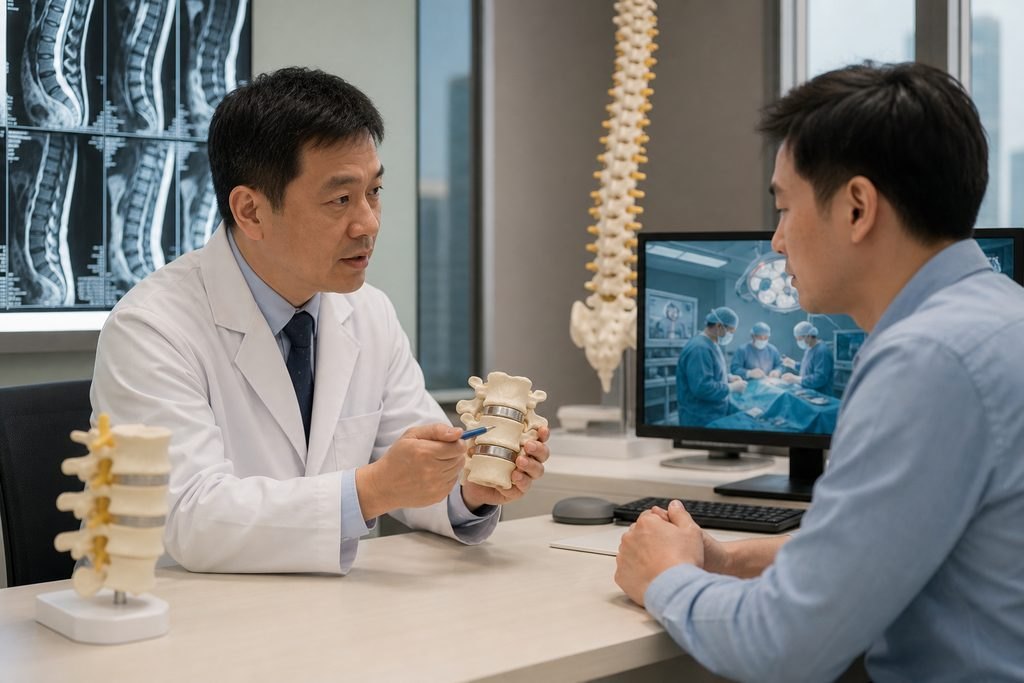
Why the disc level and device name must be in writing
Artificial disc replacement is not one operation. The lumbar spine has several mobile segments, and a prosthesis is chosen for a particular level and a particular size. The AAOS patient information on lumbar artificial disc replacement describes the procedure as replacing a damaged disc with a prosthesis, and notes that it is not suitable for every patient with back pain. That single sentence carries most of the decision: the operation is level-specific and patient-specific.
Before you compare hospitals or ask about cost, ask the surgeon to write down the level or levels being proposed, the device name and manufacturer, and whether the plan is one level or more. If the answer is vague, you cannot check whether the same operation is being discussed by a second clinician, and you cannot ask meaningful questions about the implant itself.
A useful question is: "Which disc level or levels are you proposing, and what is the exact prosthesis you would use?" Then ask a follow-up: "If that device is not available or not suitable at the time of surgery, what is the alternative plan?" The answer tells you whether the plan is fixed or conditional. It also tells you whether the surgeon has considered a fusion or a non-surgical route for the same level.
This is not a test of the surgeon. It is the minimum information you need to make an informed decision, and it is the same information a second opinion would need. If you cannot obtain it in writing before travelling, that is itself useful information about how the case is being handled.
Motion preservation: what the assessment actually has to show
The appeal of artificial disc replacement is often described as preserving motion at the treated level. Whether that is a realistic goal for you depends on the assessment, not on the name of the operation. The surgeon needs to explain what findings support a motion-preserving procedure in your case, and what findings would point away from it.
Ask directly: "What in my imaging and examination makes me a candidate for a motion-preserving procedure rather than a fusion?" Then ask the reverse: "What would make you change your recommendation to fusion or to non-surgical care?" A surgeon who can answer both questions is describing a decision process, not a sales position.
You should also ask what the assessment includes. Does it involve standing or dynamic imaging, a review of the facet joints, or an assessment of bone quality and alignment? You do not need to prescribe these tests yourself, and you should not assume a particular scan is mandatory. The point is to understand which findings the surgeon is relying on, so that you can see whether the recommendation is built on your actual records.
If you have already been told you are a candidate, ask whether that conclusion was based on a full records review or on a brief conversation. The distinction matters when you are deciding whether to travel.
Alternatives: make the comparison explicit
Every surgical recommendation should be accompanied by the alternatives that were considered. For lumbar disc disease, those alternatives may include continued non-surgical management, injection-based treatment, decompression alone, or fusion. The exact options depend on your diagnosis and the level involved, and only the treating clinician can say which are reasonable for you.
Ask the surgeon to list the alternatives in order of what they would recommend for you, and to explain why the artificial disc is placed where it is. A useful phrasing is: "If I decided against artificial disc replacement, what would you recommend instead, and what would you expect the trade-offs to be?"
You should also ask what happens if the artificial disc procedure is not successful, or if further surgery is needed later. This is not a prediction about your outcome. It is a question about the revision plan, and it is reasonable to ask any spine surgeon to describe how they would approach a revision at the same level.
If the surgeon cannot describe a revision pathway, ask who would manage it and where. The answer may be that another specialist or centre would be involved. That is useful to know before you travel, not after.
Risks: ask about the specific procedure, not surgery in general
General surgical risk language is not enough for this decision. Ask the surgeon to describe the risks that are specific to the approach, the level, and the device being proposed. These may include risks related to the approach to the spine, the implant itself, and the possibility that the procedure does not relieve the pain.
A practical question is: "What are the risks you would want me to understand before I consent, and how would they be managed if they occurred?" Then ask what would happen if a complication occurred after you returned home. Who would provide the immediate care, and how would the surgical team be involved?
You should also ask about the device's own risks, not only the logistics of travel. Implant-related problems, wear, migration, and the need for further surgery are questions for the surgeon, and the answers should be documented in your records.
Do not accept a general statement that the risks are low. Ask for the specific risks that apply to your level and your proposed device, and ask how the team would monitor for them.
After you return home: review and rehabilitation
The plan after discharge is part of the operation, not an afterthought. Before you travel, ask the surgeon to describe the follow-up schedule, the imaging or review that will be needed, and how the results will be shared with your local clinician. Ask whether the follow-up can be done locally, and what the surgical team would need from your local doctor.
Rehabilitation is a separate question. Ask what restrictions apply after the procedure, how long they are expected to last, and who will supervise the rehabilitation. The treating team's instructions should guide your activity, and your local physiotherapist will make their own assessment. You should not assume that only the original surgical team can supervise your recovery.
A useful question is: "What written instructions will I receive for activity, wound care, and follow-up, and who should I contact if I have a problem after I return home?" If the answer depends on a local clinician, ask how that handover will happen.
You should also ask what records you will receive before you leave, including the operative note, the implant details, and the discharge summary. These documents are needed by any clinician who sees you later.
How to use an enquiry without turning it into a commitment
An initial enquiry to ChinaSpecialistCare is free and non-clinical. It is a way to check whether your records are complete enough for a surgeon to review, and to identify the relevant next step. It does not establish that you are a candidate for artificial disc replacement, that a particular device is available, or that a hospital will accept your case. Those decisions belong to the treating hospital and its clinicians.
If you want a records-based opinion before travelling, a proxy consultation is optional and is not a prerequisite for every appointment or operation. You can also ask for a specialist appointment or, for a complex case, a multidisciplinary review. The scope and any coordination fee are agreed before the work begins.
The practical next step is to prepare a short summary: your main question, the level or levels that have been discussed, any imaging reports, and the alternatives you have already been offered. Send that summary through the enquiry form, and ask what information is still missing. Keep your local care in place while you explore this option, and seek local care urgently if your symptoms worsen.
You can review the artificial disc replacement reference page for the procedure context, and then decide whether you want a records-based opinion before making any travel plans.
Sources & scope of this guide
References and official service information relevant to this guide.
This is general planning information and has not been individually reviewed by a doctor. Medical decisions and personal treatment advice come from your treating clinicians.