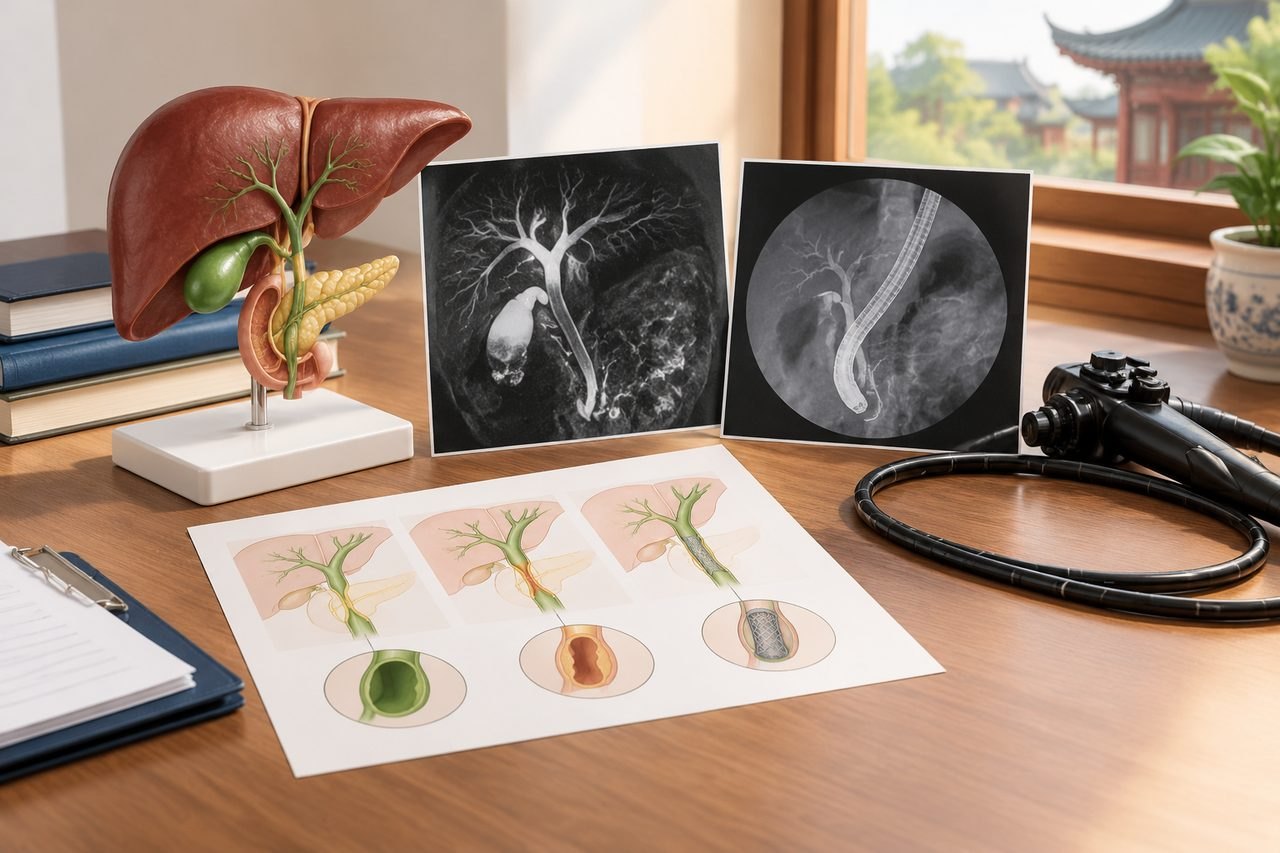
Why the stricture's exact level and cause matter more than the label
"Bile duct stricture" is a description, not a complete diagnosis. A report that only uses this phrase leaves the receiving clinician unable to judge what kind of assessment or drainage route is appropriate. The level of the narrowing matters: a stricture near the liver hilum, in the middle of the duct, or at the lower end near the pancreas involves different anatomy and different procedural options. The report should say which segment is affected and how far the narrowing extends.
The suspected cause also changes the plan. A stricture after previous gallbladder or biliary surgery, one associated with chronic inflammation, and one that could be malignant are not managed identically. If the cause is still uncertain, the report should say so explicitly rather than implying a conclusion. A phrase such as "indeterminate, malignancy not excluded" is more useful to a surgeon or endoscopist than a vague impression that hides the uncertainty.
This is the first thing to check in your file. If the MRCP report describes the level but not the likely cause, or the ERCP report names a stricture without saying whether tissue was sampled, that gap is worth resolving before you send records anywhere. You are not being asked to interpret the images yourself; you are checking whether the written report gives a receiving team enough to work with.
What the MRCP report should state about the ducts above and below the narrowing
MRCP is a magnetic resonance imaging study of the biliary and pancreatic ducts. Its value in a stricture case is not only showing the narrowing but describing what is happening on either side of it. The report should indicate whether the ducts upstream of the stricture are dilated, whether the downstream duct looks normal or abnormal, and whether the gallbladder and pancreatic duct appear involved.
Upstream dilatation suggests the blockage is causing pressure to build behind it. That finding influences how urgently drainage is considered. A report that mentions a stricture but says nothing about duct calibre upstream leaves an important question open. If the original report is unclear on this point, ask the radiology department whether the images show dilated intrahepatic ducts and whether that was documented.
The MRCP report should also note any stones, masses, or fluid collections it identified, and whether the study was limited by any technical factor. A limited study is not a failed study; it simply tells the next clinician what could and could not be seen. When you send records to China, include the full report text rather than only the conclusion line, because the descriptive body often contains the detail a specialist needs.
What the ERCP report adds, and why the procedure note is not the same as the images
ERCP combines endoscopy and X-ray imaging to examine and treat the bile ducts. When an ERCP has already been performed, the procedure report is often the single most informative document in the file. It should describe what was seen, what was done, and what was left undone. For a stricture, the key items are whether the narrowing was directly visualised, whether it was dilated, whether a stent was placed, and whether any tissue or fluid was collected for laboratory examination.
A common gap is a report that states a stent was inserted without saying what type, what length, or where it sits. Another is a report that describes a successful drainage procedure but does not state whether the stricture itself was characterised. These details matter because a receiving team needs to know whether the stricture has been imaged, sampled, or only bypassed.
The ERCP report should also note any complications or difficulties encountered, and whether a follow-up procedure was planned. If the report mentions that a further ERCP was recommended, that recommendation is part of the clinical picture and should travel with the records. Do not rely on memory or a discharge summary alone; the full procedure note is the document a specialist will want to read.
Distinguishing a stent that is already in place from one that is only proposed
Bile duct stents can help drainage when a duct is blocked, and the approach and follow-up depend on assessment. This means the word "stent" in a report can refer to two very different situations. An existing stent is a device already sitting in the duct, placed during a previous procedure. A proposed stent is a recommendation that has not yet been carried out. Confusing the two can lead to incorrect assumptions about what has already been treated.
Check your reports for language that makes the status unambiguous. Phrases such as "stent deployed," "stent inserted," or "stent in situ" describe an existing device. Phrases such as "stenting recommended," "consider stent placement," or "plan for ERCP with stenting" describe something still to be done. If a report is ambiguous, ask the treating team to clarify in writing.
For an existing stent, the report should ideally state the type, the position, and whether it was functioning at the time of the last assessment. It should not be assumed that every stent is permanent or that a fixed exchange date applies to every patient. Whether a stent needs review, exchange, or removal is a clinical decision based on the individual case, and the receiving team will make that judgement after reviewing the records.
Drainage status and infection: what the report should say about the current situation
A stricture matters clinically largely because of what it does to bile flow. The report should therefore make the drainage status clear. Is bile draining adequately at present, or is there evidence of obstruction? Are there signs of cholangitis, such as fever, jaundice, or abnormal liver blood tests? If a drainage procedure has been performed, did it achieve satisfactory flow?
These questions are not academic. If there is active infection or worsening obstruction, that requires urgent local assessment rather than overseas travel planning. A report that documents stable drainage and no current infection tells a different story from one that documents ongoing obstruction. The receiving clinician needs the most recent picture, not only the picture at the time of the first diagnosis.
The report should also state when the most recent assessment took place. A normal drainage status recorded several months ago may not reflect the current situation. If your symptoms have changed since the last report, that change is itself important information and should be communicated to the clinical team, along with any recent blood test results that show liver function or infection markers.
Preparing the record set and the questions to send with it
Once you have checked the four points above, assemble a clear record set. The goal is not to send everything you own, but to send the documents that answer the receiving team's likely questions. A focused set is easier to review and less likely to bury the important findings.
A practical record set for a bile duct stricture enquiry typically includes the full MRCP report, the full ERCP procedure report or reports, any pathology results from tissue sampling, recent liver function blood tests, and a short summary of your current symptoms and their timeline. If you have imaging on disc or a link to a cloud viewer, mention that it is available; do not send large files through a first enquiry form.
Along with the records, send a short list of questions. Useful ones include: does the report establish the stricture level and cause; is a stent currently in place and what type; what was the most recent drainage status; and what further assessment would the treating team consider. These questions help the receiving clinician respond specifically rather than generally.
If you are considering care in China, the relevant starting point is the bile duct stenting procedure reference, which explains the context for drainage procedures. You can also begin with a free initial case review: our team checks the available diagnosis, records and your main question, identifies missing information and suggests the relevant next step. This is not a diagnosis or a promise of acceptance, and it does not require buying a proxy consultation. Hospital suitability and any treatment decision belong to the treating hospital and licensed clinicians.
Sources & scope of this guide
References and official service information relevant to this guide.
This is general planning information and has not been individually reviewed by a doctor. Medical decisions and personal treatment advice come from your treating clinicians.