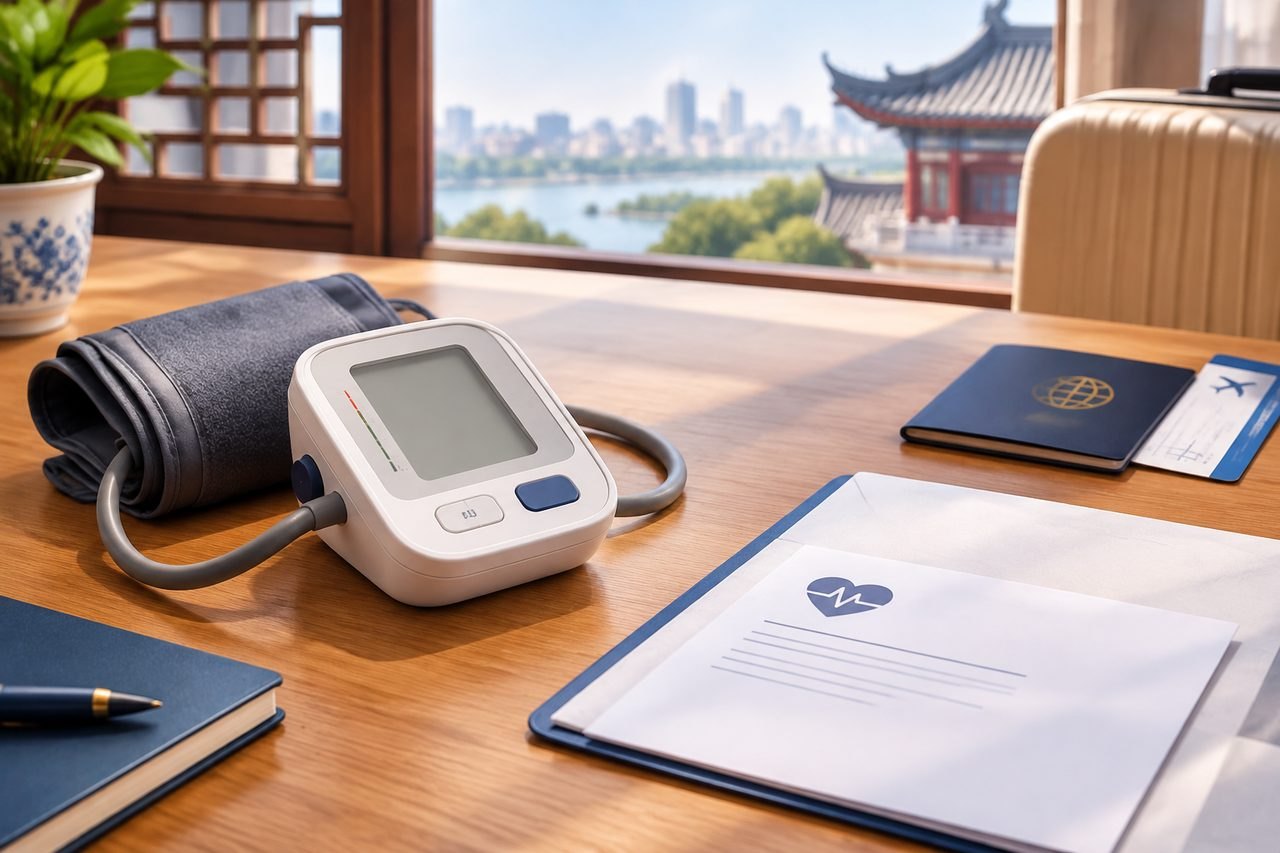
Why the report timing matters before you book
Blood pressure assessment in China can include a clinic measurement, home monitoring over several days, or ambulatory monitoring worn for a set period. The report is not always ready the same day. If your flight home is soon after the assessment, you may leave before the final report is written, signed, or translated.
That gap is an administrative problem, not a clinical one, but it still needs a plan. The person who explains the results should be a clinician who can see the full record, not a coordinator reading numbers aloud. The person who sends the report should be named before you leave, so you are not emailing a general hospital address and hoping.
Ask the hospital directly: when is the report expected, who signs it, and who sends it to me? Get the answer in writing, with a named department or contact. If the answer is vague, treat that as a reason to confirm before you travel, not after.
Who actually explains the results
The treating hospital and its clinicians own the interpretation. They know how the measurement was taken, what device was used, what your readings were across the monitoring period, and what else was found. A coordinator, interpreter, or travel service does not diagnose and does not decide what your blood pressure numbers mean.
If you want the report explained after you leave, ask the hospital whether a follow-up consultation can be arranged remotely, by phone, or by video, and whether an English-speaking clinician is available for that discussion. This is a question to confirm with the specific hospital, not an assumption. Some departments can arrange it; others cannot.
Your home clinician is the right person to place the results in context with your history, medicines, and other conditions. The China report is one input. Ask your home clinician what they need from the report so the handover is useful rather than just a PDF.
What to settle in writing before departure
Before you leave, confirm the practical chain: who writes the report, who translates it if needed, who sends it, to which email address, and who you contact if it does not arrive. Ask whether the report will be in English, Chinese, or both, and whether a translated version is an extra step with its own timing.
Ask what the report will contain. A useful report for your home clinician typically includes the readings, the dates and times of monitoring, the device or method used, and any clinician comment. If you need a specific format for your home doctor, say so before the assessment, not after.
Keep your own copy of the discharge or visit summary, the contact details of the department, and any receipt or reference number. These make follow-up faster if the report is delayed or sent to the wrong address.
- Name of the department or clinician who will sign the report.
- Name and email of the person who will send it.
- Language of the report and whether translation is included.
- What the report will contain and whether a clinician comment is included.
- Who to contact if the report has not arrived.
If the report arrives after you are home
When the report reaches you at home, do not act on it alone. Send it to your home clinician first. They can compare it with your previous readings, your medicines, and your symptoms, and decide whether anything needs to change. Do not stop or adjust prescribed blood pressure medicine based on a report you have not discussed with a clinician.
If you have questions about the China report itself, such as what a particular reading or comment means, direct those to the hospital or clinician who produced it. If a remote follow-up was arranged, use it. If it was not, ask whether one can still be requested.
If you develop new or worsening symptoms, such as chest pain, severe headache, breathlessness, or vision changes, seek local medical care promptly. Do not wait for an overseas report or a remote appointment. Urgent symptoms take priority over administrative follow-up.
What a coordinator can and cannot do
A non-clinical coordinator can help with the administrative side: requesting the report, chasing a missing document, arranging interpretation, or helping you ask the hospital for a remote follow-up. ChinaSpecialistCare can assist with records handling, interpretation, and specialist appointment requests for confirmed services, but it does not diagnose, prescribe, decide suitability, or guarantee that a hospital will provide a particular follow-up format.
The hospital decides whether it can offer a remote explanation, what it will include, and when it will be ready. A coordinator cannot promise a report deadline, a specific clinician, or a particular outcome. If someone offers those guarantees, treat it as a warning sign.
If you are planning a blood pressure assessment in China and want help preparing the enquiry, you can start with a short summary of your situation. You do not need to buy a proxy consultation to ask a question or request an appointment.
How to prepare your enquiry and next step
When you contact a hospital or a coordination service, keep the first message short. State that you are considering a blood pressure assessment in China, give your main question, and ask what records they need. Do not send a full medical archive or payment details in the first message.
Ask specifically: can the report be explained after I leave, who will explain it, and how do I contact them? Ask for the answer in writing. If the hospital cannot confirm a remote explanation, plan for your home clinician to receive the report and discuss it with you there.
The timing question deserves the same precision. Ask when the report is expected to be finalised, whether that date is before or after your planned departure, and what happens if it slips. If the report will be ready only after you fly, confirm the sending method and the receiving address before you leave the hospital, not by email from the airport.
For a report that arrives after departure, the handover has two parts. The hospital sends the document to you or to a named recipient. Your home clinician then reviews it alongside your history and decides what, if anything, changes. Keep those two steps separate in your own notes so a missing document does not get confused with a missing clinical decision.
If the assessment was arranged through a coordination service, ask that service what it will and will not do once you are home. Confirmed help covers records handling, interpretation, and specialist appointment requests for services the hospital has agreed to provide. It does not include diagnosing from the report, prescribing, or deciding whether a particular follow-up is clinically suitable. Those decisions stay with licensed clinicians.
One practical habit makes the whole chain easier to audit. Keep a single thread, whether email or messaging, containing the report request, the named contact, the agreed language, and the expected sending date. If you later need to chase the report, you are replying to a documented request rather than starting a new explanation of who you are and what you had done.
An initial enquiry is free. You can share a brief summary of your situation, and the team will identify missing information and suggest the relevant next step. The hospital decides suitability and what the assessment will include. No outcome is guaranteed.
Sources & scope of this guide
References and official service information relevant to this guide.
This is general planning information and has not been individually reviewed by a doctor. Medical decisions and personal treatment advice come from your treating clinicians.