Why the two sets of information answer different questions
A burn reconstruction enquiry usually arrives with a folder: discharge summaries, operative notes, photographs taken years apart, maybe a letter from a surgeon who has since retired. It is tempting to treat that folder as the assessment. It is not. The folder is a history. The assessment is a judgement about your present situation.
Old records answer questions about the past. What caused the burn, when it happened, which wounds were closed and how, whether skin grafts were used, whether any contracture was released before, and what complications were recorded at the time. That history matters because reconstructive surgery is planned around tissue that has already been operated on, and the treating team needs to know what has been done rather than rediscover it.
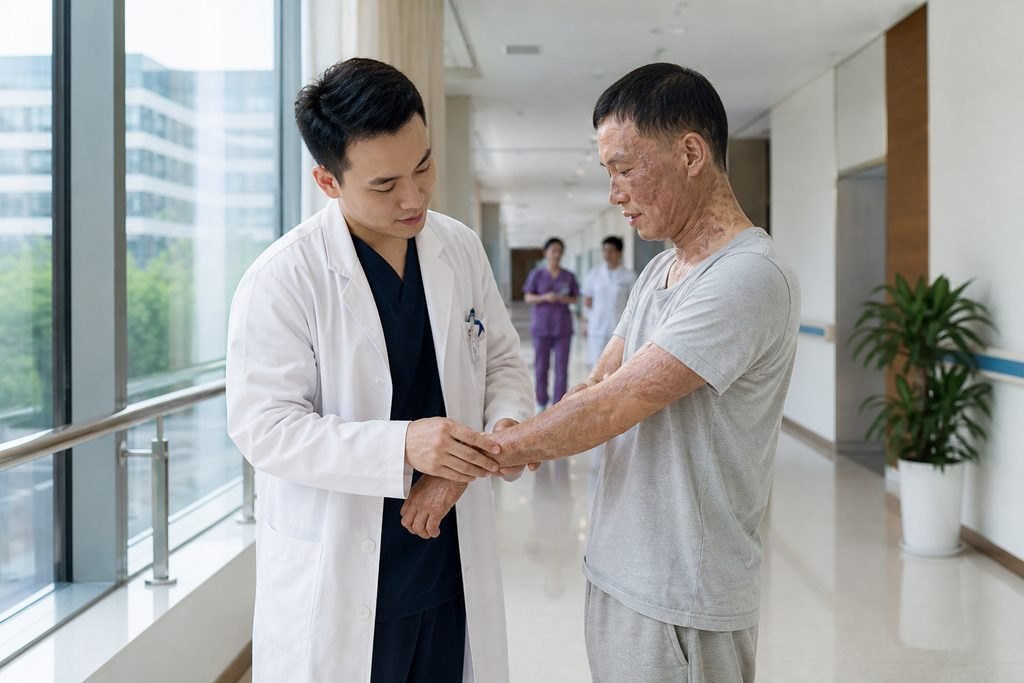
A new assessment answers questions about now. Which movements are restricted, which areas are painful, itchy, unstable or repeatedly breaking down, how the scarring affects sleep, work, dressing and self-care, and what the patient actually wants to be able to do again. These are not the same facts, and a record written ten years ago cannot supply them.
The practical consequence is that sending records is not the same as being assessed. Records help the hospital decide whether your situation is within its scope and what further information it wants. The examination and the clinician's judgement decide what, if anything, is offered.
What old records can and cannot establish
Records are most useful when they are specific. An operative note that names the procedure, the date and the anatomical area tells the team more than a summary saying 'burn surgery'. Discharge summaries that list complications, wound infections or graft loss are relevant because they may change how the team thinks about the tissue. Photographs are useful when they are dated, because a sequence shows change over time rather than a single moment.
Records cannot establish current function. A note saying a graft healed does not tell anyone whether the patient can now fully extend an elbow, grip an object or turn the head. Records also cannot establish what the patient wants. A technically successful reconstruction that does not restore the movement a patient cares about may still be a disappointment to that patient.
Records may also be incomplete in ways that matter. If the original injury was treated in a setting where documentation was limited, the team may need to work from examination rather than history. That is a reason to say so plainly in the enquiry rather than to delay sending what exists.
One more limitation is worth stating. Records from another country do not tell a Chinese hospital what its own clinicians will find on examination, and they do not establish that a particular procedure is available, suitable or advisable for you. They inform the assessment; they do not replace it.
What a new assessment is actually trying to answer
A reconstructive assessment for healed burns is usually trying to answer a small number of practical questions. Which problems are structural and which are related to scarring, tightness or joint position? Which of those problems might be improved by surgery, and which are better addressed by therapy, splinting, pressure management or time? What is the risk of making something worse?
The assessment also looks at priorities. A patient with scarring across several areas may have one function they care about most: opening a hand, closing an eye, turning the neck, sitting comfortably. Reconstructive planning is often staged, and staging is usually driven by which problem causes the most difficulty and which procedure the tissue can tolerate first. The treating team decides that sequence; the patient's account of daily life is what makes the sequence meaningful.
This is why describing activities is more useful than describing scars. 'I cannot hold a cup with my right hand' or 'I cannot turn my head when driving' gives the clinician a functional target. 'The scar is tight' is true but less actionable.
The assessment should also address what reconstruction cannot do. Burn care can include surgery to repair wounds or reconstruct damaged skin, but no responsible team promises a scar-free result or a guaranteed return of full movement. If a plan is presented as certain to restore normal appearance or function, that is a reason to ask more questions, not fewer.
The questions that decide whether a China assessment is worth arranging
Before committing to travel, it helps to know what the hospital can and cannot tell you remotely. A records-based opinion can indicate whether your situation is within a team's scope and what further evaluation it would want. It cannot substitute for examination, and it does not confirm acceptance for surgery.
Ask directly which of your problems the team considers potentially reconstructable and which it does not. Ask whether the assessment would be a single consultation or a staged process, and whether any decision depends on tests or imaging that would be arranged in China. Ask who would make the final decision about suitability and what would cause the team to decline.
It is also reasonable to ask how the team handles patients whose original injury was treated elsewhere, and whether they need records translated or summarised in a particular way. These are administrative questions, but they change what you prepare.
Finally, ask what the team would want to know about your general health. Reconstruction is surgery, and fitness for anaesthesia and healing are part of the assessment. That discussion belongs with the treating clinicians, not with a coordination service.
Function goals, staging and rehabilitation as one conversation
Reconstruction and rehabilitation are not sequential in the way patients often assume. Therapy may continue before and after surgery, and the timing of surgery can depend on how tissue responds to therapy. A plan that treats rehabilitation as an afterthought is incomplete.
When you speak with the team, describe the activities that are affected and ask how staged reconstruction and rehabilitation would be scheduled. Ask what would be expected of you between stages, how long each stage might require you to remain in the area, and what support you would need at home. These are questions to confirm with the named provider, not assumptions to carry from another health system.
Ask, too, what the alternatives are. For some problems, non-surgical management may be the preferred first step. For others, surgery may be the only realistic option. The treating clinician's judgement on that point is the one that matters.
If you are considering care in China, the relevant reference page for this subject is the burn reconstruction service page, which describes the scope of the service rather than a specific plan.
Preparing the enquiry without over-promising yourself an outcome
A first enquiry does not require a complete archive or a purchased opinion. A short summary is enough to start: when the burn happened, what treatment you have had, which areas are affected, what you cannot do now, and what you most want to change. From there, the team can tell you what records would be useful and what the next step is.
Be careful about the assumptions you bring. Sending records does not establish eligibility. An initial review does not confirm that surgery is advisable, available or suitable for you. A hospital decides acceptance, and the treating clinicians decide the plan. If you are told otherwise by anyone outside the clinical team, treat that as a question to verify.
If your symptoms are worsening, if a wound is not healing, or if you have new pain, discharge or fever, seek local medical care rather than waiting on an overseas enquiry. Reconstruction of healed burns is elective; acute problems are not.
When you are ready, share a brief summary through the enquiry form, email or WhatsApp. The initial case review is free and is a non-clinical check of what you have and what you are asking. It is not a diagnosis, and it does not commit you to travelling or to any procedure.
Sources & scope of this guide
References and official service information relevant to this guide.
This is general planning information and has not been individually reviewed by a doctor. Medical decisions and personal treatment advice come from your treating clinicians.