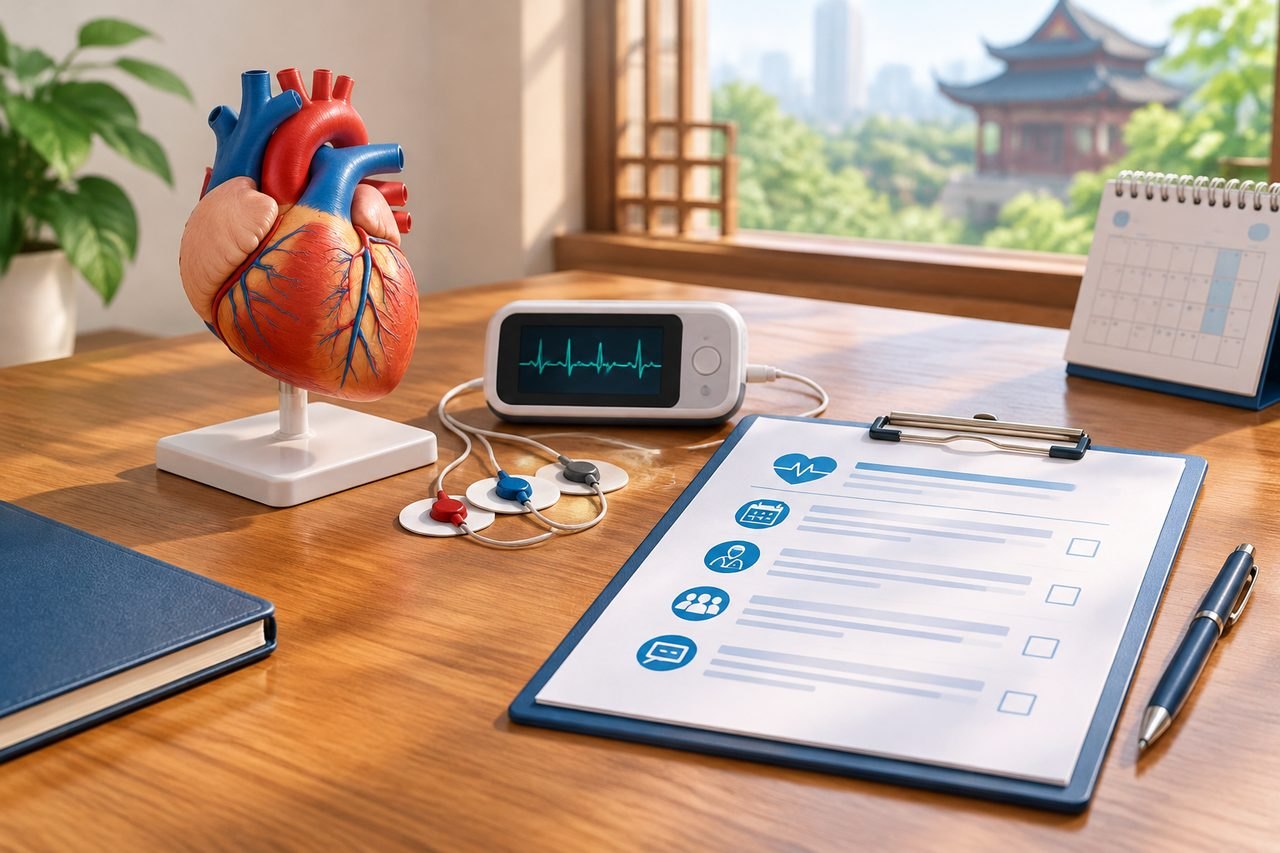
Why a written follow-up plan matters after ablation
Catheter ablation treats selected abnormal heart rhythms by targeting the tissue responsible, and the approach depends on the rhythm problem. Because the procedure is tailored to your specific arrhythmia, the follow-up plan must also be tailored. A verbal summary at discharge is easy to misremember, especially when you are travelling home or communicating across languages. A written plan gives you and your local clinician a shared reference.
The plan is not a substitute for clinical judgement. It is a record of what the treating team has decided, what still needs to be confirmed, and who to contact when a question arises. Ask the electrophysiology team to write it in plain language, and request an English version if you do not read Chinese. If the hospital provides a translated discharge summary, check that the follow-up section is included and not left as a separate verbal instruction.
A useful plan answers four practical questions: which rhythm records are needed, when and how reviews happen, who coordinates them, and who is responsible for acting on results. If any of these is missing, ask for it to be added before discharge.
Which rhythm records the electrophysiology team needs
The electrophysiology team will want to know how your heart rhythm behaves after the procedure. Ask them to specify, in writing, which records they need and how those records should reach them. The exact requirements depend on your arrhythmia and the team's protocol, so treat this as a question to confirm rather than a fixed list.
Common items teams may ask about include ECG tracings, Holter or ambulatory monitor recordings, and any rhythm data from a wearable or implanted device. If you already use a home monitor, ask whether the team wants those transmissions and through which channel. If you do not have a monitor, ask whether one is needed and how it would be arranged.
The written plan should state the format the team accepts, the time window they want covered, and the contact point for sending records. It should also say what the team will do with the records once received, and how you will learn the result. Without that, you may send data into a channel that no one reviews.
If your local clinician will collect rhythm records at home, ask the electrophysiology team to write a short request that your local clinician can follow. This avoids duplicated or incompatible recordings and makes the review more useful.
How post-procedure reviews are coordinated
Ask the treating team to describe, in writing, how follow-up reviews are coordinated. The plan should distinguish between reviews done in China and reviews done by your local clinician, and say how information moves between them. It should also state what triggers an earlier review, such as a change in symptoms or a rhythm recording that concerns you.
The plan should name the type of review, not just a date. For example, it might specify a rhythm review, a medication review, or a wound and access-site check. Each has a different purpose and may involve a different clinician. Ask who leads each review and who you contact if the scheduled review needs to change.
If the plan includes remote review, ask how it is conducted, what platform is used, and what happens if the connection fails. If it includes an in-person visit in China, ask how the appointment is booked and what records to bring. Do not assume that a review will happen automatically; confirm who initiates it.
Ask the team to write down what they consider a normal recovery course for your procedure and what would prompt urgent local care. This helps you and your local clinician decide when to seek help without waiting for a scheduled review.
Contacts, responsibilities and language
A written plan should name a contact point and state that person's role. It should also say what that contact can and cannot do. A coordination contact can help with appointments and records, but clinical decisions belong to the treating clinicians. Ask the team to separate these roles clearly in the document.
If you do not speak Chinese, ask how communication will work after discharge. Confirm whether the contact speaks English, whether interpretation is available, and how to request it. If a family member or interpreter will relay messages, ask the team to record that arrangement so messages reach the right person.
Ask who is responsible for acting on each result. For example, if a rhythm recording shows a change, who reviews it, who contacts you, and within what arrangement. The plan does not need to promise a specific response time, but it should identify the responsible clinician or team.
Finally, ask for the plan in a format you can share. A PDF or printed copy with the hospital's contact details is more useful than a photograph of a handwritten note. Keep a copy with your other medical records.
What to confirm before you leave China
Before discharge, review the written plan with the treating team and confirm each item. Ask them to correct anything that is unclear or missing. This is also the moment to ask about medication instructions, activity limits, and when you can travel, because those decisions belong to the treating clinicians and may change your follow-up arrangements.
Do not change any anticoagulant or rhythm medication on your own. If your local clinician proposes a change, ask them to discuss it with the electrophysiology team or to document the rationale. The written plan should state who to contact if medication questions arise.
If you feel unwell before your scheduled review, seek local care rather than waiting. Acute symptoms such as chest pain, severe breathlessness, fainting, or a rapid or irregular heartbeat that concerns you need prompt assessment. The follow-up plan is for planned review, not for emergencies.
Ask the team to note in the plan which records you should bring to each review and how to request copies if you need them later. This reduces the chance of gaps when care moves between clinicians.
Working with ChinaSpecialistCare on the written plan
ChinaSpecialistCare provides information and non-clinical coordination for international patients considering care in China. For cardiac ablation, we can help you prepare a short summary of your rhythm history and questions, and we can request appointment coordination with a suitable hospital. We do not decide suitability, write the clinical follow-up plan, or replace the treating team's judgement.
If you would like help obtaining a written follow-up plan, start with a brief enquiry. Share your diagnosis, the procedure you are considering or have had, and your main question about follow-up. Our team checks the available information, identifies what is missing, and suggests the relevant next step. An initial enquiry is free and does not require buying a proxy consultation.
The hospital decides whether to accept you for assessment or treatment, and the electrophysiology team decides what follow-up is appropriate. Our role is to help you communicate clearly and to coordinate practical arrangements, not to make clinical decisions.
You can review general information about catheter ablation on our procedure reference page before you enquire. Use it to prepare questions, not as a substitute for the treating team's advice.
Sources & scope of this guide
References and official service information relevant to this guide.
This is general planning information and has not been individually reviewed by a doctor. Medical decisions and personal treatment advice come from your treating clinicians.