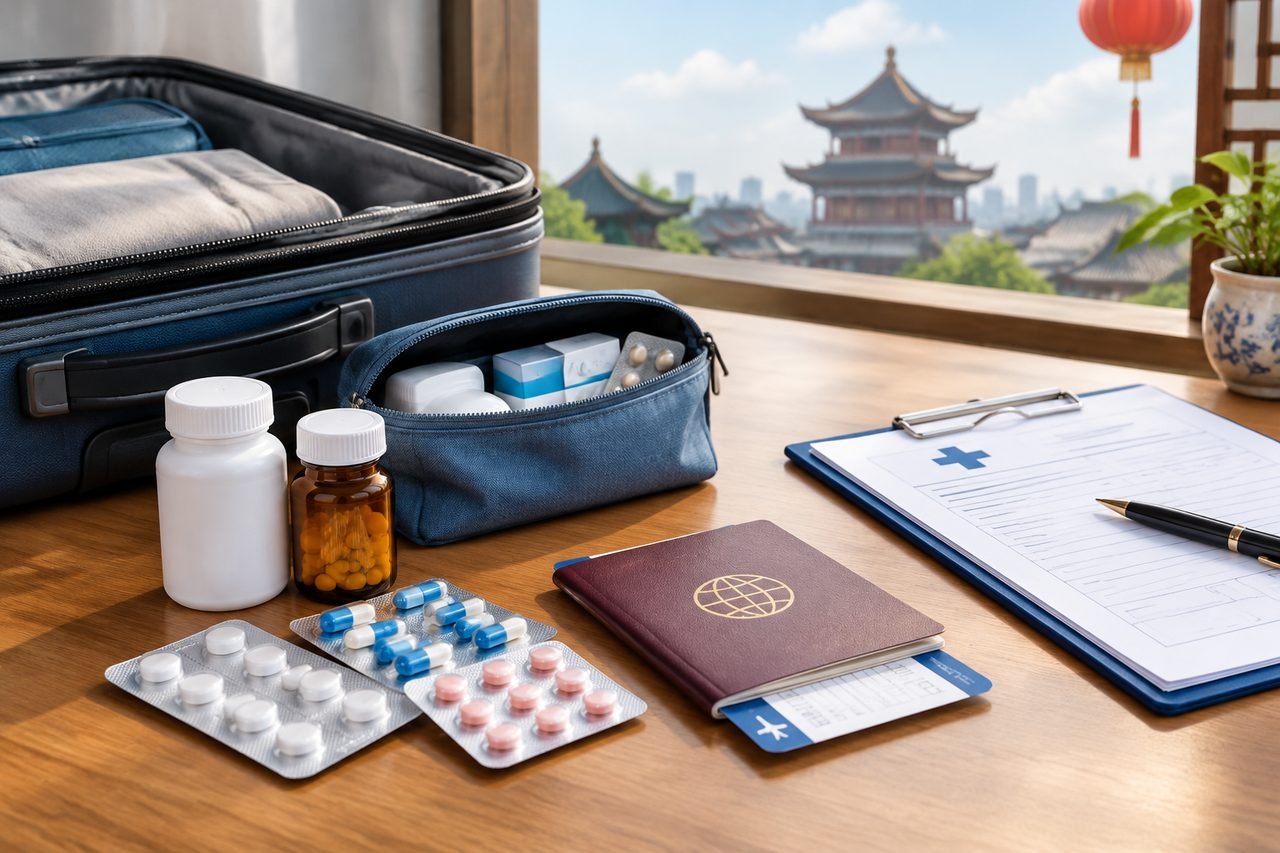
Why the carrier's status matters more than the prescription
The practical problem is not whether the medicine is legitimate where it was prescribed. It is whether you, the person carrying it, are entitled to bring it in for someone else. Customs rules are written around a traveller's own personal use, and an official Shanghai government guide separates small personal quantities from narcotic and Class I psychotropic medicines, which need separate documentation. Nothing in that guidance says a foreign prescription automatically transfers the patient's entitlement to a relative or friend acting as courier.
That distinction changes what you should do first. Instead of packing the medicine and hoping the paperwork speaks for itself, identify the exact product and ask the authority that will actually inspect your bag. The arrival-port customs office is the decision-maker for your route, not a clinic, a pharmacy or an online forum. If you are travelling through more than one country, each transit point may apply its own rules, so a single answer from one airport does not cover the whole journey.
A second reason to check early is timing. If the medicine turns out to need a permit, a letter or a different quantity limit, you need that answer before you book a non-refundable ticket or promise your relative a delivery date. Treat the customs reply as the anchor for every other arrangement, including how the medicine is packed and who carries it.
Separate ordinary personal-use medicines from controlled medicines
The Shanghai government guidance draws a line between medicines for personal use in small quantities and controlled medicines, specifically naming narcotic and Class I psychotropic medicines as needing separate documentation. That is the single most useful distinction for planning, because it tells you the two categories do not follow the same path.
For an ordinary medicine, the questions are still concrete: what is the exact active ingredient, what formulation is it, how many units are you carrying, and does the authority consider that a small personal quantity for this trip. For a controlled medicine, the same questions apply but the documentation requirement is the point of the enquiry. Do not decide from memory that a particular drug is or is not controlled. Ingredient names, salt forms and brand names can differ between countries, and a medicine that is routine at home may sit in a stricter category in China.
This is also where a translated foreign prescription can mislead you. A translation may help a clinician understand the treatment, but it does not by itself authorise import, dispensing or carriage. Keep the original prescription and the clinician's explanation, and ask customs whether those documents are sufficient for your specific product. If the answer is unclear, ask again with the ingredient name written out in full.
Records from the treating clinician that support the enquiry
Customs decides entry, but the treating clinician supplies the context that makes your question answerable. Ask the prescriber for a letter or summary that names the medicine, the ingredient, the dose and the reason it is being continued. Ask whether the medicine is essential for the patient's condition and what would happen if it were interrupted. That information helps you explain the request to customs and helps any clinician in China understand the treatment if the patient needs care after arrival.
Keep the original prescription and a clear copy. If the medicine is a controlled one, ask the prescriber whether any additional certificate or authorisation is normally issued for travel, and whether that document is recognised outside the prescribing country. Do not assume it is. The clinician can describe the treatment; only the customs authority can tell you what it will accept at the border.
If the patient will also be travelling, their own records matter for a different reason: a clinician in China may need to review the current treatment before continuing or adjusting anything. Ask the treating team what summary, test results or imaging would be useful, and bring those as separate documents. Do not change any dose or stop a medicine in preparation for travel without the prescriber's instruction.
Packing, transit and what a reply does not confirm
Once you have a customs answer, match your packing to it. Keep medicines in their original labelled containers where possible, carry the prescription and the clinician's letter together, and keep the quantity consistent with what you declared. If you are carrying for a relative who is not travelling with you, be ready to explain the relationship and the reason for carriage. Do not split a controlled medicine between bags to spread the risk; that usually makes the story harder to explain, not easier.
Transit countries are a separate question. A reply from Chinese customs does not cover an airport where you change planes, and airline cabin rules are set by the carrier and the aviation security authority, not by the customs office. Check storage and carriage requirements with the airline and, for the medicine itself, with the manufacturer's labelled storage instructions. Do not infer those requirements from the customs guidance.
A customs reply also does not confirm that the medicine can be dispensed, replaced or prescribed in China. It addresses carriage at the border only. If your relative will need ongoing treatment after arrival, that is a clinical and supply question for a licensed clinician and the treating hospital, and it should be asked separately. A translated foreign prescription does not automatically allow dispensing in China, so plan for a local clinical review rather than assuming the home prescription will be filled.
If a step cannot be completed before departure
Sometimes the customs answer is slow, the certificate is not ready, or the clinician cannot issue the letter in time. In that situation, the safer fallback is to delay carriage of that medicine rather than carry it on an assumption. Ask the prescriber whether the treatment can be interrupted safely for the trip, and whether a local clinician in China could assess and prescribe after arrival. Do not make that decision yourself, and do not stop or alter a prescribed medicine without clinical advice.
If the patient needs care in China, an initial enquiry to ChinaSpecialistCare is free and can start with a short summary rather than a full archive. Our team can help with records, interpretation and specialist appointment requests as confirmed coordination, but we do not decide customs questions, prescribe, dispense or import medicines. A proxy consultation is optional and is not required to make an initial enquiry. The treating hospital and licensed clinicians decide suitability and any treatment plan.
For urgent or worsening symptoms, seek local medical care first rather than waiting on an overseas enquiry or a travel plan. The customs question and the clinical question run in parallel, and neither one should delay necessary care.
Sources & scope of this guide
References and official service information relevant to this guide.
This is general planning information and has not been individually reviewed by a doctor. Medical decisions and personal treatment advice come from your treating clinicians.