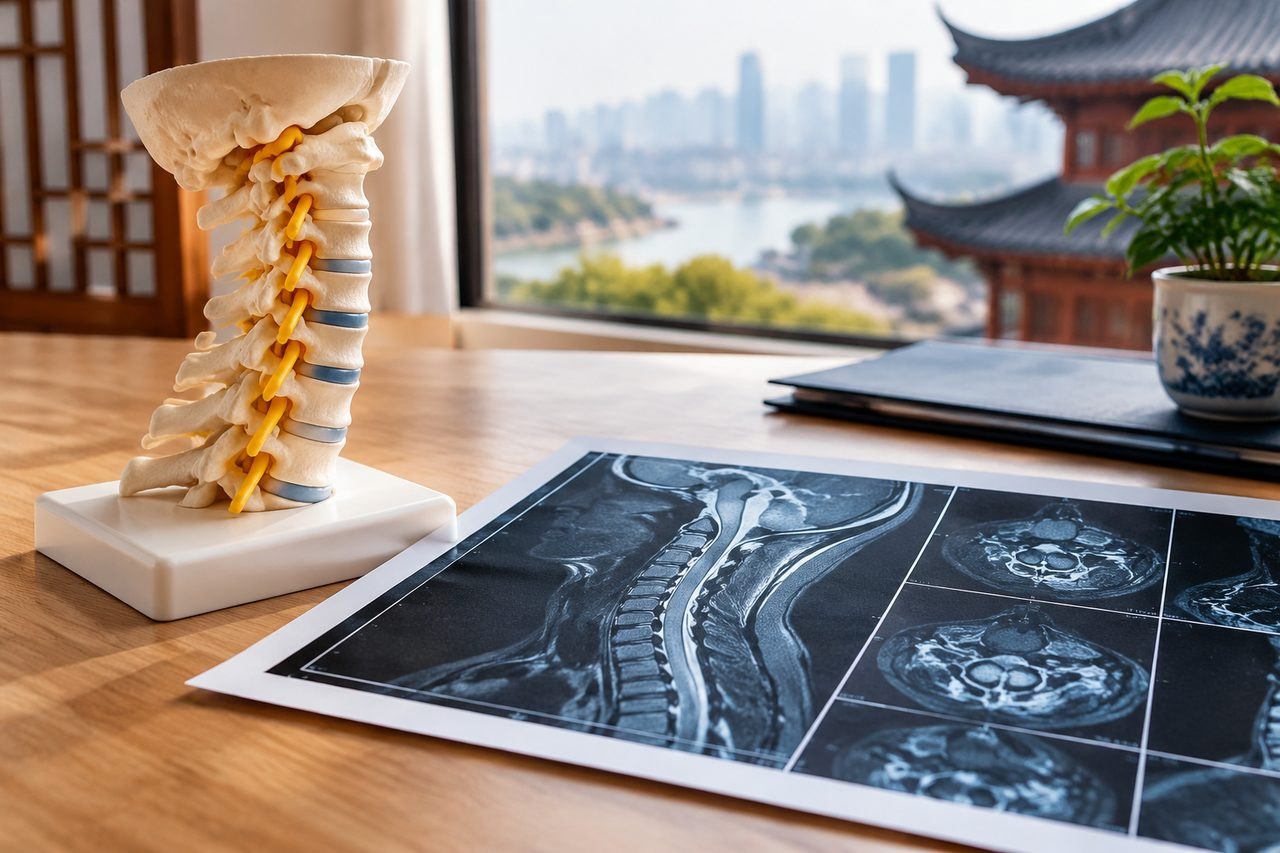
Why neck imaging comes before any fusion decision
Cervical fusion joins vertebrae in the neck. The surgical levels and approach depend on the individual problem, so the same symptom label can lead to very different operations. Imaging is what allows a surgeon to see which level or levels are involved, how the nerve or spinal cord is affected, and whether the proposed fusion matches the actual anatomy.
This matters for an overseas patient because the decision is not simply whether fusion is possible. It is whether fusion at a specific level, or across a specific number of levels, is the right operation for your neck. A general MRI report from your home country may describe findings, but the treating surgeon still needs to relate those findings to your symptoms, examination and the proposed surgical plan.
If you are planning care in China, the imaging review is therefore not an administrative formality. It is the clinical step that defines the scope of any operation and helps the hospital decide whether to accept the case for surgical assessment.
What the imaging review is actually trying to establish
The imaging review answers a small number of practical questions. Which cervical level or levels show the problem that surgery would target? Is the compression or instability at one level, or does it extend across several? Does the imaging explain the symptoms the patient reports, or is there a mismatch that needs further assessment?
These questions matter because fusion is not a single procedure. A one-level fusion and a multi-level fusion differ in surgical time, implant requirements, hospital planning and follow-up. The imaging helps the surgeon decide whether the proposed fusion is limited or extensive, and whether an anterior, posterior or combined approach is being considered.
For the patient, the useful outcome of this review is a clear statement of the proposed levels and the reason for them. If that statement is missing, the treatment plan is still provisional.
A level-by-level reading also changes what the operation has to achieve. If the imaging shows one segment causing compression, the surgical target is narrow. If several segments are involved, the surgeon has to weigh how much of the neck to include, because adding levels changes the mechanical demand on the remaining vertebrae and the amount of fixation required. That is a clinical judgement, and it depends on your anatomy and symptoms rather than on the number of abnormal lines in a report.
The same images can also point away from fusion. If the visible changes do not match the distribution of your symptoms, or if the examination findings point elsewhere, the surgeon may want further assessment before proposing an operation. This is not a delay tactic. It is how a level-specific plan avoids operating on a segment that is not the source of the problem.
Imaging also informs the approach rather than only the levels. Whether the surgeon plans to work from the front of the neck, the back, or both depends on where the compression sits and what has to be stabilised. Two patients with the same number of fused levels can therefore have different operations, different implant configurations and different post-operative instructions.
For an overseas patient, this is the point where a general diagnosis becomes a concrete proposal. Ask which levels are named, what each level contributes to the plan, and whether the surgeon considers the imaging sufficient or wants additional views. Those three answers tell you whether the review has actually reached a surgical plan or is still at the stage of gathering information.
Records that help a China-based team review your neck
A records-based review works best when the imaging itself is available, not only the written report. The treating clinician may want to see the actual MRI or CT images, because the report is a summary and the surgeon's assessment depends on the images. If you only have a report, ask the hospital what it needs before it can give a meaningful opinion.
A short clinical summary is also useful: when symptoms started, what they feel like, which arm or hand is affected, what makes them better or worse, and what treatments have already been tried. This is not a complete medical archive. It is the minimum needed to relate the imaging to your situation.
Do not send passport numbers, payment details or a full medical history at the first contact. Start with a brief summary and ask what the hospital requires next.
How imaging shapes the surgical plan and the estimate
The number of levels involved directly affects the surgical plan. A single-level fusion and a multi-level fusion are different operations with different implant needs, different operating time and different post-operative arrangements. This is why a meaningful estimate cannot be given before the levels are confirmed.
When you ask a hospital in China about cost, ask how its written estimate accounts for the proposed levels and the implants. Ask what is included, what is excluded and what remains undecided until the surgeon reviews the imaging. Do not assume that a quote from one hospital will match another, because the scope of the operation and the implant plan may differ.
The same principle applies to the choice between fusion and other options. The imaging review is what allows the surgeon to explain why fusion is being proposed rather than another approach, or why further assessment is needed first.
Questions to ask before you commit to travel
Before making any travel arrangements, you need a clear answer to a few questions. Which cervical levels are proposed for fusion? Is the plan based on the imaging you have already sent, or does the hospital need additional views? Has the surgeon confirmed that fusion is appropriate for your individual problem, or is the plan still provisional?
You should also ask how the hospital will review your case after discharge. What follow-up arrangements are expected, and how will they be communicated if you return home? This is not a promise of a particular outcome. It is a practical question about how the treating team plans to monitor your recovery.
If the hospital cannot answer these questions before you travel, that is useful information. It may mean the review is incomplete, or that the hospital needs more records. Either way, it is better to clarify before committing to a trip.
What imaging does not decide
Imaging does not by itself establish that fusion is the right treatment. The decision depends on the clinical picture, the response to previous treatments and the surgeon's assessment. A scan can show a disc or a narrowed space, but it cannot show whether surgery will relieve your symptoms.
That distinction matters when you are weighing an operation in another country. A hospital may review your images and still conclude that fusion is not the appropriate route, or that a different level or a different procedure should be considered. The imaging narrows the question; it does not settle it.
Imaging also does not guarantee hospital acceptance or a particular outcome. The hospital decides whether to accept a case for surgical assessment, and the treating team decides whether fusion is suitable. No outcome is guaranteed, and a remote review does not replace an in-person clinical assessment.
It is worth separating two different decisions that patients often merge. The first is whether the imaging supports a surgical discussion at all. The second is whether you are a suitable candidate for the specific operation proposed. A records-based review can help with the first. The second depends on examination, your general health and a conversation with the treating surgeon about benefits, risks and alternatives.
You can and should ask the treating clinician about evidence-based risk estimates for your situation. Asking how often a complication occurs, or how much improvement is realistic, is a reasonable part of informed consent. What no estimate can do is guarantee your individual result, because your anatomy, symptoms and recovery differ from any published figure.
If your symptoms are worsening, or if you have new weakness, numbness or difficulty with walking or balance, seek local medical assessment rather than delaying for an overseas enquiry. Urgent problems take priority over travel planning.
When you are ready to move forward, the practical next step is to send a brief summary of your symptoms and the imaging you already have, then ask the hospital which cervical levels it proposes to fuse and what its written estimate covers. An initial enquiry is free, and it is the point at which you can ask what the review still needs before any travel decision is made.
Sources & scope of this guide
References and official service information relevant to this guide.
This is general planning information and has not been individually reviewed by a doctor. Medical decisions and personal treatment advice come from your treating clinicians.