What the surgical goal actually means for cervical fusion
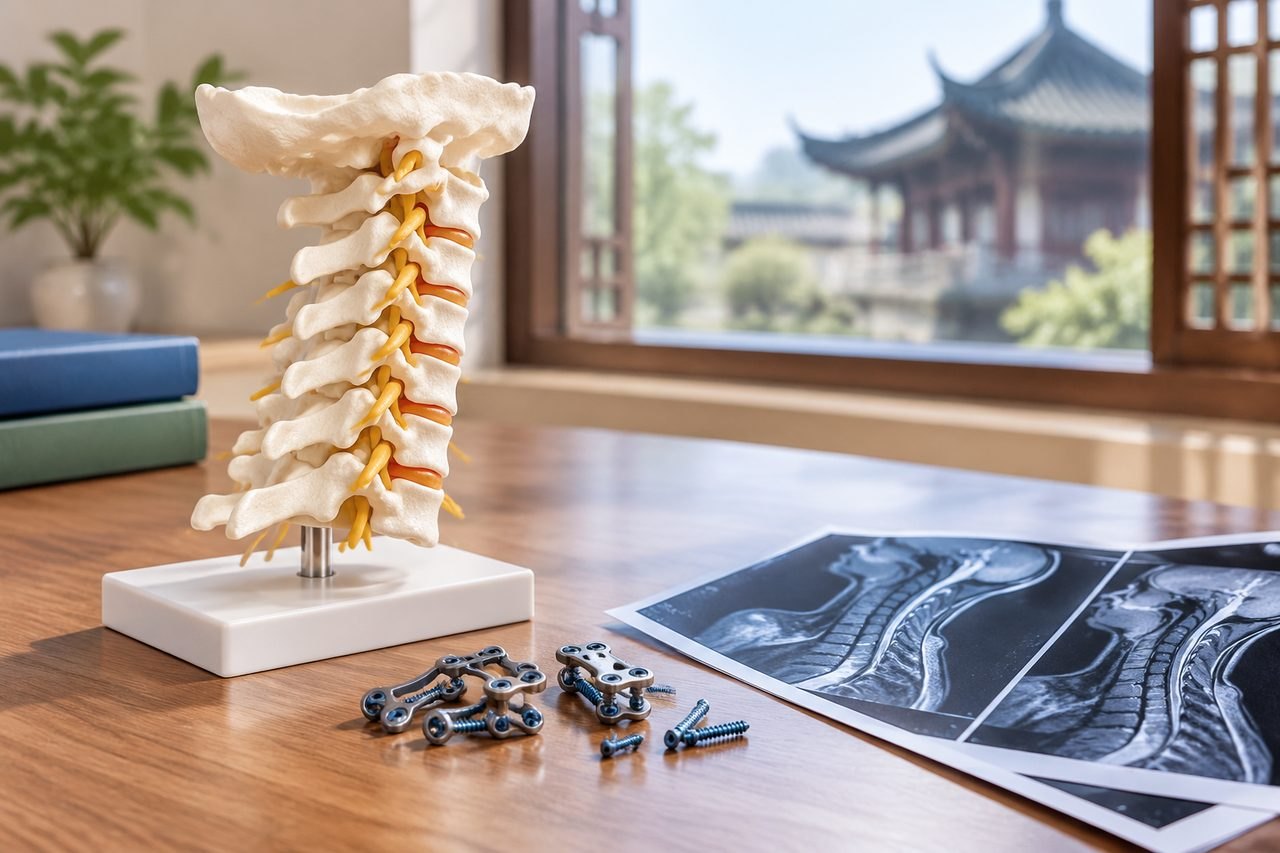
Cervical fusion joins vertebrae in the neck. The surgical levels and the approach depend on the individual problem. That is the whole clinical frame, and it is deliberately narrow. It does not tell you whether fusion is right for you, which level would be treated, or what a good result would look like in your case.
The word goal is where most overseas enquiries go wrong. Patients often ask whether fusion will stop the pain. A surgical team may instead be aiming to stabilise a segment, decompress a nerve or the spinal cord, correct alignment, or prevent further deterioration. Those are different targets, and they can produce different operations, different recovery expectations and different ways of judging whether the surgery worked.
So the first useful question is not whether fusion is available in China. It is: what specific problem is this operation meant to solve, and how will we know afterwards whether it was solved? Ask for that answer in writing, in plain language, before any travel decision.
Why the goal changes the operation, not just the outcome
A fusion at one level for a single compressed nerve root is not the same operation as a multi-level fusion for deformity or instability. The number of levels, whether the surgeon approaches from the front, the back or both, and whether instrumentation is used all follow from the underlying problem and the anatomy.
This matters for an overseas patient because the goal determines what you are consenting to. If the stated goal is nerve decompression, the fusion may be a way of protecting that decompression rather than the main event. If the stated goal is stabilisation, the decompression may be secondary. If the goal is alignment correction, the planning may involve measurements and imaging that a simple disc problem would not need.
Ask the team to separate the goal into parts: what is being decompressed, what is being stabilised, and what is expected to change for you. If those three answers are vague or interchangeable, the plan is not yet specific enough to plan travel around.
A second question follows: what would the team do if the imaging and examination pointed to a different goal? A surgeon who can describe an alternative plan is showing you the reasoning, not just the recommendation.
A labelled planning example, not medical advice
Consider a hypothetical overseas patient with neck and arm symptoms, imaging showing a problem at one level, and a surgeon proposing a single-level fusion. The goal might be framed as decompressing the affected nerve and stabilising that segment. In that example, the patient should ask which symptoms the operation is expected to address, which symptoms might remain, and what non-surgical options were considered.
Now change one detail: the same imaging but symptoms that are mainly neck pain without a clear nerve pattern. The goal may be much less clear, and the surgeon may reasonably recommend further assessment or a different approach. The point of the example is not to suggest a diagnosis. It is to show that the same words, cervical fusion, can describe operations with different purposes.
Use the example as a template for your own questions. Write down what you believe the goal is, then ask the team to confirm or correct it. If your understanding and theirs do not match, resolve that before discussing dates, hospitals or travel.
Questions that change the next step
The answers to a small number of questions determine whether you continue planning, seek another opinion, or pause. Ask which levels are involved and why. Ask what the operation is intended to achieve and what it is not intended to achieve. Ask what alternatives were considered and why they were set aside.
Ask how the team will assess the result. If the goal is decompression, what examination or imaging finding would show it worked? If the goal is stabilisation, what would show the segment is stable? If the goal is symptom relief, which symptoms and over what period would the team expect to judge?
Ask what could make the team change the plan during surgery, and how that would be discussed with you beforehand. Ask who will make the final decision about suitability and what information they still need. These are not challenges to the surgeon. They are the normal content of a consent discussion, and they are harder to have across a language and distance gap unless you prepare them.
Finally, ask what the team would recommend if you decided not to proceed. That answer tells you how the operation sits within the overall options, not just within the surgical list.
Records and imaging that support a goal-specific review
A records-based review can only be as specific as the records. For a cervical question, ask the receiving clinician which items they need and in what format. The imaging itself, rather than only the radiologist's report, is often what a surgeon wants to see, because the goal depends on the anatomy at the treated level. Previous imaging for comparison can show whether a problem is stable or changing. A clear description of your symptoms, and how they have changed over time, gives the clinical context that images alone cannot provide.
Do not assume that a report alone is enough, and do not assume that a particular scan is mandatory for everyone. Which images are needed, and whether new imaging is required before a decision, are clinical judgements for the treating team and depend on your problem. If you are missing records, ask what is missing and why it matters, rather than assuming you must complete a full archive before any clinical assessment.
If you are seeking a records-based opinion before travelling, be clear about what that opinion can and cannot establish. A remote review can discuss the likely goal, the reasonable options and the questions still to resolve. It cannot confirm acceptance, final suitability or the exact operation in advance. The hospital decides suitability after its own assessment, and that assessment may change the plan.
It also helps to ask what the review will produce. Will you receive a written opinion, a suggested plan, or a list of further questions? Knowing the output in advance tells you whether the review is worth arranging before you commit to travel, and what you will still need to settle in person.
How China fits into the decision, and the next step
China is one possible setting for this surgery, not a shortcut around the clinical question. The same goal-setting discussion applies wherever you are treated. What changes in China is the practical route: which hospital and team you approach, how records are shared, how the consultation is arranged, and how language and follow-up are handled.
Public tertiary hospitals and private international hospitals are both possible routes, and the appropriate one depends on your case and preferences. Hospital consultation fees, treatment costs and any coordination fees are separate matters, and you should ask the named provider what its written plan and quote include rather than rely on general assumptions.
A practical next step is to write a one-page summary: your main symptom, the question you want answered, the imaging you have, and the goal you believe is being proposed. An initial enquiry with ChinaSpecialistCare is free and can help identify what is missing and which route fits. You do not need to buy a proxy consultation to make that first contact.
Sources & scope of this guide
References and official service information relevant to this guide.
This is general planning information and has not been individually reviewed by a doctor. Medical decisions and personal treatment advice come from your treating clinicians.