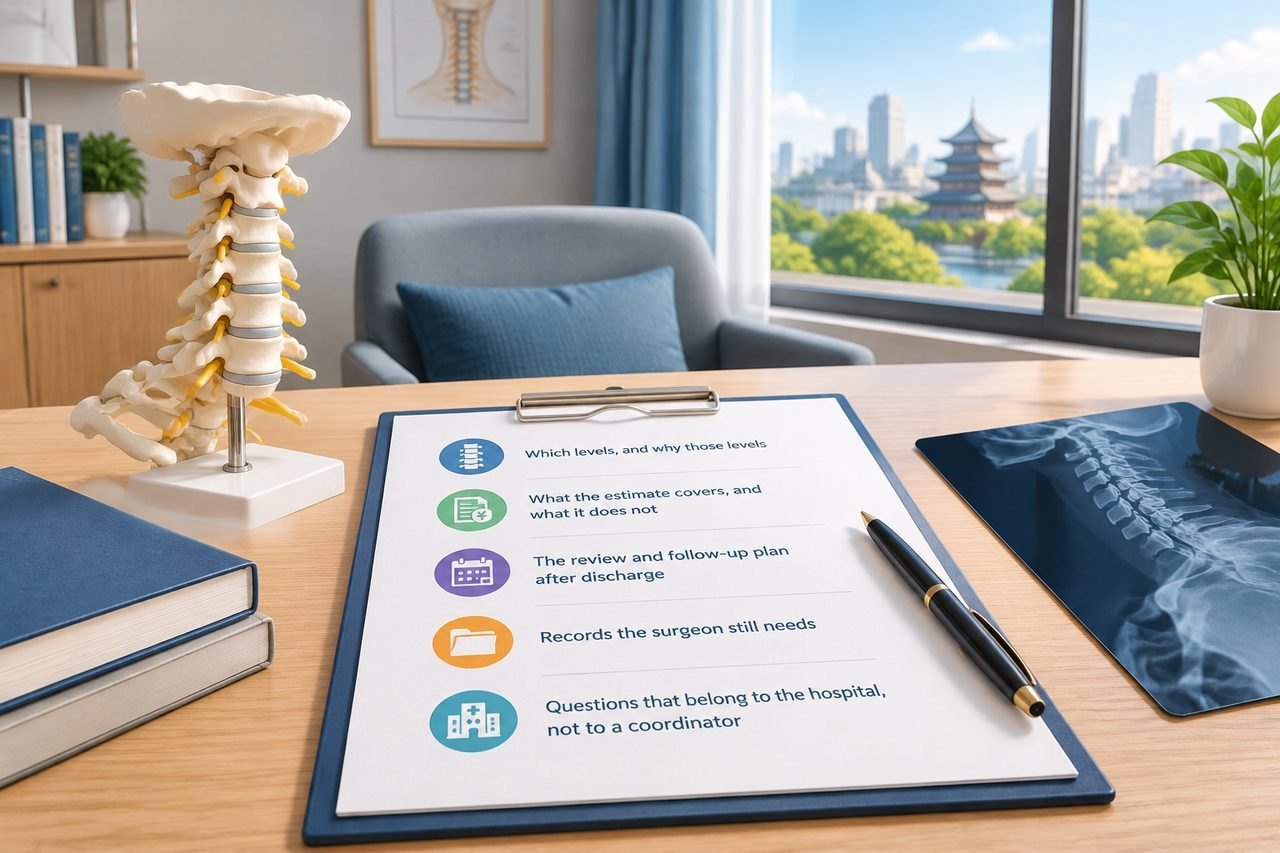
What a written follow-up plan should contain after cervical fusion
Cervical fusion joins vertebrae in the neck, and the surgical levels and approach depend on the individual problem. That means a follow-up plan cannot be a generic template. It must name the exact levels operated on, the approach used, any implants placed, and the clinical milestones the surgical team expects to review.
A useful written plan answers four practical questions. First, what was done: levels, approach, implants and any intraoperative findings. Second, what happens next: when the surgical team wants to see you, what imaging they want, and what clinical signs should prompt earlier contact. Third, who does what: which clinician or department is responsible for each review, and who to contact if a problem appears between visits. Fourth, how information moves: how your home clinician can send records to the surgical team and how the team will send records back.
Ask for this document before discharge, not after you return home. Once you leave China, obtaining a signed plan, operative note and imaging becomes slower and more uncertain. The plan should be dated and identify the responsible clinician or department, even if individual names change.
Records to request before you leave the hospital
The follow-up plan is only one document. Ask the hospital what it can release and in what format. A discharge summary, operative report, implant details, and the imaging performed in China are the items most home clinicians ask for. Availability and release procedures differ between hospitals, so confirm what this provider can supply and how long it takes.
Implant documentation matters because your home clinician may need to know the manufacturer, model and any MRI-safety information. Ask specifically whether the hospital provides implant cards or equivalent records, and whether these are in English. If they are not, ask about certified translation.
Imaging is often the hardest item to transfer. Ask whether you will receive discs, a download link, or a written radiology report, and whether the images include the levels operated on. Do not assume a report alone is enough; many receiving clinicians want the actual images. Confirm the format and whether it can be opened outside China.
Keep a personal copy of everything. A simple folder with the discharge summary, operative note, implant details, imaging and the follow-up plan will make every later conversation easier, whether it happens in your home country or with the surgical team in China.
Confirming review timing and imaging without inventing a schedule
There is no single correct review schedule for cervical fusion. The appropriate interval depends on the levels involved, the approach, bone quality, whether a fusion is expected to consolidate, and the individual clinical course. The surgical team should state its own recommended review points in the written plan.
Ask the team to write down what imaging it wants, at which review point, and why. If the plan says a scan is needed at a certain stage, ask what clinical question that scan is meant to answer. This helps your home clinician understand whether the request is routine surveillance or a response to a specific concern.
If the plan is silent on a particular point, ask before discharge. A missing answer is easier to resolve while you are still in the hospital than after you have left. Write down the question, who answered it, and the date.
Do not treat a follow-up plan as a guarantee that fusion will occur or that symptoms will resolve. It is an administrative and clinical roadmap, not an outcome promise. The treating clinician remains responsible for assessing your individual progress.
Who is responsible for what after discharge
Responsibility after cervical fusion is often shared between the surgical team in China and a local clinician at home. That split needs to be explicit. Ask the surgical team to state in writing which parts of follow-up it will manage remotely and which parts it expects a local clinician to handle.
A practical way to frame this is to ask three questions. Who reviews the imaging? Who adjusts any medication? Who decides whether a new symptom needs urgent assessment? If the answer is 'your local doctor', ask the surgical team to write a short note to that clinician explaining what to look for and how to make contact.
Contact details matter. Ask for a named department, an email address or phone number that is monitored, and the expected response route. Do not assume a general hospital switchboard will connect your home clinician to the right person. Confirm the channel in writing.
If the surgical team changes, ask who takes over responsibility for your follow-up. A written plan that names a department rather than an individual is more durable, but you still need to know how to reach that department.
How to keep the plan usable when you are back home
A follow-up plan written only in Chinese may be difficult for your home clinician to act on. Ask whether an English version is available, and if not, arrange a certified translation. Keep both versions together.
Before you travel home, test the communication channel. Send a short message to the contact address and see whether you receive a reply. This is a practical check, not a clinical test. If the channel does not work, ask for an alternative before you leave.
Share the plan with your home clinician at the first opportunity. Bring the operative note, implant details and imaging as well. Ask the local clinician whether anything in the plan needs clarification, and if so, help them send the question to the surgical team.
Keep a simple log of contacts: date, who you spoke to, what was decided, and what happens next. This is useful if the plan needs to be adjusted and helps avoid conflicting advice.
What to confirm with the hospital before you commit
Before surgery, ask the hospital how it documents follow-up arrangements. Ask whether a written plan is issued, what it contains, whether it is provided in English, who signs it and when it is handed over. These questions are easier to answer before admission, when the administrative team is already handling your file and can check its own process rather than describe a general policy.
Ask how the hospital handles records requests after discharge, including imaging. Confirm whether there is a charge for copies or translation, what format the images come in, and how long the process takes. These are administrative questions, and the hospital should be able to answer them directly. If the answer is vague, ask for it in writing before you commit, because a records process that is unclear before surgery rarely becomes clearer afterwards.
The written plan should also state which levels were operated on and how the estimate accounts for implants. If you are comparing quotes, ask each provider to separate the hospital's medical fees from any coordination fee, and to state what the surgical fee covers. A quote that does not name the levels, the implant type or the review arrangements is not comparable with one that does.
If you are considering care in China for cervical fusion, the relevant reference page is Cervical Fusion Surgery. It explains the procedure itself; this article focuses on the follow-up documentation you should request.
An initial enquiry to ChinaSpecialistCare is free and does not require buying a proxy consultation. You can start with a short summary of your situation and your main question about follow-up arrangements. The hospital decides suitability and the treating clinicians decide the clinical plan.
Sources & scope of this guide
References and official service information relevant to this guide.
This is general planning information and has not been individually reviewed by a doctor. Medical decisions and personal treatment advice come from your treating clinicians.