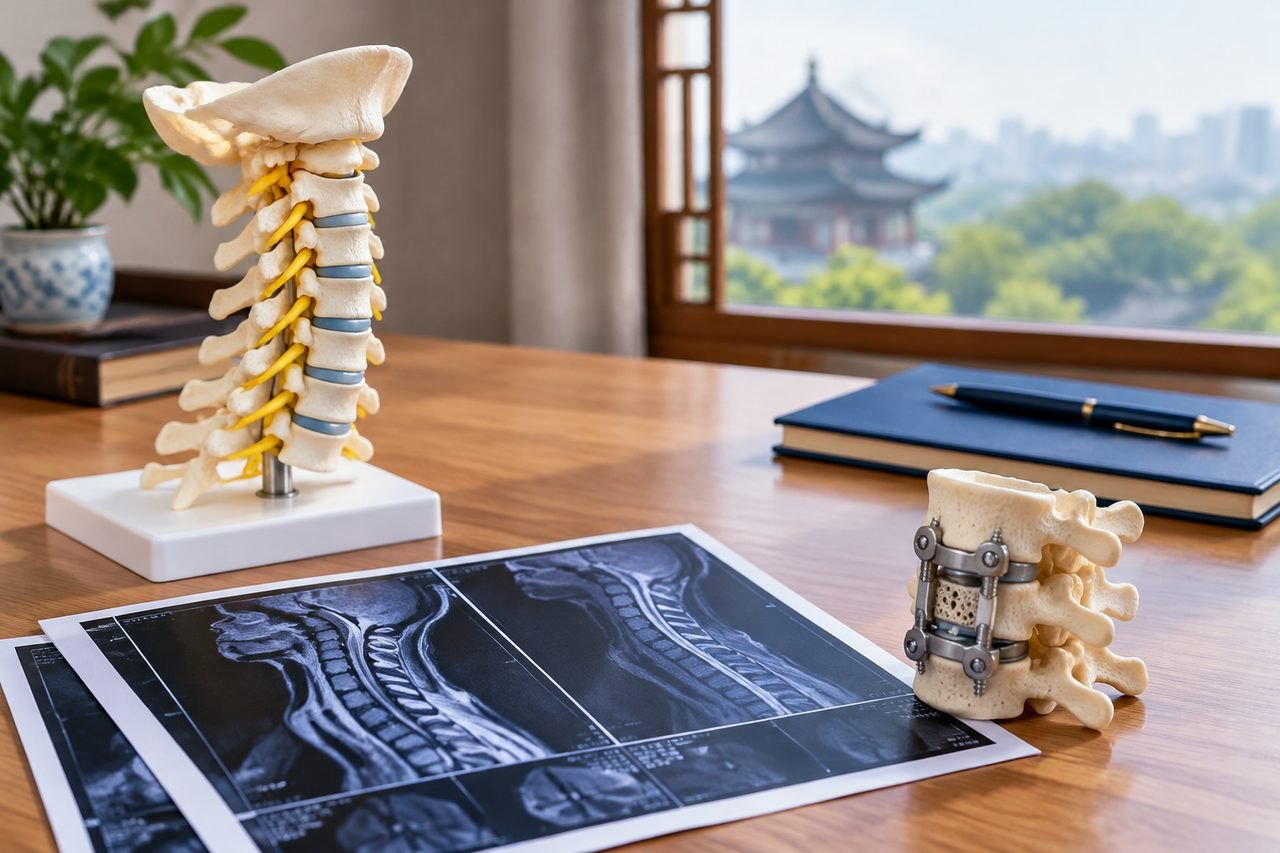
What fusion scope actually means for your neck
Cervical fusion joins vertebrae in the neck, and the surgical levels and approach depend on the individual problem. That single sentence from the American Academy of Orthopaedic Surgeons is the whole reason scope deserves its own conversation. A one-level fusion and a three-level fusion are different operations with different implant counts, different operating time and different demands on the bone and soft tissues around the neck.
Scope is not only a number. It is a set of decisions: which vertebral levels are included, whether the approach is from the front, the back or both, whether any level is being decompressed without fusion, and whether a level is being left alone deliberately because it looks acceptable on current imaging. Each of those decisions should be traceable to something in your records rather than to a general preference.
This matters for an overseas patient because scope drives almost everything downstream. It changes what the hospital must quote, what implants must be available, how long the admission is likely to be, and what the discharge instructions will ask of you. If you only learn the number of levels after you arrive, you have lost the chance to ask informed questions while you are still at home.
Getting the levels named, not summarised
A useful answer names levels in a way you can check against your own imaging report. Ask for the specific vertebrae, for example which disc spaces or motion segments are proposed, and ask for the same list in writing. A verbal 'two or three levels' is not a scope; it is an estimate of a scope.
Then ask the reverse question: which levels are being left unfused, and why. Surgeons sometimes fuse one segment and treat an adjacent one differently, or observe a mild finding rather than include it. Knowing the reasoning helps you understand whether the plan is conservative or extensive, and it gives you something concrete to raise if a second clinician later reads the same scans differently.
Ask also whether the plan is fixed or conditional. Some operations have a planned scope that could change if the surgeon finds something unexpected during the procedure. That is a legitimate clinical reality, but you are entitled to know in advance that it is possible, roughly what would trigger a change, and how the hospital would communicate a change to you or your family while you are in the operating area.
Connecting the scope to your imaging and records
Scope should be justified by the imaging and by your symptoms, not by the imaging alone. Bring the actual images, not only the written report, because a surgeon reviewing the images may see the levels differently from the radiologist who wrote the summary. Ask whether the hospital wants the images on disc, on a secure upload, or both, and confirm the format before you travel.
Your records should also show what has already been tried. A fusion recommendation is easier to evaluate when the reviewing clinician can see prior conservative management, injections, physiotherapy notes and any earlier surgery. If some of that history is missing, say so rather than waiting to be asked. Missing records do not stop a clinical assessment, but they do limit how firmly anyone can comment on whether fusion at those levels is the right next step.
Keep a short one-page summary at the front of your file: main symptoms, duration, treatments tried, current medications, allergies, prior neck surgery and the exact question you want answered. That page is what a busy clinic reads first, and it is what keeps the conversation on scope rather than on reconstructing your history.
How an estimate should account for implants and levels
An estimate for cervical fusion is only meaningful if it states its scope assumptions. Ask the hospital or provider to put in writing which levels the figure covers, which implants and devices are included, which are excluded, and which items are still undecided pending the surgeon's final plan. Without those four statements, a number cannot be compared with anything.
Ask the provider to clarify the implants in its proposed plan and estimate. Ask whether the quote names the type of implant, how many levels' worth are included, and what happens financially if the surgeon adds or removes a level. Ask whether the figure covers the hospital stay, imaging, laboratory work, anaesthesia, medicines and follow-up visits, or whether some of those are billed separately. If an item is not mentioned, ask directly rather than assuming it is covered.
You are not asking for a discount. You are asking for a written scope so that you can decide whether the plan and the budget match. A hospital that can name the levels and the implant plan can normally also describe what its estimate includes; a vague answer is itself useful information about how much detail you will receive later.
Review arrangements after discharge
Scope affects follow-up because more levels generally mean more to monitor. Before you agree to travel, ask who will review you after discharge, how that review is arranged, and what the hospital expects to see at each visit. Ask whether imaging will be repeated, when, and whether the results can be sent to your home clinician in your own country.
Ask what the discharge documentation will contain: the levels fused, the implants used, restrictions, wound care instructions and warning signs that require urgent attention. Ask for it in English if you need it, and confirm whether that is possible rather than assuming it. If you will fly home soon after discharge, ask the treating team what they advise about timing and about any precautions during travel; that is a clinical judgement for them, not a logistics question.
Finally, ask how your home clinician will be kept informed. A short discharge summary and the operative note, sent with your consent, make it far easier for your own doctor or physiotherapist to take over your care. They remain free to assess you independently and to disagree with any part of the plan, which is exactly why they need the primary documents rather than a verbal account from you.
Questions to send before you commit
A short written list gets a clearer answer than a long conversation. Send the treating team these points and ask for written replies: the exact vertebral levels proposed for fusion; the levels deliberately left alone and the reason; the approach planned and whether it may change; the implant type and how many levels it covers; what the estimate includes, excludes and leaves undecided; and who reviews you after discharge, where, and with what documentation.
Add two personal questions. First, what would make this team decide not to operate, or to operate at fewer levels? Second, what alternatives were considered, and why fusion was preferred for your situation. A clinician who can answer both is giving you the information you need to weigh the plan, and you can take those answers to another opinion if you want one.
If you would like help organising the records and putting these questions to a hospital in China, you can start with a free initial enquiry. Our team checks the available diagnosis, records and your main question, identifies what is missing and suggests the relevant next step. It is not a diagnosis and not a promise of acceptance, and hospital suitability and the final fusion plan remain decisions for the treating clinicians.
Sources & scope of this guide
References and official service information relevant to this guide.
This is general planning information and has not been individually reviewed by a doctor. Medical decisions and personal treatment advice come from your treating clinicians.