
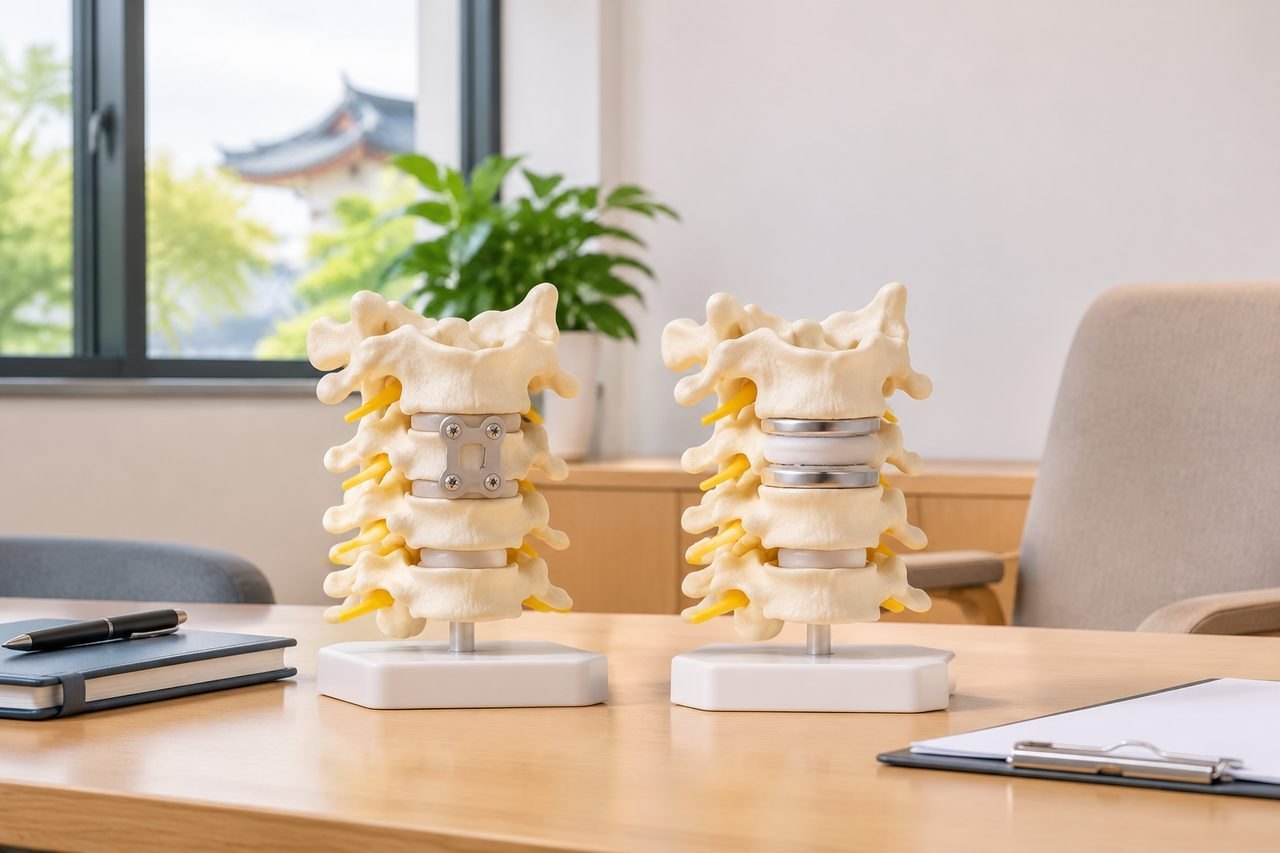
What actually separates the two operations
Both operations approach the cervical spine from the front in the common anterior route, remove the disc that is causing trouble, and relieve pressure on the nerve root or spinal cord. The difference is what is left in the disc space. Cervical fusion places a graft or cage, often with a plate or screws, and the goal is for the treated segment to become stable bone. Artificial disc replacement inserts a moving device intended to preserve some motion at that segment.
That single difference drives most of the decision. Fusion is a well-established way to stabilise a segment. Replacement is offered only where the anatomy and the pattern of disease make a moving implant a reasonable option. Neither is automatically better. A surgeon recommending one over the other should be able to explain why the alternative is less suitable for this particular neck, not simply that it is their preferred operation.
It also helps to be clear about what is being compared. A one-level replacement is not the same decision as a two-level replacement, and neither is the same as a fusion that also involves decompression at several levels. Ask which exact levels are proposed and what will be done at each.
The findings that push the decision one way
Surgeons weigh several features together. The number of symptomatic levels matters, because replacement is generally considered for a limited number of levels rather than a long span of disease. The condition of the facet joints at the back of the spine matters, because a moving implant relies on those joints to guide motion; significant facet arthritis at the target level is a reason surgeons may hesitate. Bone quality and any previous surgery at the same level also enter the assessment.
The reason for operating is equally important. If the main problem is a disc herniation pressing on a single nerve root with preserved alignment, the range of options may be wider. If there is compression of the spinal cord itself, significant instability, deformity, or slippage of one vertebra on another, the priorities change and stabilisation often becomes central. These are the points a surgeon should address directly when explaining a recommendation.
Imaging supports this. Plain X-rays, including views in flexion and extension, show alignment and whether the segment moves abnormally. MRI shows the discs, nerves and cord. CT helps where bone detail matters. Which of these a given patient needs is a clinical decision, so treat any list as something to discuss with the treating team rather than a fixed requirement.
Why the implant is not chosen from a brochure
Patients often arrive having read about a particular disc design and want to know whether they can have it. The more useful question is whether any motion-preserving implant is appropriate at the affected level, and then which device the hospital actually uses and stocks. Device availability, sizing and the surgeon's familiarity with a specific system are practical factors that belong in the conversation with the treating team.
Replacement also carries its own risks, and these should not be reduced to logistics. They include the general risks of anterior neck surgery, such as bleeding, infection, nerve or voice-related complications, and difficulties swallowing; they also include implant-related concerns such as wear, loosening, migration or the need for later revision. Fusion carries its own set of risks, including problems with the graft or hardware and the possibility that the segment above or below takes on extra stress over time. The balance of these risks for an individual is a matter for the surgeon, and it is reasonable to ask how they weigh them in your case.
Do not expect a guarantee from either operation. Ask what the realistic aims are, what function the surgeon hopes to preserve or restore, and what would make them change the plan during surgery.
Records that make the discussion concrete
A useful review starts with the imaging itself, not only the radiologist's report. The treating surgeon will want to see the actual MRI and X-ray images, ideally in a format that can be viewed at full resolution, along with any CT. Reports help, but the images are what the decision rests on.
Bring the clinical story as well: when the symptoms began, which arm or hand is affected, whether there is numbness, weakness or problems with balance or walking, what treatment has already been tried and how the neck has responded. A short written summary in English is enough to begin. Previous operation notes and pathology or imaging from earlier episodes are relevant if the neck has been operated on before.
It is reasonable to ask the receiving team which specific images and records they need before a firm opinion, and to send those rather than a complete archive. If something is missing, the team can say what would change their assessment. A records-based opinion can clarify the likely options and the questions to pursue, but it does not replace an in-person examination and does not by itself establish that either operation is suitable or that a hospital will accept the case.
Questions that expose the reasoning
A recommendation is easier to trust when the reasoning is visible. Ask which levels are affected and which the surgeon proposes to treat. Ask why replacement is or is not suitable at those levels, and what specific findings on your imaging drive that view. Ask what the alternatives are, including continuing non-surgical treatment, and what the expected trade-offs are.
Ask about the device: which system the hospital uses, whether it is available for your anatomy, and what the plan would be if it were not. Ask about the surgeon's own experience with both operations and how the team handles revision if a procedure does not go as hoped. Ask what the recovery and follow-up will involve in general terms, and what warning signs should prompt urgent contact. These are legitimate questions, and a team should be willing to answer them plainly.
If you are comparing care in China with care elsewhere, compare the same thing: the diagnosis, the proposed levels, the operation and the aftercare. A different recommendation may reflect different imaging, a different reading of the same imaging, or a different view of risk, and it is worth asking which.
How ChinaSpecialistCare fits in, and the next step
ChinaSpecialistCare provides information and non-clinical coordination for international patients considering spine surgery in China. We can help identify a suitable hospital and senior spine team, prepare the records for a specialist appointment, and coordinate admission and practical arrangements after a hospital accepts the case. We do not decide whether fusion or replacement is right for you, and we cannot promise a particular surgeon, hospital acceptance or outcome. Hospital consultation, tests, treatment and device costs are paid to the hospital; our coordination fees are separate, and an initial enquiry is free.
A practical next step is to send a brief summary: the main symptoms, which levels are affected according to your imaging, and your central question about fusion versus replacement. From that, the team can suggest whether a records-based specialist review or an in-person appointment is the more useful route. You can start through the care review page, and the treating surgical team will make the clinical decision.
Sources & scope of this guide
References and official service information relevant to this guide.
- Related treatment reference
- Prosthetic intervertebral disc replacement in the cervical spine | Guidance | NICE
This is general planning information and has not been individually reviewed by a doctor. Medical decisions and personal treatment advice come from your treating clinicians.