
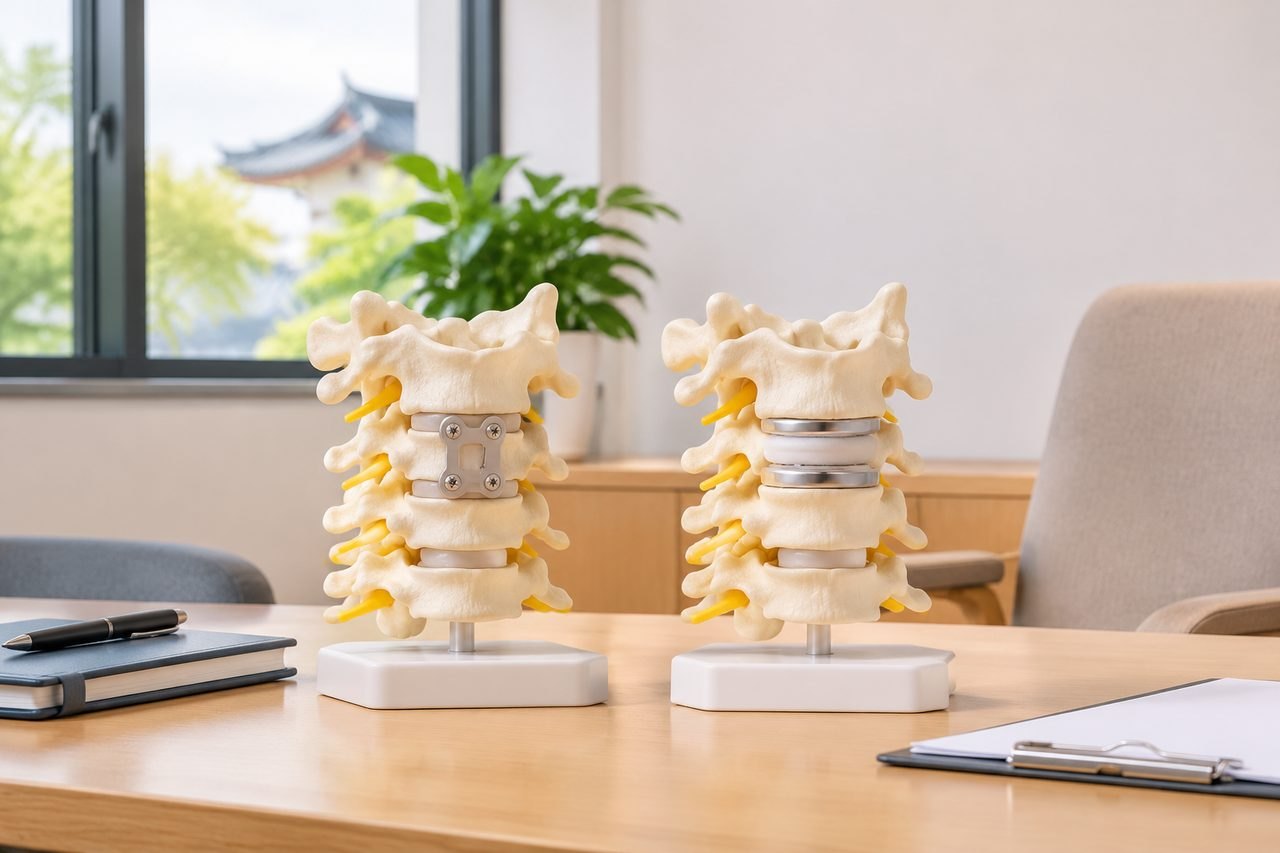
What each operation actually does
Cervical fusion is a procedure in which the surgeon removes the disc that is compressing a nerve or the spinal cord, then stabilises that spinal segment so the bones grow together into a single solid unit. Bone graft or a cage is placed in the disc space, and screws, plates or similar hardware hold the segment while it heals. The aim is to stop movement at that level and take pressure off the affected nerve or cord. Once the bones unite, that segment is fixed for good.
Artificial disc replacement, also called cervical disc arthroplasty, removes the diseased disc and puts a mechanical implant in its place. The implant is designed to allow some movement at that level rather than locking the bones together. The goal is decompression of the nerve or cord while keeping motion at the operated segment. It is a different operation with a different mechanical result, not a newer version of fusion.
The practical difference is motion. Fusion deliberately eliminates movement at the treated level. Disc replacement tries to preserve it. That single distinction drives most of the other differences in who is considered suitable, what imaging is needed and what follow-up involves.
Why the choice is not simply the newer option
Patients often assume the motion-preserving implant is the better operation. That is not how surgeons decide. Disc replacement is generally considered for a narrower group of patients, and fusion remains the appropriate operation for many situations. The treating surgeon has to match the operation to your actual pathology, not to a preference for newer technology.
Several factors push the decision toward fusion. If more than one level needs treatment, if there is significant instability, deformity or bone loss, or if the facet joints are badly arthritic, a surgeon may judge that a motion-preserving implant is not appropriate. Fusion is also used when the main problem is spinal cord compression that needs a wider decompression and stabilisation.
Disc replacement tends to be considered when the problem is at a single level, the disc is the main source of nerve compression, the facet joints are reasonably preserved and the bone quality can support the implant. These are general principles, not a checklist you can apply to yourself. The surgeon confirms suitability after reviewing imaging and examining you.
This is a decision where the individual assessment matters more than the general comparison. Two patients with similar-looking MRI reports can be offered different operations because of differences in symptoms, examination findings, bone quality and the state of the surrounding joints.
What the evidence can and cannot tell you
Cervical disc replacement has been studied in randomised trials and longer-term follow-up, and reviews of that literature report that it can be a reasonable alternative to fusion in carefully selected patients with single-level disease. The evidence does not show that it is superior for every patient, and it does not remove the need for individual assessment.
The National Institute for Health and Care Excellence in the United Kingdom has published interventional procedures guidance on cervical disc replacement for cervical radiculopathy, reflecting that the procedure has been evaluated but that long-term outcomes and patient selection continue to matter. That guidance is about the procedure in general, not a recommendation for any one person.
What the evidence cannot do is tell you which operation is right for your neck. It cannot weigh your bone quality, your facet joints, the number of affected levels or your own goals. Those belong to the treating surgeon and to you, in a discussion that includes the alternatives and the risks of each option.
Be cautious of any source that presents one operation as clearly better without discussing selection. The honest answer is that both operations have a role, and the role depends on the case.
Questions that make a consultation useful
A productive consultation is one where you leave understanding why a particular operation was proposed for you. Prepare a short list of questions and ask them directly. You do not need to decide in the room, but you should understand the reasoning.
Ask which levels the surgeon proposes to treat and why. Ask whether your imaging shows features that make disc replacement unsuitable, such as facet arthritis, instability or multilevel disease. Ask what the alternatives are, including non-surgical treatment and fusion if replacement is proposed, or replacement if fusion is proposed. Ask what the surgeon expects in terms of hospital stay, activity restrictions and follow-up, and ask who will provide that follow-up if you return home.
It also helps to ask about the specific implant, if replacement is proposed, and whether the hospital has experience with that device. For fusion, ask what graft and hardware are planned. These are legitimate questions and a surgeon should be able to answer them.
Bring your imaging on disc or via a link the hospital can open, your radiology reports, any previous spine surgery records and a list of your medicines. Ask the hospital in advance what format it accepts for foreign imaging, because this varies between institutions and should be confirmed rather than assumed.
Planning care in China around this decision
If you are considering surgery in China, the first practical step is to establish whether a spine surgeon at a suitable hospital would consider you a candidate for either operation. That requires a records-based review before any travel planning. A short summary of your diagnosis, symptoms, imaging and main question is enough to start.
ChinaSpecialistCare can check the available records, identify what is missing and suggest a relevant next step. This initial review is free and is not a diagnosis or a promise of acceptance. If a records-based specialist opinion would help before you travel, a proxy consultation is available as an optional service; it is not a prerequisite for an appointment or an operation. Hospital consultation fees and treatment costs are separate from coordination fees.
For cost planning, ask the treating hospital for an individual written estimate that states what the plan and fee scope include, and keep our coordination fees separate from hospital charges. Published reference ranges for named procedures are indicative only and are not a fixed quote; the final figure depends on your assessment, the levels treated and the devices used. Our existing price page sets out the reference ranges we hold, and the hospital confirms the actual estimate for your case.
The hospital decides suitability, the operation and the final plan. Coordination can help with appointments, interpretation and practical arrangements, but it does not determine clinical decisions.
What to do next
Start with a brief enquiry describing your neck problem, what imaging you have and what you want to know. Keep the first message short; you can share fuller records after contact. The team will tell you what information is missing and what step makes sense. An initial enquiry is free, and you do not need to buy a proxy consultation to ask a question.
If your symptoms are worsening, or you develop new weakness, clumsiness or problems with walking or bladder control, seek urgent local medical assessment rather than waiting on an overseas planning process.
Sources & scope of this guide
References and official service information relevant to this guide.
- Related treatment reference
- NICE interventional procedures guidance: Cervical disc replacement for cervical radiculopathy
- National Institute for Health and Care Excellence
This is general planning information and has not been individually reviewed by a doctor. Medical decisions and personal treatment advice come from your treating clinicians.