Why walking and hand-function history belongs in the report
Cervical myelopathy is a condition in which the spinal cord in the neck is compressed or otherwise affected. The symptoms that matter most for decision-making are often functional: how far someone can walk without stopping, whether their gait has become unsteady, whether they drop objects, struggle with buttons, or find handwriting has changed. A diagnosis report that records only 'neck pain' or 'arm numbness' leaves out the very information a spinal surgeon needs to understand severity and progression.
This is not about self-diagnosis. It is about making the existing record useful. If the report says 'difficulty walking' without saying when it started, whether it is worsening, or whether it affects balance, the treating clinician cannot tell whether the problem is stable or advancing. A short functional history — even a few dated observations from the patient or a family member — can be more informative than a long list of non-specific symptoms.
For an overseas patient preparing to seek care in China, the practical step is to ask the current treating clinician to document these functional changes in the report. If that is not possible, the patient can write a dated summary of what has changed and when, and ask the receiving team whether that summary is acceptable as supplementary information. The hospital decides what it needs; the patient's job is to make the available history clear.
What serial spine imaging should show and why one scan may not be enough
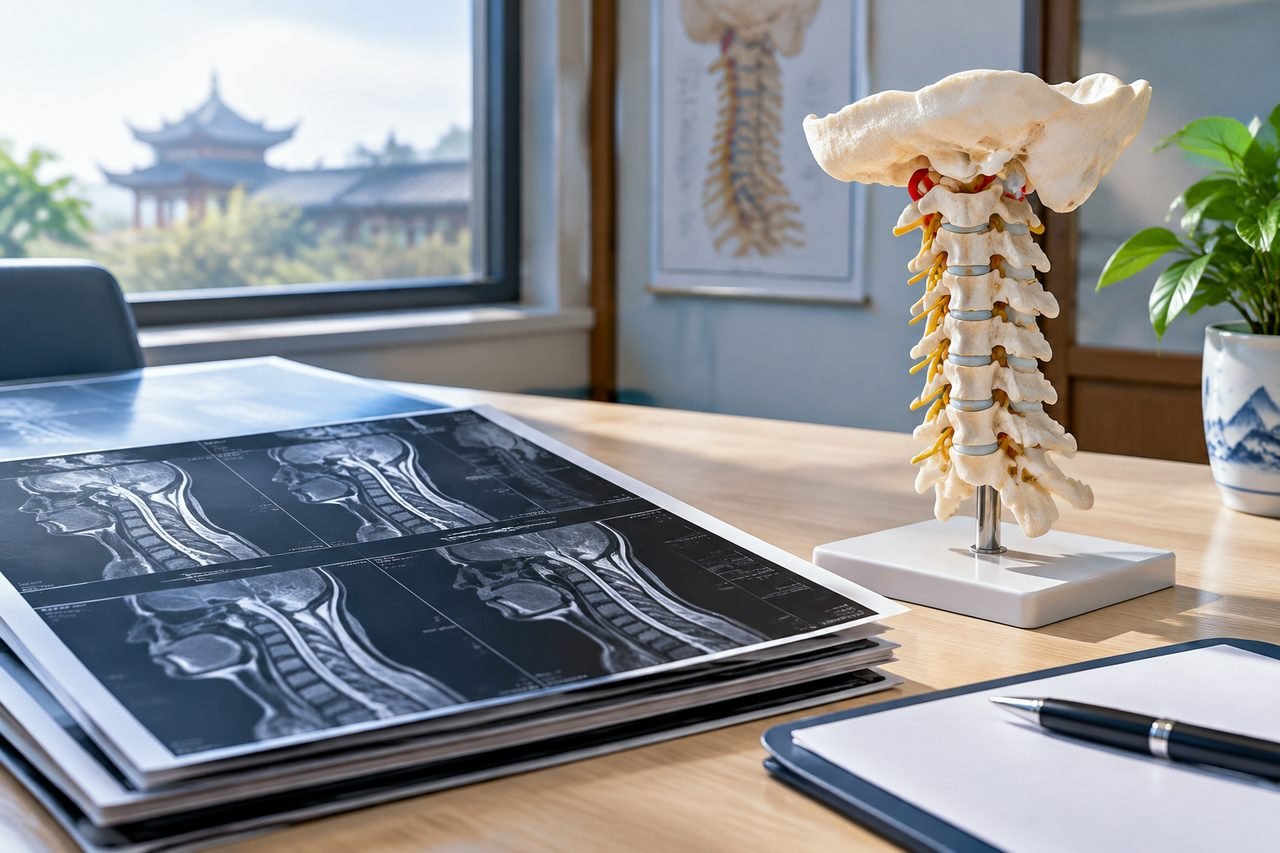
A single MRI or CT scan can show compression at a point in time. It cannot show whether that compression is stable, worsening, or changing in relation to symptoms. When a diagnosis report includes serial imaging — scans taken at different dates — the treating clinician can compare the degree of cord compression, the presence of signal changes within the cord, and any narrowing or alignment changes over time.
The report should state clearly which levels are affected, what type of imaging was used, and the dates of each study. If only one scan exists, the report should say so. If earlier imaging was done at another facility, the patient should ask whether those images or reports can be included. A report that mentions 'cervical spondylosis' without specifying levels, cord involvement, or comparison to prior imaging is difficult to use for surgical planning.
The surgical levels and approach depend on the individual problem. Cervical fusion joins vertebrae in the neck, but whether fusion is appropriate, which levels are involved, and whether an anterior or posterior approach is considered are decisions the treating surgeon makes after reviewing the full imaging record and the patient's functional history. The diagnosis report's role is to present that record clearly, not to recommend a procedure.
How urgency is described in the report and what it changes
Some diagnosis reports describe cervical myelopathy as 'chronic' or 'stable' without explaining what that means for the patient's safety. Others note 'progressive symptoms' without stating how quickly things have changed. For an overseas patient considering travel to China, this distinction matters: a report that documents rapid progression, new bowel or bladder symptoms, or a recent fall may prompt the treating team to advise local urgent assessment rather than international travel.
The report should clarify whether the clinician considers the condition stable, slowly progressive, or requiring urgent attention. It should also note any red-flag symptoms that have been asked about and their answers — for example, whether the patient has experienced loss of balance, new weakness in the legs, or changes in bladder control. These are not details the patient should interpret alone; they are details the report should contain so that the next clinician can assess urgency properly.
If the report does not address urgency, the patient can ask the current clinician a direct question: 'Based on what you see, is there any reason I should seek care sooner rather than later?' The answer belongs in the record. For anyone with worsening symptoms, local care takes priority over planning an overseas trip.
What a China-based clinical review can and cannot do with this report
A records-based review in China can help a patient understand whether the diagnosis report contains enough information for a specialist to form a preliminary view. It cannot replace an in-person examination, and it does not establish hospital acceptance or final surgical suitability. The reviewing clinician may identify missing records, ask for additional imaging, or request a functional history that was not included.
This is why the diagnosis report's clarity matters before any review is arranged. If the report lacks walking and hand-function history, serial imaging, or an urgency statement, the review may be limited to general questions rather than case-specific guidance. The patient may be asked to obtain supplementary records from the original treating facility — a process that can take time and may require the patient's authorisation.
ChinaSpecialistCare can help coordinate a specialist appointment or a records-based opinion, but the clinical assessment belongs to the treating hospital and its licensed clinicians. An initial enquiry is free and does not require purchasing a proxy consultation. The team checks the available diagnosis, records and the patient's main question, identifies missing information and suggests the relevant next step. That step might be gathering more records, seeking local urgent care, or proceeding to a specialist appointment.
Practical preparation: what to gather and what to ask
Before seeking a review in China, the patient should gather the diagnosis report, all available spine imaging (including dates and levels), and any functional history that has been documented. If the report is incomplete, the patient can ask the current clinician to add a dated note describing walking ability, hand function, and any changes over time. This is not a request for a new diagnosis; it is a request to record what is already known.
The patient should also prepare a short list of questions for the receiving team. These might include: Does the report contain enough information for you to assess the condition? What additional records would help? Based on the report, is there any urgency I should discuss with my local doctor? What does the review process involve, and what decisions can and cannot be made without an in-person examination?
A checklist can help organise this preparation, but it should not replace the report itself. The goal is a clear, dated record that a spinal specialist can use. If the patient is unsure what to gather, the initial enquiry can clarify what is missing. The hospital decides what it needs; the patient's role is to provide accurate information and ask what else would be useful.
- Diagnosis report with dates and clinician names
- All spine imaging reports and, if available, the images themselves
- A dated summary of walking and hand-function changes
- Any notes on urgency, progression, or red-flag symptoms
- A short list of questions for the receiving clinical team
Next step: clarify the report before arranging travel
The most useful next step is to check whether the diagnosis report answers the three questions this article has focused on: what has changed in walking and hand function, what serial imaging shows, and how urgent the condition is considered to be. If any of these are missing, the patient can ask the current clinician to add them or can prepare a dated summary to share with the receiving team.
For overseas patients considering care in China, an initial enquiry is free. The team can review the available records, identify what is missing, and suggest whether a specialist appointment or a records-based opinion is the appropriate next step. A proxy consultation is optional and not a prerequisite for every appointment. The treating hospital and its clinicians decide suitability, acceptance, and any treatment plan.
No article can replace an individual clinical assessment. If symptoms are worsening, new, or affecting safety, local urgent care should come first. For stable or slowly changing symptoms, gathering a clear diagnosis report is a practical way to make any future review more useful — whether that review happens locally or in China.
Sources & scope of this guide
References and official service information relevant to this guide.
This is general planning information and has not been individually reviewed by a doctor. Medical decisions and personal treatment advice come from your treating clinicians.