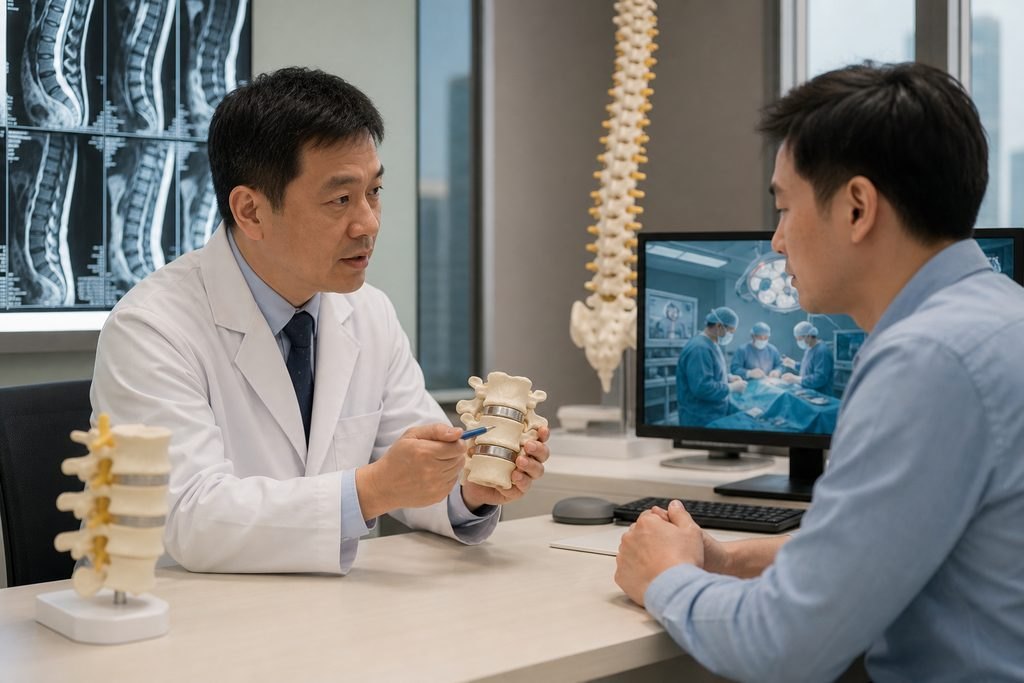
What a Changed Recommendation Actually Means
A changed recommendation is not automatically a sign that the first plan was wrong. It may reflect new information: a repeat examination, a different imaging report, a response to nonsurgical treatment, or a clearer picture of which nerve root is affected. It may also reflect a different clinician's judgement about the same facts. The practical question is not which recommendation is better in general, but what specifically changed between the two.
Cervical radiculopathy involves nerve-root compression or irritation in the neck, producing pain, numbness or weakness in a specific pattern. Nonsurgical treatment is often considered first, while surgery may be discussed when symptoms are severe, progressive or persistent despite other care. The exact threshold for surgery is a clinical judgement, not a fixed rule you can apply from a report alone.
When a recommendation changes, ask the clinician to state the old recommendation, the new recommendation, and the reason for the change in one or two sentences. If the reason is a new scan finding, ask which finding and how it relates to your symptoms. If the reason is your response to treatment, ask what changed in your examination. This summary becomes the core of any second opinion, whether you seek it locally or in China.
Diagnosis: Is the Working Diagnosis Still the Same?
A changed treatment plan sometimes follows a changed diagnosis. Neck pain with arm symptoms can have several explanations, and the label 'cervical radiculopathy' should be supported by a consistent clinical picture and imaging. Ask whether the working diagnosis is still cervical radiculopathy, or whether the clinician is now considering another cause for your symptoms.
If the diagnosis has shifted, ask what evidence supports the new direction. This matters for care in China because a receiving clinician will assess your records against their own examination. A diagnosis written on a referral letter is a starting point, not a conclusion. The treating clinician decides what fits your case after reviewing the full picture.
Ask for the diagnosis to be written in plain terms, including the level or levels involved if that has been established. If the level is uncertain, that uncertainty should be stated rather than smoothed over. A clear statement of what is known, what is suspected and what remains unclear is more useful than a confident label that hides gaps.
Imaging: What the New Report Does and Does Not Show
Imaging is a common reason a recommendation changes, but an imaging report is not the same as a clinical decision. Ask which images were compared, what changed between them, and whether the change is meaningful for your symptoms. A finding that looks different on paper may not change what a clinician recommends once your examination is taken into account.
Ask for the actual images, not only the written report. A receiving clinician may want to review the images directly rather than rely on a summary. If the images are on discs or a hospital portal, ask how they can be shared. If only a report is available, that limitation should be stated clearly in your enquiry.
Do not assume that a more detailed scan automatically leads to a different plan. The question is whether the imaging explains your symptoms and whether it changes the balance between nonsurgical treatment and surgery. That is a clinical judgement, and it should be made by the treating clinician who examines you, not by the report alone.
Treatment Goal: What Are You Trying to Achieve?
Two clinicians can agree on the diagnosis and imaging yet recommend different treatments because they are aiming at different goals. One may focus on relieving pain over the next few weeks; another may focus on preventing long-term nerve damage. Ask what goal the new recommendation is designed to serve, and how success would be judged.
If the new recommendation is surgery, ask what the surgery is intended to achieve and what alternatives were considered. If the new recommendation is to continue nonsurgical treatment, ask what would prompt a change and what warning signs should lead you to seek care sooner. These questions are not challenges to the clinician; they are part of informed consent.
For cervical radiculopathy, options may include medication, physical therapy, injections or surgery, depending on the individual case. The choice is not a simple ladder that everyone climbs in the same order. Ask why this option, for you, at this point, rather than assuming that a changed recommendation means the previous plan was inappropriate.
Records to Gather Before Asking About Care in China
If you are considering care in China, the first step is not choosing a hospital. It is assembling a clear record of what has already been decided and why. A receiving clinician needs to understand your symptoms, the examination findings, the imaging, and the reasoning behind the current recommendation. Without that, any opinion is based on fragments.
Start with a short written summary in English: when symptoms began, what they feel like, what makes them better or worse, what treatments you have tried, and what the current recommendation is. Then attach the supporting documents. Keep the summary factual and brief; the detail belongs in the records.
Ask the current clinician for copies of clinic notes, imaging reports and images, and any treatment records. If a document is missing, say so rather than leaving a gap that the receiving clinician has to guess about. A clear statement of what is unavailable is more useful than an incomplete file presented as complete.
- A one-page symptom and treatment summary in English.
- Clinic notes from the visits where the recommendation changed.
- Imaging reports and, where possible, the images themselves.
- A list of medications and other treatments already tried.
- The current recommendation in writing, with the reason given.
Questions to Ask the Receiving Clinician
When you contact a hospital or coordination service about cervical radiculopathy care in China, ask what the clinician would need to assess your case. Ask whether they want the images or only the reports, whether they need the original pathology or imaging files, and whether a remote review is possible before you travel. These are practical questions, and the answers vary by provider.
Ask how the clinician would approach a case where the recommendation has changed. A useful answer will describe what they would review, what they would want to examine themselves, and what they could not conclude without seeing you. Be cautious of any reply that promises a specific outcome or confirms surgery before a proper assessment.
If you want help organising records, interpretation or a specialist appointment request, ChinaSpecialistCare can assist with that coordination. This is non-clinical support; the treating clinician decides suitability, and hospital acceptance is never guaranteed. You do not need to purchase a proxy consultation to make an initial enquiry.
The next step is to write a short summary of your situation and the specific question you want answered, then send it through the enquiry form. Keep it brief at first. The team can explain what records to share next and how to prepare for a specialist appointment request if that is the right route for you.
Sources & scope of this guide
References and official service information relevant to this guide.
This is general planning information and has not been individually reviewed by a doctor. Medical decisions and personal treatment advice come from your treating clinicians.