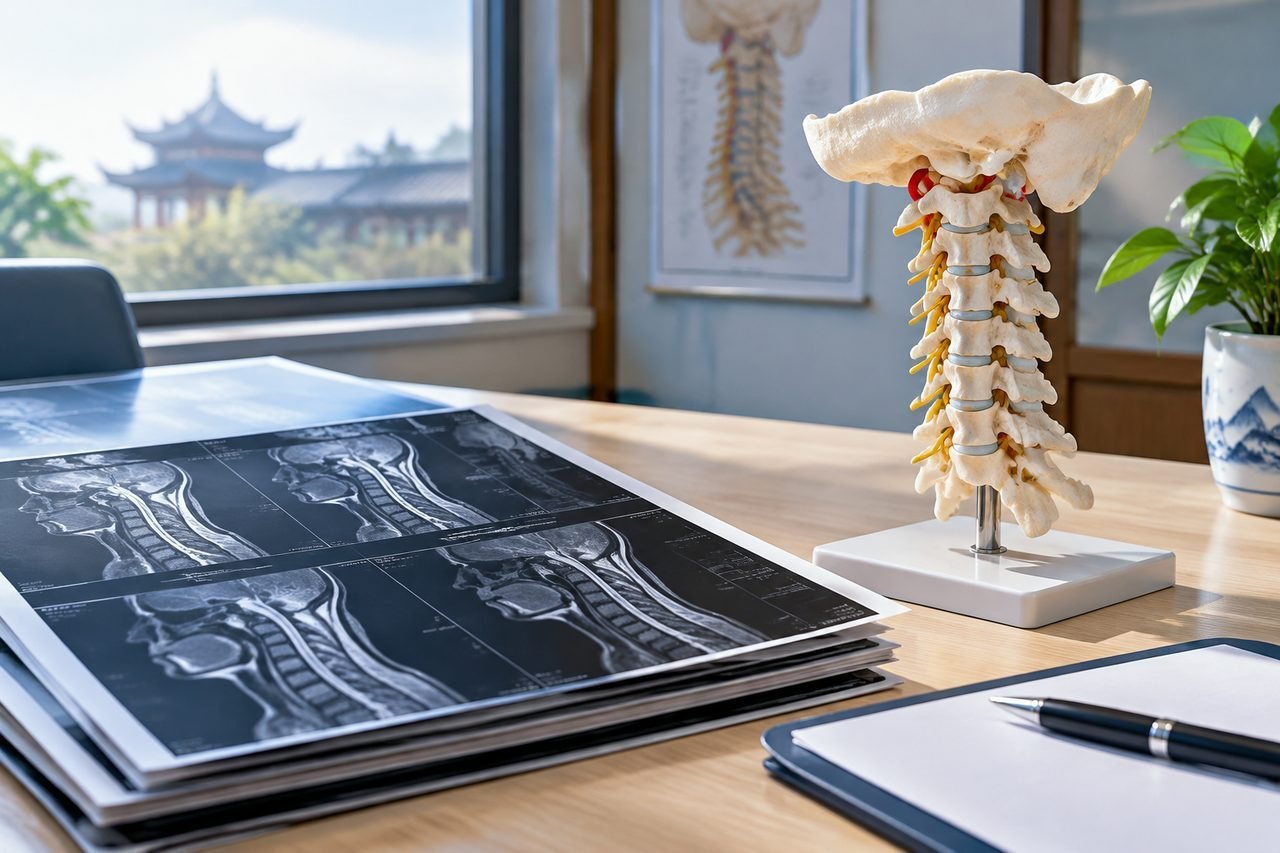
Why the symptom description and the neck scan must be read together
Cervical radiculopathy is not simply neck pain. It is a set of symptoms that follows a nerve root as it leaves the spine: pain, numbness, tingling, or weakness that travels into the shoulder, arm, or hand. A neck MRI or CT can show a disc bulge, bone spur, or narrowed opening, but those findings are common in people without any arm symptoms. The report becomes clinically useful only when the described pattern matches the level of the imaging finding.
This is why a report that says only 'disc herniation at C5-C6' is incomplete for an overseas planning decision. It does not tell the reader whether that finding explains the symptoms, whether the symptoms are getting better or worse, or whether the nerve is showing signs of significant compression. A hospital reviewing your records from another country needs both halves of the picture to decide what to offer.
If you are preparing records for a specialist appointment in China, the goal is not to collect every scan you have ever had. It is to make the link between symptoms and imaging explicit, so the treating clinician can see the reasoning rather than reconstruct it.
What the symptom history should record
A clinician reading your file wants to know the distribution and behaviour of the symptoms, not just their presence. Which arm is affected, and where does the sensation start and end? Does the pain follow a line down the outer arm, the thumb side, or the little-finger side? Those patterns point to different nerve roots.
The timing matters too. When did it begin, and is it improving, stable, or worsening? What makes it better or worse — turning the head, looking up, coughing, lying down, or carrying something? Have you noticed weakness, dropping objects, or changes in fine hand movement? Those are different from pain alone and change how urgently the case should be assessed.
A short, dated summary is more useful than a long narrative. Two or three sentences per symptom, with dates, gives the reviewing clinician a clear timeline without burying the key facts.
- Which arm and which part of the arm or hand is affected.
- Whether the problem is pain, numbness, tingling, weakness, or a combination.
- When it started and whether it is improving, stable, or worsening.
- What movements or positions change it.
- Any weakness, clumsiness, or dropping things.
- Any previous treatments and how the symptoms responded.
What the neck imaging report should state
An imaging report prepared for overseas review should identify the level, the type of finding, and the effect on the nerve or spinal cord. 'Disc protrusion at C6-C7 with contact or compression of the exiting nerve root' is more useful than 'degenerative changes'. If the radiologist has commented on the spinal cord, the central canal, or the size of the opening the nerve passes through, that should be included.
The report should also state the date of the scan and the type of scan. An MRI from two years ago may not reflect current symptoms, and a CT shows bone differently from an MRI. If you have both, send both, with a note about which is most recent.
One practical point: the written report and the images themselves are different things. A hospital may want the actual image files, not only the radiologist's text. Ask the imaging centre how to obtain a copy in a format the receiving hospital can open, and confirm what the receiving hospital accepts before you send anything.
Why the report must say what has already been tried
A report that does not mention previous treatment leaves the reviewing clinician unable to judge whether the situation has changed since the scan, or whether the symptoms have already responded to something. Record each treatment with a date and a plain outcome: physiotherapy and how many sessions, medication and whether it dulled the arm pain, an injection and how long any relief lasted, a collar or traction, or any other approach. "Six weeks of physiotherapy, no change in the arm numbness" tells the reader more than "tried physiotherapy."
The pattern matters as much as the list. Symptoms that improved and then returned after a period of relief describe a different situation from symptoms that have never changed at all. If a treatment helped for a while and then stopped working, note when that happened. If nothing has been tried yet, say so explicitly rather than leaving the section blank; a blank section is ambiguous, and the reviewing clinician cannot tell whether treatment was skipped or simply not recorded.
Include any opinion already given in your home country, and include the reasoning, not only the conclusion. "Recommended surgery at C5-C6" is far less useful than the same sentence plus why: which finding, which symptoms, and what the clinician expected surgery to change. A second opinion is more useful when it can see the first one's logic and either agree with it or explain where it differs.
This section is a record, not a recommendation for or against any treatment. Its purpose is to let the treating team discuss options with you on the basis of what has actually happened, rather than starting the conversation from a blank page. Keep it factual and dated, and resist the urge to argue your own case inside it; the clinical reasoning belongs to the clinicians who examine you.
Fusion, motion preservation, and what the report cannot decide
When surgery is discussed for cervical radiculopathy, the conversation often includes fusion and motion-preserving options. These are different procedures with different considerations, and the choice depends on the specific level, the pattern of disease, the state of the adjacent segments, and the individual patient. A diagnosis report can inform that discussion, but it does not make the decision.
It is worth being clear about the limits of any records-based review. A clinician reviewing your file from a distance can comment on the imaging and the history, but cannot examine you, test your reflexes and strength in person, or confirm how you are responding now. That means a remote opinion is a step in planning, not a final treatment decision. The treating hospital decides suitability after its own assessment.
For a motion-preserving option such as artificial disc replacement, the general principle is that it replaces a damaged disc with a prosthesis and is not suitable for every patient. That principle comes from lumbar spine material, and it should not be stretched to claim a cervical advantage, a specific eligibility threshold, or confirmed implant availability. Those are questions for the treating team about your case.
How to prepare the file and what to ask next
Start with a one-page summary in English: your main symptom, which arm, when it started, what has been tried, and your main question. Attach the imaging reports with dates and the actual image files if you have them. Keep the first contact brief; you can share more records once the team tells you what is missing.
When you contact a hospital or a coordination service, ask specific questions rather than general ones. What does the reviewing clinician need that is not in the file? Does the hospital want the images or only the reports? Who will read the file, and will you receive a written response? What would change the recommendation? These questions turn a vague enquiry into a useful exchange.
For care in China, it also helps to ask how the hospital handles records in another language, whether an interpreter is needed for the consultation, and what the next step would be if the review suggests an in-person assessment. An initial enquiry is free and does not commit you to anything. You do not need to buy a proxy consultation to ask whether your records are complete enough for a specialist to review.
The practical next step is to write the one-page summary, gather the dated imaging reports, and send a short enquiry describing your main question. The hospital decides suitability; your job at this stage is to make the clinical picture clear enough for that decision to be made well.
Sources & scope of this guide
References and official service information relevant to this guide.
This is general planning information and has not been individually reviewed by a doctor. Medical decisions and personal treatment advice come from your treating clinicians.