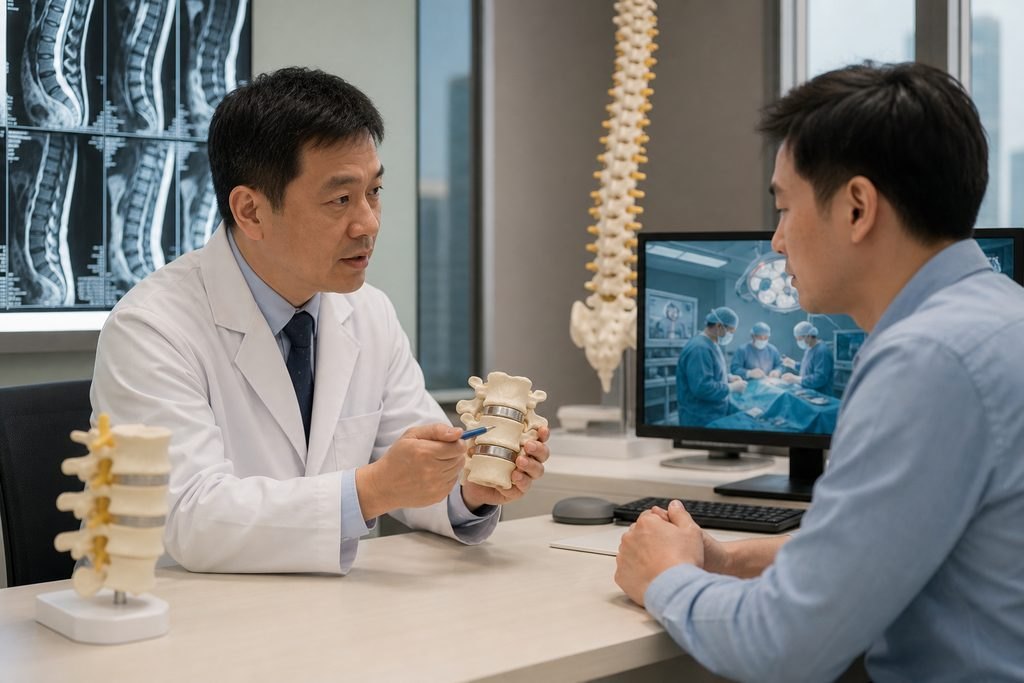
Why Some Answers Cannot Come From Records Alone
Cervical radiculopathy is a condition where a nerve root in the neck is compressed or irritated, causing pain, numbness, tingling or weakness that travels into the arm or shoulder. Imaging such as MRI or CT can show disc bulges, bone spurs or narrowing, but it does not show how your nerves and muscles are actually functioning. A radiologist's report describes what is visible on the scan. It does not confirm that the visible finding is the cause of your current symptoms.
This distinction matters when you are considering care in China. A records-based opinion can review your diagnosis, your imaging and your treatment history. It can identify missing information and suggest what to ask. It cannot perform the physical tests that distinguish cervical radiculopathy from other causes of arm pain, such as shoulder problems, peripheral nerve compression or muscle disorders. Those tests include checking your reflexes, muscle strength, sensation and specific neck movements. The treating clinician needs to see and examine you to interpret those findings.
The same limitation applies to judging whether your symptoms are improving, stable or worsening. A clinician who examines you can compare your strength and sensation over time. A remote reviewer reading a report from three months ago cannot know how you are functioning today. If your symptoms are worsening quickly, or if you develop new weakness or difficulty with walking or balance, seek local urgent care before planning travel.
Questions That Usually Need an In-Person Examination
Certain questions about cervical radiculopathy cannot be answered reliably without a physical examination. The treating clinician needs to correlate your imaging with your clinical signs. For example, an MRI may show a disc protrusion at one level, but your symptoms may point to a different level. Only an examination can help clarify whether the imaging finding matches the nerve root that is causing your problem.
Questions about the severity of nerve involvement also require examination. A clinician can test your muscle strength, reflexes and sensation to assess how much the nerve is affected. This information influences whether nonsurgical treatment is appropriate or whether surgery should be discussed. You cannot self-report these findings accurately, and a written description of weakness or numbness does not give the same information as a hands-on assessment.
Whether you are a candidate for a particular procedure is another question that requires in-person review. For example, cervical fusion and motion-preserving options such as artificial disc replacement are considered for selected patients. The choice depends on the level and pattern of nerve compression, the condition of the disc and surrounding structures, your symptoms and your overall health. A records-based opinion can explain the general principles, but the treating clinician must examine you and review your full imaging before discussing whether a specific procedure is suitable for you.
The source below concerns lumbar artificial disc replacement, not cervical. It states that lumbar artificial disc replacement replaces a damaged disc with a prosthesis and is not suitable for every patient with back pain. This supports the general point that disc replacement is a selected option, not a universal solution. It does not establish cervical eligibility, advantages over fusion or implant availability in China. Those are questions for the treating clinician.
Questions That Can Be Explored Before You Travel
Not every question requires an in-person visit. Some can be explored through records before you travel, which helps you prepare and decide whether a trip is worthwhile. A records-based review can clarify whether your diagnosis is clear, whether your imaging is recent enough, and what additional information the treating clinician may want. It can also help you understand the general treatment pathways for cervical radiculopathy, including nonsurgical options such as physiotherapy, medication and injections, and surgical options such as decompression or fusion.
You can also ask about the practical side of care in China before travelling. For example, you can ask whether the hospital has a specialist who focuses on cervical spine conditions, what records they want to see, and how appointments are arranged. These are administrative questions that can often be answered without an examination. They help you plan, but they do not replace the clinical assessment that determines suitability for treatment.
A useful way to prepare is to write down your questions and separate them into two groups: those that can be answered from records and those that need an examination. This makes your appointment more efficient and helps you avoid expecting a remote reviewer to answer questions that require physical testing. If you are unsure which group a question belongs to, ask the coordinator or the hospital's international office. They can tell you what the treating clinician typically needs to see in person.
What Records Help the In-Person Assessment
The quality of your in-person assessment depends partly on the records you bring. Imaging is central. If you have had an MRI or CT of your cervical spine, bring the actual images on a disc or USB drive, not only the written report. The treating clinician may want to review the images directly rather than rely on a summary. If your imaging was done more than a few months ago, the clinician may want to repeat it, but that is a decision for the treating team.
Bring any previous treatment records, including physiotherapy notes, medication lists, injection records and any surgical reports. If you have had nerve conduction studies or electromyography, include those results. A clear timeline of your symptoms is also helpful: when the pain started, what makes it better or worse, and how it has changed over time. This information helps the clinician understand your situation before the examination.
Do not worry if your records are incomplete. Missing records are common, and the treating clinician can often work with what you have. The important thing is to be honest about what is available and what is not. If you are unsure whether a particular record is relevant, bring it anyway. It is better to have more information than less. The hospital will tell you if additional tests are needed after the assessment.
How to Prepare Your Questions for the Specialist
A productive in-person assessment starts with clear questions. Before your appointment, write down what you most want to know. For cervical radiculopathy, useful questions include: Does my imaging explain my symptoms? How much nerve involvement is there? What nonsurgical options are available, and how long should I try them before considering surgery? If surgery is discussed, what are the alternatives, including fusion and motion-preserving options? What are the risks and expected recovery for each option in my case?
Ask the clinician to explain the reasoning behind their recommendations. For example, if they suggest surgery, ask why nonsurgical treatment is not sufficient in your case. If they suggest a particular procedure, ask how your imaging and examination findings support that choice. You are not expected to make a clinical decision on the spot. It is reasonable to take time to consider the information and ask follow-up questions.
It also helps to ask what the clinician needs from you to give a complete answer. Some questions may require additional tests or a follow-up visit. Ask whether a second appointment is needed and what it would involve. This helps you plan your time in China and avoid unnecessary delays. Remember that the hospital decides suitability for any procedure, and the treating clinician's judgment is based on your individual situation.
Next Steps for Planning Care in China
If you are considering care in China for cervical radiculopathy, start by gathering your records and clarifying your main question. You can share a brief summary with ChinaSpecialistCare through the enquiry form, email or WhatsApp. The initial case review is free and non-clinical. It checks the available diagnosis, records and your main question, identifies missing information and suggests the relevant next step. It is not a diagnosis or a promise of acceptance.
If you need a records-based opinion before travelling, a proxy consultation is optional and not a prerequisite for every appointment. It involves a doctor taking your records to a relevant hospital specialist for an opinion while you remain at home. This can help you understand whether an in-person assessment in China is likely to be useful, but it does not replace that assessment. The hospital and treating clinician decide suitability for any treatment.
For confirmed help with records, interpretation or specialist appointment requests, ChinaSpecialistCare can coordinate with suitable hospitals. The relevant procedure reference for artificial disc replacement is available for general information. Use it to understand the topic, then ask the treating clinician how it applies to your cervical spine. Your next step is to prepare your records and questions, then contact the team to discuss the appropriate route.
Sources & scope of this guide
References and official service information relevant to this guide.
This is general planning information and has not been individually reviewed by a doctor. Medical decisions and personal treatment advice come from your treating clinicians.