What cervical radiculopathy symptoms should you document before an enquiry
Cervical radiculopathy is a clinical diagnosis. It describes symptoms caused by compression or irritation of a cervical nerve root, and it is not the same as uncomplicated neck pain or a generalised stiff neck. The pattern of symptoms matters because it tells the clinician which nerve level may be involved and whether the presentation is typical.
Before you send records to any provider, write a plain, dated description of what you feel. Note where the pain starts and where it travels. Record any numbness, tingling, weakness or heaviness in the arm or hand, and which fingers are affected. Note whether coughing, sneezing, straining or certain neck positions change the symptoms. Record what makes it better or worse, including sleep position and any activity that reliably triggers it.
Also record the timeline. When did it start? Has it been constant, or does it come and go? Has it changed in the last few weeks? A clinician reviewing a file from overseas needs to know whether the problem is stable, improving or worsening, because that changes the urgency and the range of options.
Finally, note any red-flag features you have experienced, such as difficulty with walking, balance, bowel or bladder control, or weakness in both arms or legs. These are not routine radiculopathy symptoms, and they need prompt local medical assessment rather than an overseas planning enquiry. If you have any of these, seek care where you are first.
Which neck imaging records actually help a specialist review
Imaging is useful only when it can be matched to your symptoms and to the original report. A disc bulge or a narrowed foramen on a scan does not by itself prove that it is causing your arm symptoms. Many imaging findings are also seen in people without symptoms, so the clinician needs both the pictures and the clinical story.
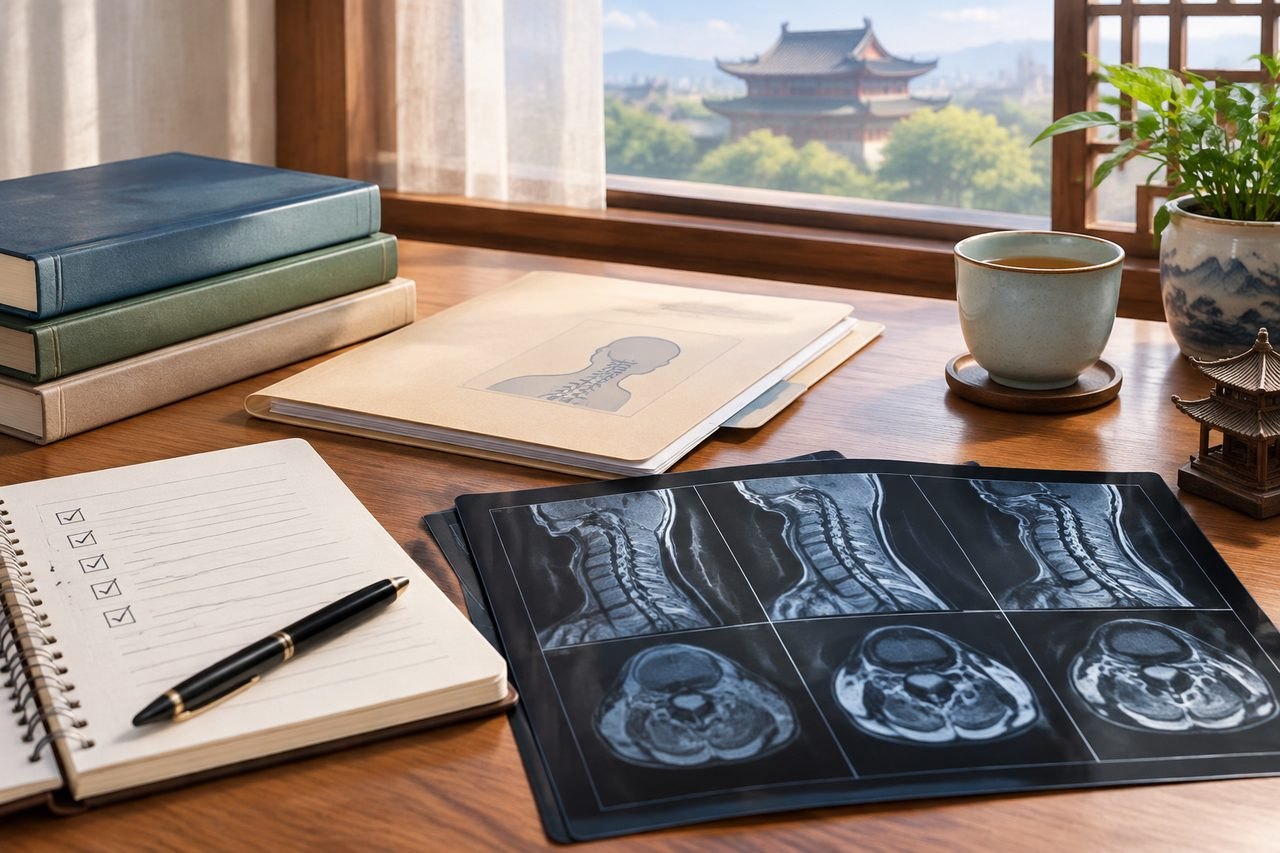
The most useful items are usually the actual image files, not only the written report. If you have had an MRI of the cervical spine, ask the imaging centre for a copy of the DICOM files on a disc or a secure download link, together with the radiologist's report. If you have had CT, X-ray or electromyography, include those reports and files as well. Keep the dates clear, because an older scan may not reflect the current situation.
It also helps to include a short list of any previous treatments and their results: physiotherapy, medication, injections, or any period of rest or activity modification. A specialist reviewing a records-based opinion needs to know what has already been tried and what happened, because that affects what might be considered next.
Do not assume that a particular scan will be requested in China before any review. Whether additional imaging is needed, and which type, is a clinical decision for the treating team after they have seen your existing records and examined you. Ask them directly what they would need and why.
Why the symptom and imaging picture must be read together
A common source of confusion for patients is that the scan and the symptoms do not always point to the same level. A radiologist may report a disc protrusion at one level, while your arm pain follows a different nerve root pattern. A clinician has to reconcile these, and sometimes the answer is that the imaging finding is incidental and not the cause of the current problem.
This is why a records-based opinion is a review, not a final diagnosis. The reviewing clinician can comment on whether the described symptoms and the available imaging are consistent, what further information would help, and what broad categories of treatment might be considered. They cannot confirm suitability for a specific procedure without a proper clinical assessment, and they cannot guarantee an outcome.
If you are asked to provide more detail, be specific rather than general. Instead of writing 'arm pain', describe the distribution, the quality, the severity at its worst, and the functional impact, such as difficulty dressing, holding a cup, or typing. This kind of detail is what allows a specialist to form a useful preliminary view.
Non-surgical options and what to ask about them
Many people with cervical radiculopathy are managed without surgery. The options discussed in general clinical practice include activity modification, physiotherapy, pain medication, and in some cases image-guided injections. The choice depends on the severity of symptoms, the presence of weakness, the response to previous treatment, and the individual's overall health.
If you are considering care in China, ask the treating clinician what non-surgical options they would consider in your case, what the expected course of each would be, and what would prompt a change in plan. Ask whether any medication you currently take would need to be reviewed, and who would manage that. Do not change any prescribed medicine on your own based on an article or an enquiry reply.
It is also reasonable to ask how non-surgical care would be coordinated if you are travelling. Would it require a stay in China, or could some of it be done locally with follow-up? The answer depends on your situation and on what the hospital can arrange, so ask for it in writing rather than assuming a standard pathway.
Fusion, motion preservation and the limits of what can be promised
When surgery is discussed for cervical radiculopathy, the conversation often includes decompression, fusion, and in some cases motion-preserving options such as disc replacement. These are different procedures with different considerations, and not every patient is a candidate for every option. Published material on artificial disc replacement for the lower back describes replacing a damaged disc with a prosthesis and notes that it is not suitable for every patient with back pain; that evidence concerns the lumbar spine, so it does not establish cervical disc replacement advantages, eligibility thresholds, or assured implant availability.
That distinction matters for your decision. If you have read about disc replacement and want to know whether it applies to you, the honest answer is that only the treating clinician can assess that after reviewing your imaging, symptoms and examination. Ask what the proposed procedure is, what it involves, what the alternatives are, and what the known risks and uncertainties are for your situation.
You should also ask what would happen if the first plan does not work, and what follow-up would be needed. A responsible clinician can discuss evidence-based risk and outcome estimates in general terms, but no estimate guarantees your individual result. Be cautious of any reply that promises a specific outcome or implies that a particular implant is always available.
Preparing your records and the questions to send
A practical way to prepare is to build a single, short summary document that a clinician can read quickly. Include your main symptom in one sentence, the timeline, the distribution of pain or numbness, any weakness, what has been tried, and a list of your current medications and relevant medical conditions. Attach the imaging reports and note where the image files can be obtained.
Then prepare a short list of questions. Ask whether your symptoms and imaging are consistent, what further information the clinician would need, what non-surgical options they would consider, whether surgery is a possibility and why, and what the next practical step would be. Ask who will be responsible for each part of your care and how communication will work if you are not in China yet.
For an initial enquiry, you do not need to send a complete medical archive or payment details. A brief summary is enough to start. The team can then tell you what else is needed. An initial enquiry is free, and it does not commit you to a proxy consultation or to treatment. The hospital decides whether to accept a case and what it can offer.
If your symptoms are worsening, or you develop new weakness, walking difficulty, or bowel or bladder changes, seek local medical care promptly rather than waiting for an overseas reply. Planning for care in China can continue once your immediate situation is stable.
Sources & scope of this guide
References and official service information relevant to this guide.
This is general planning information and has not been individually reviewed by a doctor. Medical decisions and personal treatment advice come from your treating clinicians.