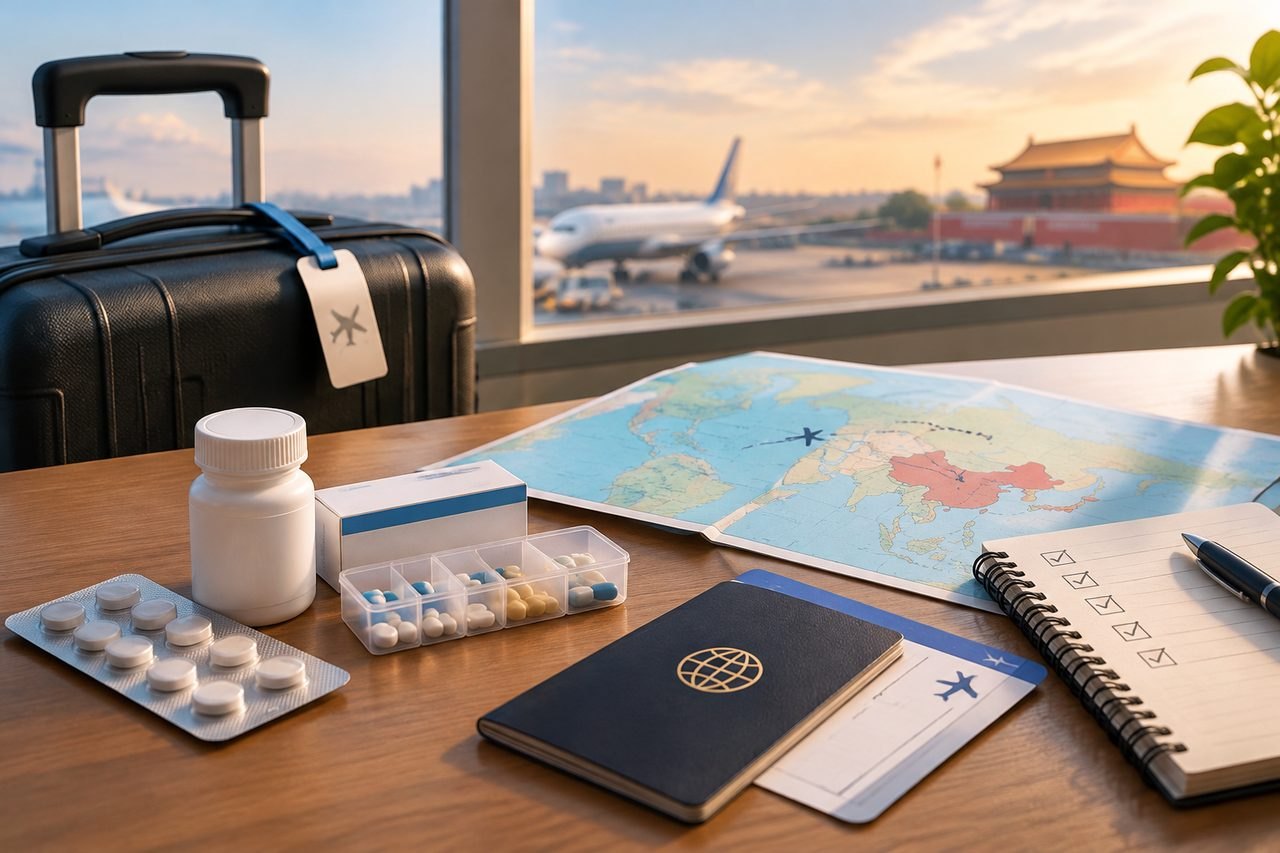
Why a new route is not just a new flight number
When you change flights, you may change the countries you pass through, the airline carrying you, the airports where you wait, and the order in which you clear customs. Each of those can bring a different set of medicine rules into play. The rules that matter at your final arrival port in China are not the same as the rules applied by a transit country or by an airline at the gate.
This is why a route that worked before may need fresh checking after a change. The medicine itself has not changed, but the authorities and carriers reviewing it may have. Treat the new itinerary as a new set of questions rather than assuming the old answers still apply.
The practical point is simple: separate the checks. One set belongs to China as your arrival port. Another set belongs to every transit country and airline on the new route. Neither set automatically covers the other.
A flight change can also alter which airport staff first inspect your hand luggage, whether you pass through a transfer security screening, and whether your checked bag is transferred automatically or collected and re-checked. Those are operational details, but they decide who looks at your medicines and when.
Consider a concrete example. A route that previously flew direct into Shanghai might now connect through another Asian hub. The medicine in your bag is identical, yet the transit airport's security and the connecting airline's carriage conditions now apply as well.
The reverse also happens. A connection you once cleared may be replaced by a longer layover, an overnight stop, or a change of terminal that requires you to enter the transit country. Each of those shifts the question from airside transit to something closer to entry.
None of this means a changed route is a problem. It means the checklist you used last time is no longer the whole checklist. The sections below separate the arrival-port questions from the transit and airline questions so you can work through them in order.
Arrival-port rules in China: what the official guidance covers
Official Shanghai government guidance on personal medications and entry to China describes two broad situations. Small personal quantities of ordinary medicines are treated differently from controlled medicines. For narcotic and Class I psychotropic medicines, the guidance describes separate documentation requirements.
That distinction matters when you plan what to carry and what to declare. It does not mean every medicine falls neatly into one category, and it does not mean a foreign prescription automatically authorises entry. The guidance points travellers toward the arrival-port customs authority for the exact ingredient and formulation.
If your flight change moves you to a different arrival city or a different terminal, the practical step is to confirm the current requirements with the customs authority responsible for that specific port. Ask about your exact medicine name, the ingredient, the formulation, the quantity you plan to carry, and the documentation they expect. Keep the reply with your travel documents.
Do not rely on memory to decide whether a medicine is controlled. If you are unsure, ask the arrival-port customs authority directly rather than guessing from the medicine's name or from what happened on a previous trip.
Transit-country and airline rules are a separate check
A transit stop can create its own requirements even if you never leave the airport. Transit countries may apply their own rules to medicines carried through, and airlines may have their own conditions for carriage, documentation or advance notice. These are not the same as China's arrival-port rules, and China's rules do not replace them.
After a flight change, identify every country your new route touches and every airline operating each leg. Then check each one separately. If a connection involves an overnight stay or a change of airport, that may add another layer to confirm.
Airline and transit requirements can also cover practical matters such as how medicines must be packed, whether you need to carry them in hand luggage, and whether you should notify the carrier in advance. These details are best confirmed with the airline or the relevant authority rather than inferred from the customs guidance for China.
If a transit country's requirements cannot be confirmed before departure, that is useful information. It tells you the route carries an unresolved question, and you can decide whether to adjust the itinerary or seek clearer guidance before travelling.
What to verify, in a sensible order
Start with the medicines themselves. List each one by its exact name, the active ingredient, the formulation, the dose, and the total quantity you plan to carry. Include anything you take regularly, anything you might need during the trip, and any medicine that could be considered controlled in any country on your route.
Next, match that list to your new itinerary. For each leg, note the departure country, any transit country, the arrival port in China, and the operating airline. This gives you a clear map of which authorities and carriers to contact.
Then contact the arrival-port customs authority in China about the medicines you will bring. Ask specifically about the exact ingredient and formulation, and about the documentation they require. If any medicine may be controlled, raise that directly rather than waiting to be asked.
In parallel, contact each airline and check the transit-country requirements for every country on the route. Ask what documentation, packing or advance notice they require for your medicines.
Finally, keep written replies together with your prescriptions, your doctor's letter if you have one, and your itinerary. If a reply is unclear, ask a follow-up question rather than filling the gap with an assumption.
What a reply does and does not confirm
A reply from an airline confirms that carrier's conditions for carriage on that route. It does not confirm what the arrival-port customs authority in China will decide, and it does not cover a transit country's rules.
A reply from a customs authority about your medicine confirms the position for the ingredient and formulation you described. It does not automatically extend to a different formulation, a different quantity, or a medicine you did not mention.
A prescription from your own doctor documents that the medicine was prescribed for you. It does not by itself authorise entry into China or into a transit country. Whether a translated foreign prescription allows dispensing in China is a separate question for the relevant authority, not something to assume.
If a step cannot be completed before you travel, say so plainly in your own planning. An unresolved question about a controlled medicine or a transit country is a reason to seek clearer guidance, not a reason to treat the route as cleared.
If something cannot be confirmed before departure
Sometimes an airline or authority does not give a clear answer in time. In that situation, the useful move is to narrow the question. Ask about one medicine, one ingredient, one formulation and one route rather than the whole list at once. A specific question is easier to answer accurately.
If a transit country remains unclear, consider whether a different routing would remove that stop. If a medicine's status is unclear, ask the arrival-port customs authority directly rather than relying on a general assumption. If you need a medicine during travel and its status is unresolved, discuss the options with your prescribing clinician before you fly.
Keep your own records of what you asked, whom you asked, and what they replied. If your flight changes again, you will know which answers still apply and which need rechecking.
For patients also planning care in China, confirmed coordination can help with records, interpretation or specialist appointment requests where those are relevant to the visit. It does not cover customs clearance, dispensing, importing or prescribing, and it does not decide whether a medicine may enter China. An initial enquiry is free and does not require buying a proxy consultation.
If your flight changes, recheck the arrival-port rules and the transit and airline rules separately, in writing, before you travel. That is the step that keeps the route and the medicines aligned.
Sources & scope of this guide
References and official service information relevant to this guide.
This is general planning information and has not been individually reviewed by a doctor. Medical decisions and personal treatment advice come from your treating clinicians.