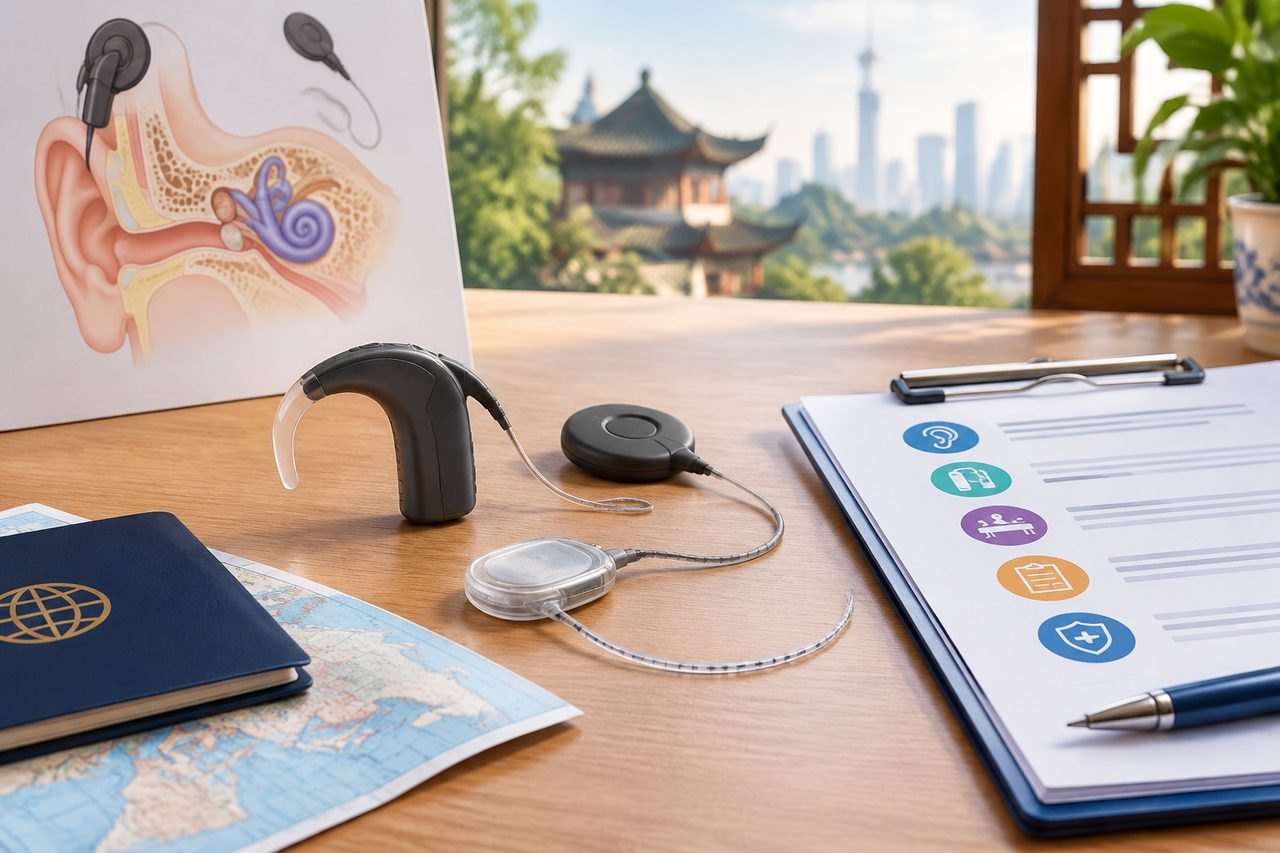
What the assessment must establish before anyone discusses surgery
Cochlear implants are considered for some severe permanent hearing loss when hearing aids do not help sufficiently. They include external and surgically implanted components. That description sets the boundary of the decision, not the answer for an individual. The first consent question is not about the device. It is about whether the assessment in China will actually establish that you fall within the group for whom an implant is considered, and whether the records you bring are enough for that judgement.
Ask the clinical team to explain, in writing, which hearing tests they will use, what each test measures, and what result would make an implant appropriate or inappropriate for you. If you have already had hearing tests abroad, ask whether those results can be used or whether the team needs to repeat them. The reason this matters is practical: if the assessment is incomplete when you arrive, you may be asked to stay longer or return, and you will not know that until you are already there.
You should also ask who will make the suitability decision and whether that decision can be made from records alone or requires an in-person assessment. A records-based opinion can help you understand your options, but it does not establish final eligibility or hospital acceptance. Those remain the treating hospital's decisions.
Device selection: who chooses, and on what basis
Cochlear implant systems include external and surgically implanted components. Different systems and different configurations exist, and the choice is not only technical. It affects how you wear the device, how it is programmed, what maintenance and replacement may involve, and whether support is available where you live.
Ask the team to explain which device or devices they propose for you and why. Ask what alternatives exist and what the trade-offs are. Ask whether the device you would receive in China can be programmed and serviced in your home country, and who would provide that support. This is not a question about brand preference. It is a question about whether the care you begin in China can continue safely after you leave.
If the team cannot confirm that a particular device can be supported in your home country, that is important information. It may change where you choose to have care, or it may mean you need to plan follow-up differently. Ask for the answer in writing so you can check it with your local audiology service.
How surgery, programming and rehabilitation fit across visits and countries
This is the question most likely to be left unclear. Cochlear implant care is not a single event. It typically involves assessment, surgery if appropriate, initial activation and programming, and ongoing rehabilitation and adjustment. Some of these stages may happen during one stay in China. Others may need to happen after you return home, or during a later visit.
Ask the team to map the stages for your situation. For each stage, ask where it would take place, who would be responsible, and what would happen if you returned home before that stage was complete. Ask how many programming visits are expected and whether they can be done remotely or must be in person. Ask what rehabilitation involves, who provides it, and whether it can be arranged in your home country.
Do not accept a general statement that follow-up can be arranged. Ask for the specific plan for your case, including what would happen if you could not return to China for a scheduled stage. If the answer is that you would need to find local care, ask what information and records the Chinese team would provide to support that handover.
The exact records and confirmations to request before you agree
Before you consent to care, you should be able to see, in writing, what the team has reviewed, what it still needs, and what it is proposing. This is not a demand for certainty. It is a request for clarity about the basis of the recommendation.
Ask for a written summary that states which records were reviewed, which hearing tests were used, what the proposed device is, what the surgical plan is if surgery is recommended, and what the follow-up plan is. Ask what is still undecided and what would need to be confirmed before each stage. If the team cannot provide this, ask what they can provide and when.
You should also ask how the hospital's written estimate or quotation works for your case. Ask what it includes, what it excludes, and what remains undecided. Do not assume that a figure you have seen covers everything. Ask the named provider to explain its own written quote rather than relying on a general description.
A written summary is useful only if it is specific to you. A general leaflet about cochlear implants, however accurate, does not tell you which tests were reviewed, which device is proposed, or what happens after you leave. If the summary you receive could have been written for any patient, ask for the parts that are specific to your case.
Ask what information the team still needs from you and by when. If you have audiograms, imaging, or reports from a hearing aid trial, ask whether those documents are sufficient or whether something is missing. A missing document is easier to address before you travel than after you arrive.
Ask who will be your point of contact for clinical questions and how quickly you should expect a response. This matters because consent is not a single conversation. If you think of a question after the appointment, you need to know who to ask and whether the answer will reach you in writing.
If the team proposes surgery during the same visit as the assessment, ask what would happen if the assessment findings differed from what was expected. Would the plan change, would the surgery be postponed, or would you be asked to decide on the spot? You are entitled to know how much of the plan is fixed and how much depends on findings that are not yet available.
Finally, ask what you would be asked to sign and what that document would say. If you cannot read it before the appointment, ask for a copy in advance or for an explanation of its main points. Consent that you cannot understand is not meaningful consent, and asking for time to read is a reasonable request.
Questions about risk, alternatives and what happens if you decline
Consent means you understand the proposed treatment, the alternatives, and the consequences of choosing not to proceed. You are entitled to ask the clinical team about evidence-based risk estimates and uncertainty for your situation. A clinician can discuss what is known about outcomes and what remains uncertain. No estimate guarantees an individual result.
Ask what the alternatives to a cochlear implant are for you, including continuing with hearing aids, other assistive devices, or no intervention. Ask what would happen if you decided to wait, and whether waiting would change your options. Ask what the risks of surgery and of the device itself are, and how those risks would be managed if they occurred.
If you are considering care in China, you should also ask what would happen if you decided not to proceed after the assessment. Would you be able to return home without further obligation? What would you still owe for the assessment? These are practical questions that belong in the consent discussion, not after it.
What to confirm before you agree, and how to take the next step
Before you agree to cochlear implant care in China, you should be able to answer these questions for yourself: What is the basis for saying an implant is appropriate for me? Which device is proposed, and can it be supported where I live? How will assessment, surgery, programming and rehabilitation fit across visits and countries? What is still undecided? What does the written estimate include and exclude? What are the alternatives and the risks?
If any of these remain unclear, ask again. A hospital's decision on suitability is separate from your decision to consent. You are allowed to ask for more information, to seek a second opinion, and to take time to decide. If you have a hearing emergency or a sudden change in your hearing, seek local care rather than waiting for an overseas enquiry.
If you would like help requesting a specialist appointment, organising records for review, or arranging interpretation during consultations, ChinaSpecialistCare can coordinate those non-clinical steps. An initial enquiry is free and does not require buying a proxy consultation. You can start with a brief summary of your situation and your main question. The hospital decides suitability and treatment.
Sources & scope of this guide
References and official service information relevant to this guide.
This is general planning information and has not been individually reviewed by a doctor. Medical decisions and personal treatment advice come from your treating clinicians.