What the first in-person discussion can and cannot settle
A cochlear implant is considered for some severe permanent hearing loss when hearing aids do not help sufficiently. The device has external and surgically implanted components. That much is general. What a first meeting can settle is narrower and more useful: whether your records are complete enough for the clinician to form a view, what further hearing tests or imaging that clinician wants, and how the team would structure care if an implant were offered.
What it cannot settle is a guarantee. No clinician can promise that an implant is suitable before seeing you and reviewing your own results. Suitability belongs to the treating team. Your job in the room is to make your situation legible and to leave with a written sense of the next step, not to extract a commitment.
This matters because overseas patients often arrive hoping for a decision on the day. A more realistic goal is a documented plan: which tests are still needed, who orders them, where they can be done, and what the team would need before any surgical date is discussed.
The records that make the conversation specific
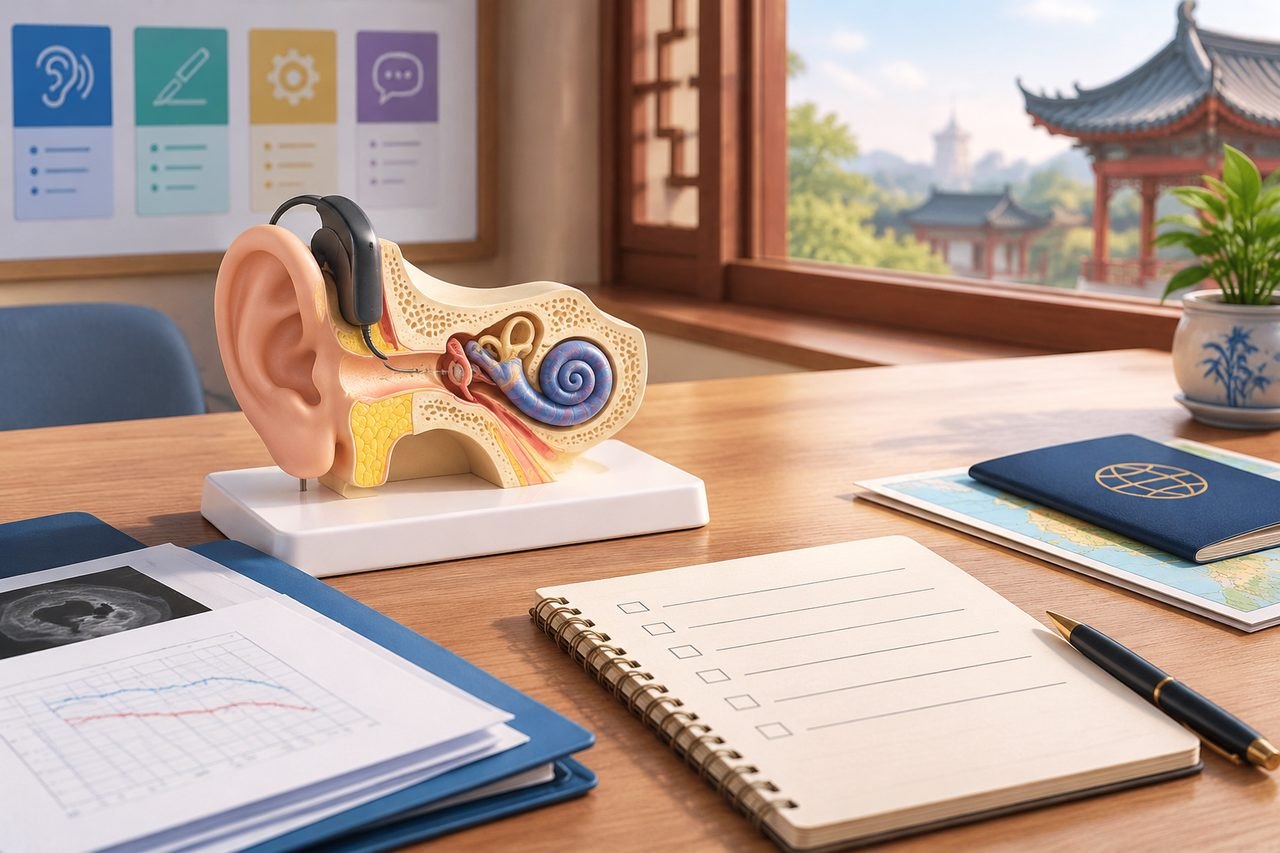
Bring the audiological history, not just the most recent audiogram. Clinicians want to see how hearing has changed over time, which hearing aids or other devices you have used, and how you have responded to them. If you have tried hearing aids and they did not help sufficiently, the details of that trial matter: which devices, for how long, fitted by whom, and what was measured.
Imaging is often part of the assessment, but the exact scan and its timing are clinical decisions. Ask the receiving team what they require rather than assuming a scan you already have will be accepted. If you have existing imaging, bring the images themselves and the report, not only the report.
Also bring a plain list of your current medicines, allergies, other diagnoses and any previous ear surgery. If you use a hearing aid in one or both ears, note which. If you have any communication preference, such as lip-reading or sign language, say so early so the team can arrange interpretation.
A short written summary in English, with your main question at the top, is more useful than a thick folder with no index. Ask the team what format they prefer before you travel.
Questions about how assessment, surgery and programming fit across visits
This is the practical heart of the discussion. Cochlear implant care is not a single appointment. It normally involves assessment, a decision, surgery if appropriate, initial activation and programming, and then rehabilitation and further programming over time. How those stages are arranged across visits and countries is exactly what you need to clarify.
Ask the clinician to describe the sequence in their own service. Which stages must happen in China, and which could be done locally or remotely if the team supports that? How many in-person visits would the assessment itself require? If surgery is offered, what follow-up would the team expect before you could reasonably return home? Do not accept a vague answer; ask for it in writing.
Programming is a specific point to raise. Ask who would do the initial activation and subsequent adjustments, whether any of that can be done by a local audiologist in your country, and what information the China team would need from that local professional. If the team says remote or shared programming is possible, ask what equipment, software or local partner would be required, and what happens if that is not available.
Rehabilitation is equally important. Ask what rehabilitation the team recommends, who provides it, and whether it can be delivered in your home country. The answer will shape how long you might need to stay and how you plan the months after surgery.
Finally, ask what would make the team decide not to proceed. A clinician who can explain the limits of the assessment is giving you more useful information than one who only describes the best case.
Language, consent and who decides what
If you do not speak Mandarin, confirm before the appointment how interpretation will be arranged and who will provide it. A family member interpreting is not the same as a professional medical interpreter, particularly when consent and device counselling are involved. Ask whether the hospital can provide interpretation or whether you need to arrange it separately.
Consent discussions should happen before any sedation or procedure, when you are fully able to ask questions. Ask the clinician to explain the alternatives to implantation, the risks the team considers relevant in your case, and what the evidence suggests about likely benefit and uncertainty. You are entitled to ask for risk and outcome estimates; no estimate guarantees your individual result.
Clarify who is responsible for what. The hospital and its clinicians decide suitability, tests and treatment. A coordination service can help with records, appointment requests and interpretation, but it does not decide clinical questions. If you use a coordinator, agree in writing what they will and will not do.
Ask for the plan in writing before you leave, including the next appointment, the tests still needed and who will contact whom.
Practical preparation before you travel
Confirm the appointment itself before booking travel. A provisional clinical stage is not a confirmed appointment. Ask the hospital or your coordinator for written confirmation of the date, the department, the clinician's name if available, and what you should bring.
Ask what payment is expected at the visit and how it is made. Hospital consultation fees, tests and any treatment are paid to the hospital or provider. Coordination fees are separate. Ask the named provider how its written estimate works and what it includes, excludes or leaves undecided; do not rely on a general assumption about billing.
Plan for communication and daily needs. If you use hearing aids, bring spare batteries and any charging equipment. Bring copies of key records in both paper and digital form. If you need a companion, confirm whether the hospital allows them into the consultation.
Do not delay necessary local care because you are planning an overseas enquiry. If your hearing changes suddenly, or you develop new symptoms such as severe dizziness, facial weakness or ear pain, seek local medical assessment first.
What to do next
Before the in-person discussion, write down your three most important questions and bring them on one page. Typical ones are: what tests do you still need from me; how would assessment, surgery, programming and rehabilitation be arranged across visits; and what would make you decide not to proceed. Add any question specific to your own hearing history.
If you would like help organising records, requesting a specialist appointment or arranging interpretation for the visit, ChinaSpecialistCare can assist with those non-clinical coordination steps. An initial enquiry is free and does not require buying a proxy consultation. The hospital decides suitability and treatment.
Send a brief summary first: your main question, your hearing history in a few lines, and the records you already have. The team will tell you what is missing and what the relevant next step is.
Sources & scope of this guide
References and official service information relevant to this guide.
This is general planning information and has not been individually reviewed by a doctor. Medical decisions and personal treatment advice come from your treating clinicians.