Why hearing evaluation comes before any implant decision
A cochlear implant is not chosen from a diagnosis label alone. The NHS explains that implants are considered for some severe permanent hearing loss when hearing aids do not help sufficiently, and that the system includes external and surgically implanted components. That description already tells you what the evaluation must establish: the type and degree of hearing loss, whether a hearing aid trial has provided enough benefit, and whether the auditory pathway can support electrical stimulation.
For an overseas patient, the practical consequence is that the hospital needs evidence, not a summary. An audiogram from two years ago, a report that says 'profound hearing loss' without thresholds, or a scan performed for another purpose may not answer the questions the implant team asks. The evaluation is also where the team decides which ear to consider, whether one or two implants are discussed, and what realistic listening goals might be.
This is why hearing evaluation is not an administrative hurdle before the 'real' treatment. It is the assessment that determines whether implantation is appropriate at all, and it shapes the device choice, the surgical plan and the rehabilitation programme that follows.
What the evaluation actually measures
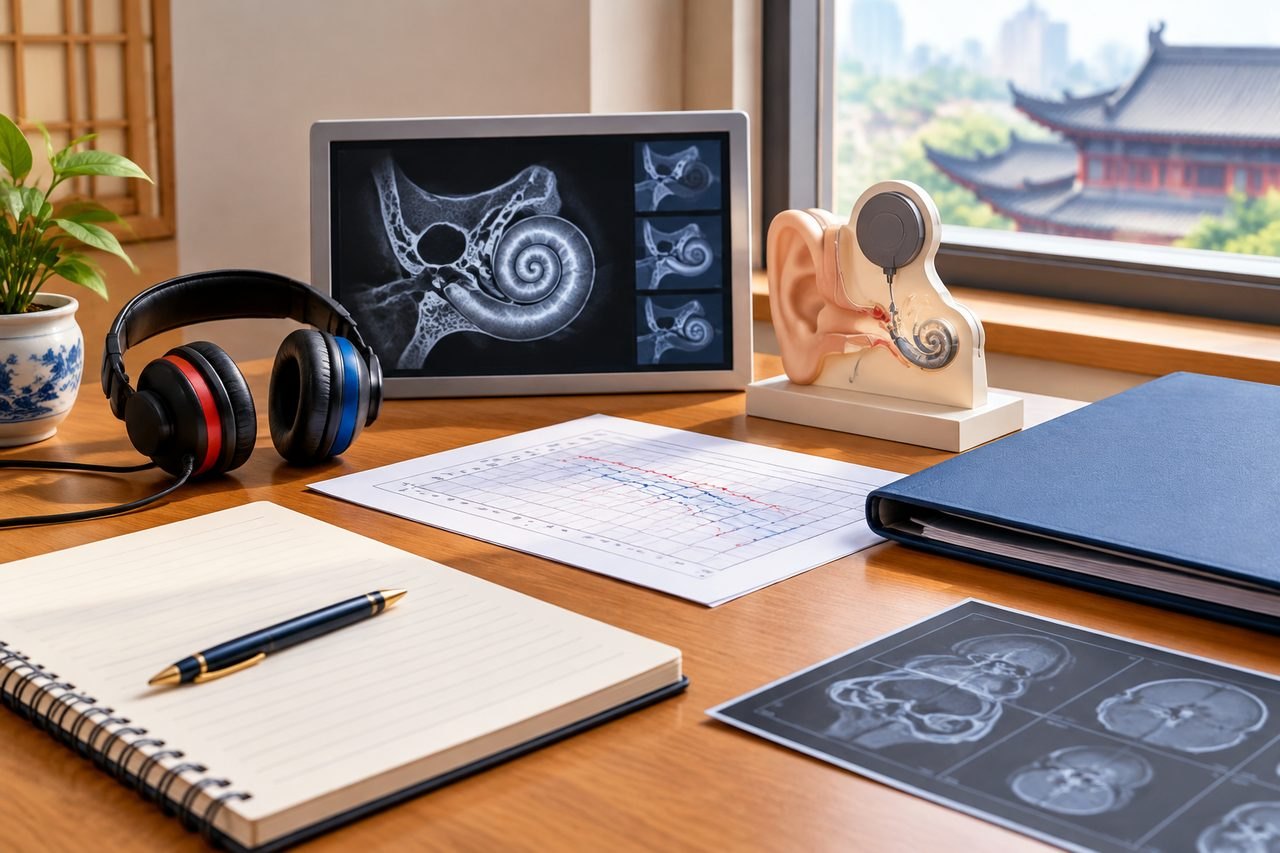
A cochlear implant assessment typically combines several types of information. Pure-tone audiometry maps hearing thresholds across frequencies. Speech audiometry shows how well you understand words with and without amplification, which is often more informative than thresholds alone. Tympanometry and acoustic reflex testing give information about the middle ear and eardrum. Otoacoustic emissions and auditory brainstem response testing may be used when behavioural testing is limited or when the team needs objective information.
Imaging is usually part of the workup. A CT scan of the temporal bone and an MRI of the inner ear and auditory nerve can show anatomical features that affect electrode choice or surgical approach. The exact imaging requested depends on your history, age and the hospital's protocol, so the receiving team should specify what it needs rather than you assuming a standard list.
Hearing aid benefit is a separate question. Many programmes ask for evidence of a recent, well-fitted hearing aid trial before considering implantation, because the comparison between aided and unaided performance helps predict whether an implant is likely to add meaningful benefit. If you have not had a recent trial, ask whether the hospital requires one and how it should be documented.
Balance testing, vestibular assessment and, in some cases, genetic or neurological review may also be requested. These are not universal requirements. The point is to ask the named hospital what its assessment pathway includes for your situation, and to share existing records so the team can tell you what is missing.
Records that make the evaluation useful
The most useful file is one that lets the implant team see change over time and understand what has already been tried. Rather than sending everything, organise the records around the questions the team will ask.
A practical record set usually includes recent audiograms with thresholds and speech scores, hearing aid fitting records and trial notes, any imaging reports and the actual images if available, operative notes from previous ear surgery, and a short timeline of when hearing changed and what interventions followed. If you have reports in another language, ask the hospital whether it needs certified translation or whether a clear summary is acceptable.
It also helps to write down your own priorities. Do you want to understand speech in quiet, on the phone, in groups, or to hear environmental sounds? Do you have one ear that is more useful than the other? These details influence the discussion and are difficult to reconstruct from test results alone.
Do not send passport numbers, payment details or a complete medical archive in a first enquiry. A brief summary with the main diagnosis, the question you want answered and the records you can provide is enough for the team to suggest the next step.
How surgery, programming and rehabilitation fit across visits
Cochlear implantation is not a single appointment. It involves assessment, surgery, initial device activation and a series of programming sessions, often with rehabilitation support. How those stages are spaced depends on the hospital, the device, your healing and your response to stimulation. No responsible guide can give you a fixed number of visits or a guaranteed timeline.
For an overseas patient, the key planning question is which stages must happen in China and which can be continued at home. Surgery and initial activation are usually tied to the implanting centre. Later programming and rehabilitation may be possible with a local audiologist, but this depends on the device brand, the availability of compatible software and the willingness of the local clinic to take on follow-up. Ask the Chinese hospital directly what it can provide remotely and what it recommends for follow-up in your country.
It is also worth asking how the hospital handles programming if you return home between sessions. Some centres provide a written schedule and coordinate with local professionals; others expect you to remain in China for a defined period. The answer affects travel planning, accommodation and how much time you need to set aside.
Rehabilitation is not optional after implantation. The brain needs time and practice to interpret new signals. Ask what rehabilitation the hospital offers, whether it is individual or group-based, whether it is available in English, and what home practice is recommended. These questions belong in the same conversation as the surgical plan.
Questions to ask the implant team before you commit
The evaluation is also your opportunity to test whether the hospital's approach fits your circumstances. Prepare a short list of questions and ask them in writing if possible, so you have a record of the answers.
Ask which tests are required before a decision, whether any can be done in your home country and how the results should be sent. Ask who reviews the file and how the team communicates its conclusion. Ask what device options are available and how the choice is made. Ask what the surgical plan involves, what the expected hospital stay is, and what complications the team will discuss with you.
On the follow-up side, ask how many programming sessions are typically needed, whether they can be combined with the initial trip, and what happens if you need adjustments after returning home. Ask whether the hospital provides a written rehabilitation plan and whether it can liaise with a local audiologist.
Finally, ask for a written outline of what the hospital's estimate includes and what remains uncertain. Costs, device availability and scheduling are hospital-specific. A clear written scope is more useful than a verbal figure, and it lets you compare options without assuming that one hospital's practice applies to another.
Turning the evaluation into a practical plan
ChinaSpecialistCare is a non-clinical coordination service. We can help you organise records, identify a relevant hospital or specialist team, prepare questions and arrange practical support such as interpretation and hospital navigation. We do not diagnose, decide suitability or perform the hearing evaluation. The treating hospital and its licensed clinicians make those decisions.
If you are considering cochlear implantation in China, the useful first step is a brief enquiry with your main question and a summary of your hearing history. Our team can review what you have, point out missing information and suggest a relevant next step. An initial enquiry is free and does not require buying a proxy consultation. If a records-based specialist opinion would help before travel, that can be discussed separately, but it is optional.
For clinical background on cochlear implantation, the NHS page on hearing aids and implants is a reliable starting point. For the procedure itself, see our cochlear implantation reference. The hospital decides whether implantation is appropriate for you, and the evaluation is how that decision is reached.
Sources & scope of this guide
References and official service information relevant to this guide.
This is general planning information and has not been individually reviewed by a doctor. Medical decisions and personal treatment advice come from your treating clinicians.