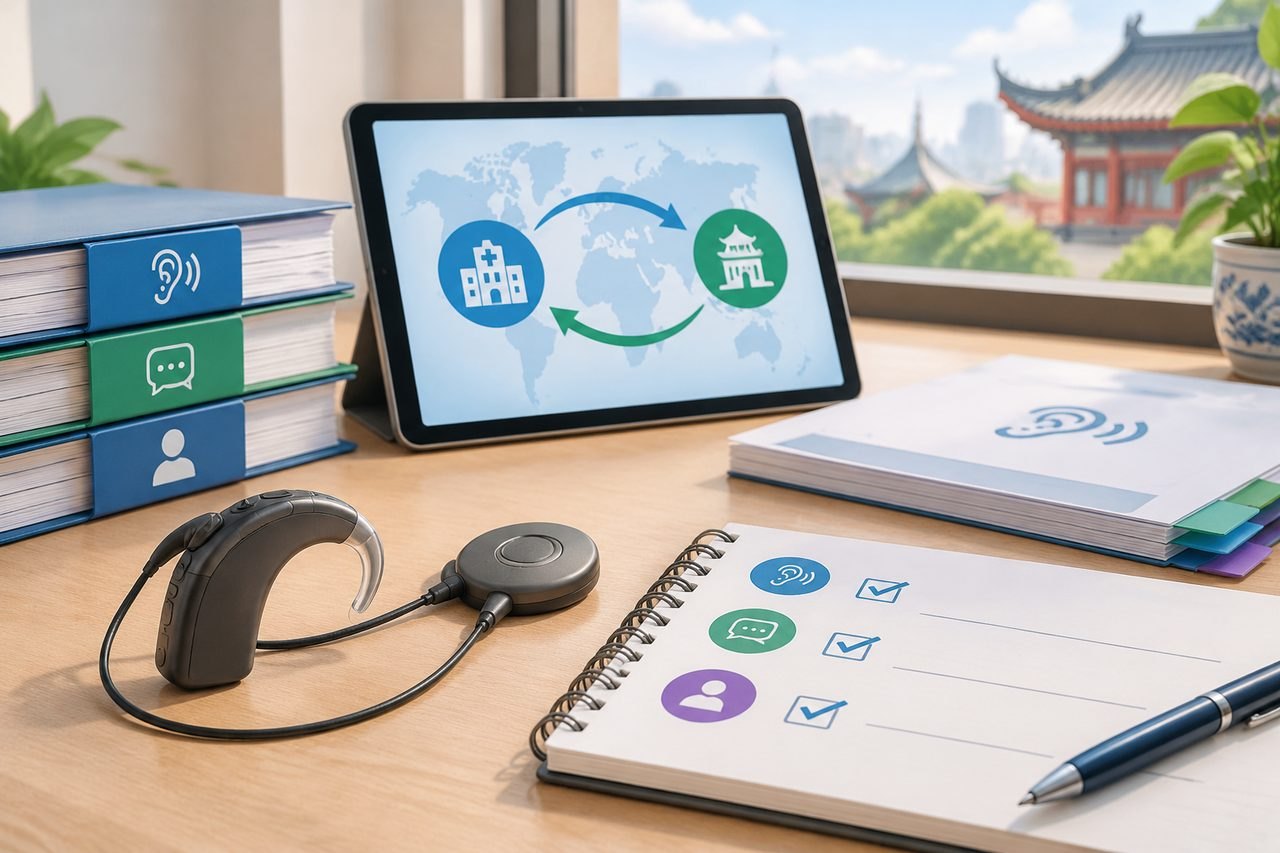
What the two teams actually need to exchange
A cochlear implant decision is not made from a single audiogram. The China team needs to understand your hearing history, how you currently communicate, what hearing aids you have tried and how consistently you have used them, and what your home clinicians have already concluded. Your home team needs to understand what the China team is proposing, on what evidence, and what would happen after you return.
The practical exchange is therefore two-directional. From home to China: audiology reports, hearing aid fitting and trial records, imaging if it exists, speech and language assessment where relevant, and a short summary of your main communication difficulty. From China to home: the assessment plan, the questions the team still needs answered, and the proposed sequence of evaluation, surgery if appropriate, and device programming.
Cochlear implants are considered for some severe permanent hearing loss when hearing aids do not help sufficiently, and they include external and surgically implanted components. That general description is not a candidacy decision. Only the assessing implant team can judge whether the profile fits, and your home clinicians may hold information that changes that judgement.
Write the question list before you send the file
Records alone rarely produce a useful reply. A file without questions tends to come back as a general acknowledgement. A short, specific question list is what makes the two teams respond to each other rather than to you.
For the China team, the questions are usually: what additional testing would you want before deciding on candidacy; which ear or ears would you assess; what device options would you consider and why; how would the evaluation, surgery if appropriate, and initial programming be spaced across visits; and what would you need from my home team before and after any procedure.
For your home team, the questions are usually: are there local options we have not yet explored; what would you need to see from a China assessment to continue care here; who would take responsibility for programming and rehabilitation after I return; and what would you want the China team to send back.
Keep the list to a page. Number the questions so each reply can be matched to a question. Ask both teams to answer in writing where possible, because a written reply is easier to pass between clinicians than a verbal summary.
Who owns which part of the plan
The gap that causes the most trouble is not missing records but unclear responsibility. Before travel, establish which team owns the candidacy assessment, which team owns the surgical decision if an implant is considered appropriate, which team owns device selection, and which team owns programming and rehabilitation after the initial period.
Programming is the part that needs a clear answer before you travel. Initial activation and early mapping sessions happen close to the surgical team, but long-term programming and rehabilitation need to continue where you live. Ask the China team what it would hand over, in what format, and to whom. Ask your home team whether it is willing and able to take that on, and what it would need to receive.
Do not assume the two teams will contact each other automatically. In many cases the patient or a coordinator carries the documents and the questions between them. If you want direct clinician-to-clinician contact, ask both sides whether that is possible and what they would need to make it happen.
How visits and countries fit together
Ask the China team how hearing assessment, any surgical stage, and programming visits would be distributed across a stay, and whether any part could be done remotely or locally. Do not accept a generic timeline. The answer depends on your assessment findings, the device pathway, and the team's own follow-up arrangements.
Ask your home team the mirror question: what could be done locally before you travel, and what could be done locally after you return. Some pre-travel testing may be available at home and could reduce what needs to be repeated. Some post-travel programming may be available locally, which changes how long you would need to stay.
If the two answers do not fit together, that is useful information before you book anything. It may mean a shorter or longer stay, a different sequence, or a decision to complete more of the pathway at home.
What to confirm in writing before committing
Before you commit to travel, ask the China provider for a written outline of what the assessment includes, what the proposed stages are, and what would be decided at each stage. Ask how its written estimate is structured and what it covers, rather than assuming a standard format.
Ask your home team for a written note of what it can and cannot provide after you return, including programming, rehabilitation and device support. Ask whether it needs any specific document from China to continue care.
Confirm who your named contact is on each side, and what response time each side expects. A named contact prevents the file from sitting unanswered while you wait.
If any answer is provisional, treat it as provisional. A records-based opinion does not establish candidacy, surgical suitability, device availability or a confirmed appointment. Those are decisions for the assessing team and the hospital.
- Ask the China team: what records do you still need, and what would change your assessment?
- Ask your home team: what would you need from China to continue my care here?
- Ask both: who is responsible for programming and rehabilitation after the initial period?
- Ask both: who is the named contact, and what response time is realistic?
Clinical background and planning scope
The general description of cochlear implants used here comes from the NHS page on hearing aids and implants. It does not establish Chinese access, eligibility, scheduling, fees or hospital requirements. Those must be confirmed with the specific provider and your own clinicians.
A handover that works has a recognisable shape. One clinician on each side knows the case by name. Each side has received the same summary of your hearing history and the same numbered question list. Each side has said, in writing, what it will and will not take responsibility for. And there is a date by which the next reply is expected, so the file does not sit unanswered while you decide whether to travel.
The most useful thing you can do before any of that is to write the summary yourself. Two paragraphs are enough: how your hearing changed, what you currently use to communicate, what hearing aids you have tried and how consistently you have used them, and what your main difficulty is now. Send the same text to both teams. A shared starting point stops the two sides from working from different versions of your history.
Then attach the numbered questions. Ask the China team what records it still needs and what would change its assessment. Ask your home team what it would need from China to continue your care locally, and whether it is willing to take on programming and rehabilitation after the initial period. Ask both who the named contact is and what response time is realistic.
If you want help carrying records and questions between your home team and a China implant team, ChinaSpecialistCare can request a specialist appointment and provide interpretation and practical coordination. This is non-clinical support. The hospital and its clinicians decide suitability, and an initial enquiry is free and does not require buying a proxy consultation.
A useful first step is to write your one-page question list for each side, then send a short summary of your hearing history and main question. The team can identify what is missing and suggest the relevant next step.
Sources & scope of this guide
References and official service information relevant to this guide.
This is general planning information and has not been individually reviewed by a doctor. Medical decisions and personal treatment advice come from your treating clinicians.