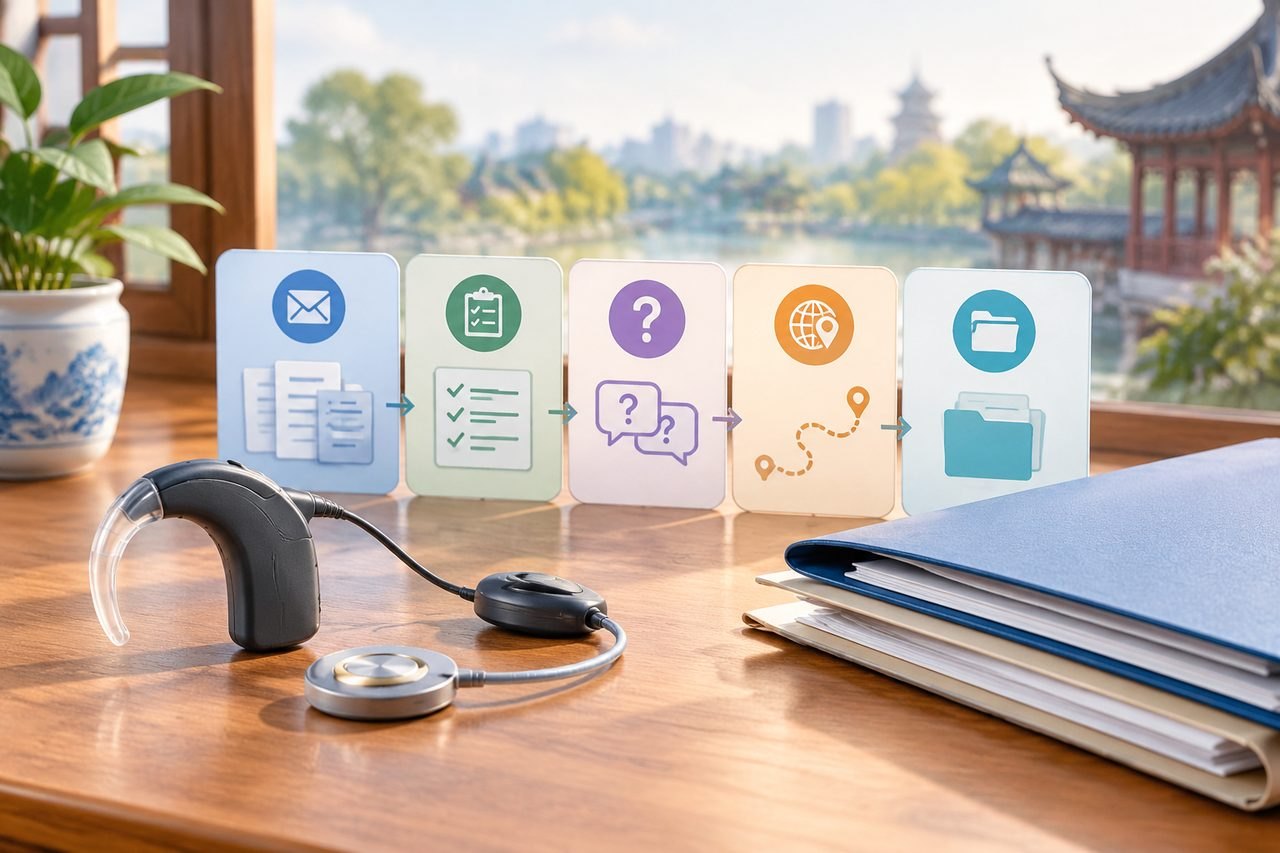
Three different replies that look almost identical
Overseas patients often receive a short message after sending audiology reports, imaging and a summary of hearing history. The wording matters because three very different situations can produce a similar reply.
The first is receipt. Someone has logged your file. No clinician has reviewed it. The second is a request for more information: a staff member has noticed that a specific document is absent or unreadable, but this is an administrative check rather than a clinical judgement. The third is a formal assessment, where a clinician has reviewed the records and given an opinion about whether cochlear implantation is worth pursuing and what would need to happen next.
Only the third stage tells you anything about suitability. A receipt message tells you the file arrived. A missing-document request tells you the file is incomplete. Neither is a decision, and neither should be treated as a green light to book travel.
This distinction matters more for cochlear implants than for many procedures because the decision is not a single yes-or-no. It involves hearing assessment, imaging of the inner ear, a review of how hearing aids have performed, and a conversation about what the patient expects. A hospital cannot complete that work from a partial file, and a coordinator cannot complete it at all.
What a formal assessment actually requires
Cochlear implants are considered for some severe permanent hearing loss when hearing aids do not help sufficiently. The device has external and surgically implanted components. That description explains the intervention, but it does not tell you which patients a particular hospital will accept or how it organises its own assessment pathway.
A treating team normally needs to understand the type and degree of hearing loss, how long it has been present, what hearing aids or other devices have been tried and with what result, and whether there are anatomical or medical factors that affect the options. Much of this comes from audiology testing and imaging performed close to the patient, not from a written summary alone.
The practical consequence is that a hospital may need tests repeated or extended in China before it can give a formal opinion. That is a question to ask directly: which assessments would be done locally, which existing records would be accepted, and which results the team would want to see before deciding.
Do not assume that sending a complete-looking file means the clinical stage has begun. Ask whether a named clinician has reviewed the records, and ask for the outcome of that review in writing.
Questions that turn a vague reply into a clear next step
The most useful response to a preliminary message is a short, specific set of questions. Keep it factual and easy to answer.
Ask which stage the file has reached: received, under administrative review, awaiting specific documents, or reviewed by a clinician. Ask what exactly is missing if anything is, and in what format it should be sent. Ask who will make the clinical decision and whether that decision will be communicated in writing.
Ask how the hospital would structure the pathway if implantation were considered appropriate. Hearing assessment, the surgical decision, device fitting and programming, and rehabilitation are not the same event, and they may not all happen in one visit or in one country. Ask how many visits the team would expect, what would happen at each, and whether any programming or follow-up could be done nearer home.
Ask what the hospital's written estimate would cover and what it would not. Ask whether the device, the surgery, the hospital stay, programming sessions and rehabilitation are each addressed in that document. If the reply does not answer a question, repeat it rather than filling the gap with an assumption.
- Which stage has my file reached, and has a clinician reviewed it?
- What specific documents or tests are still needed, and in what format?
- Who makes the clinical decision, and will it be confirmed in writing?
- How would assessment, surgery, programming and rehabilitation be spread across visits?
- What does the hospital's written estimate include and exclude?
Planning across countries without inventing a timeline
Cochlear implant care is not a single trip for most patients. Assessment, surgery, initial activation and subsequent programming sessions are separate stages, and rehabilitation continues afterwards. How those stages are distributed depends on the hospital, the patient's circumstances and the clinical findings.
That is why no responsible article can tell you how many trips you will need or how long each stage will take. Those are questions for the treating team, and the answers may change once the assessment is complete. What you can do is ask the hospital to describe its usual pathway in general terms, then ask how your own situation might differ.
It is also worth asking early whether any part of the follow-up could be delivered in your home country. Some patients coordinate programming or rehabilitation locally after surgery abroad, but this depends on the equipment, the expertise available and the willingness of both teams to share records. Ask the hospital what it would provide to support that arrangement, and ask your local clinic whether it would accept that role.
Do not book travel on the strength of a receipt message. Wait until you have a written clinical opinion and a clear description of what would happen on each visit.
Records worth preparing before you ask again
If the hospital has asked for more information, the fastest route forward is a clear, well-labelled set of documents rather than a large unorganised file. Ask the hospital what it wants before sending anything further.
In general terms, a hearing assessment file may include audiology reports, hearing aid trial information, imaging reports and any relevant medical history. The exact requirements vary, and the treating team should confirm what it needs. Do not order new tests on your own initiative; ask the hospital which tests it would require and whether results from your own country would be accepted.
Keep a simple record of what you have sent, when, and to whom. If a document is in another language, ask whether a translation is needed and who should provide it. If a report is unclear, ask whether a repeat or an additional view is required.
This is administrative work, but it directly affects how quickly the clinical stage can begin. A file that answers the team's questions is more useful than a file that is merely large.
Where ChinaSpecialistCare fits, and what it does not decide
ChinaSpecialistCare provides information and non-clinical coordination. For a cochlear implant enquiry, that can include helping you organise records, requesting a specialist appointment, and arranging interpretation during hospital visits. These are practical services; they do not include deciding whether implantation is appropriate, prescribing, or promising that a hospital will accept you.
If you would like help interpreting a hospital's reply or preparing a clearer follow-up, you can start with a brief summary through the enquiry form. An initial enquiry is free, and it does not require buying a proxy consultation. The hospital remains responsible for suitability and for the clinical plan.
The relevant procedure reference on this site is Cochlear Implants, which you can read alongside this article for background on the procedure itself.
A useful next step is to send the hospital one short message asking which stage your file has reached, what is missing, and when you can expect a written clinical opinion. If you would like support preparing that message or the records that follow it, contact ChinaSpecialistCare with a brief summary of your situation.
Sources & scope of this guide
References and official service information relevant to this guide.
This is general planning information and has not been individually reviewed by a doctor. Medical decisions and personal treatment advice come from your treating clinicians.