
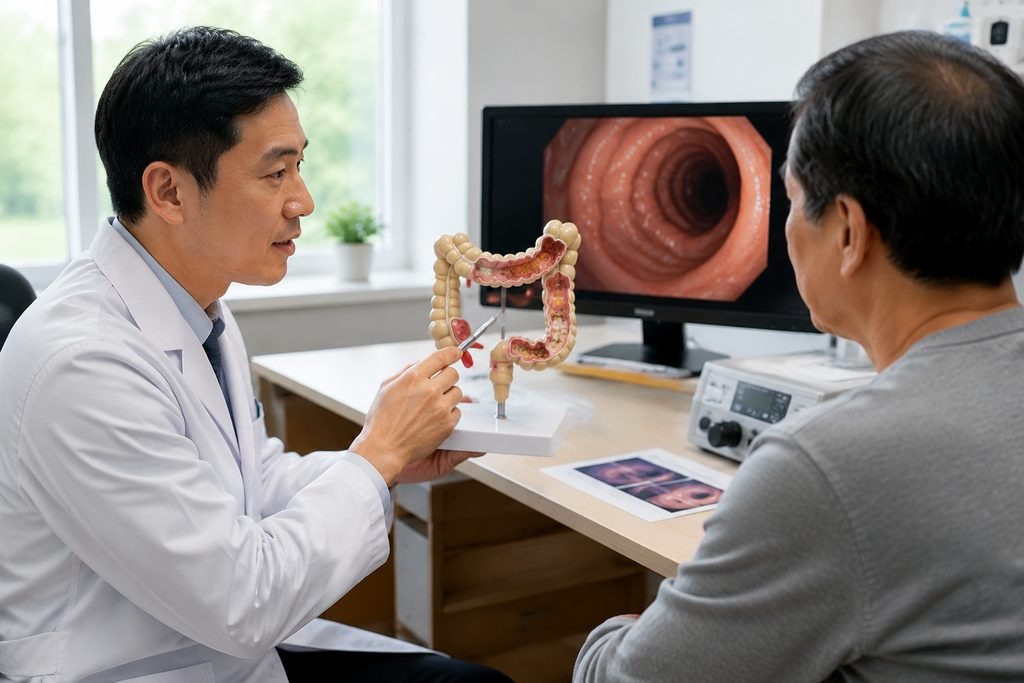
Start with the exact question, not the whole file
Most failed exchanges between an overseas patient and a hospital in China do not fail because a document is missing. They fail because nobody agreed what question the documents are meant to answer. Before any file moves, write one or two sentences that state the decision you are trying to make. For a colonoscopy enquiry, that might be: whether the records you already hold are sufficient for a specialist appointment request, or what additional information the receiving clinician wants before forming a view.
That single sentence changes what you send. If the question is about appointment planning, the receiving team may only need a short summary and the key report from your home clinician. If the question is about whether a records-based opinion is possible, the team may want the full procedure report, the histology report if one exists, and the imaging or laboratory results that the home team considers relevant. You do not decide that alone, and neither does a coordinator. The receiving clinician decides what is clinically relevant, and you ask them to state it in writing.
Keep the first contact small. A brief summary of the main concern, the date of any previous procedure, and the reports you can provide is enough to start. The detailed archive comes after the receiving team tells you what it wants. This protects your privacy and avoids sending documents that will not be read.
Name one responsible person on each side
An exchange works when two named people own it. On your home side, that is often the clinician who performed or ordered the procedure, or a practice nurse who holds the file. On the China side, it is the person who will actually receive and act on the records, not a general inbox. Ask both sides for a name, a role and a direct contact route, and write those details into your own notes.
Then agree what each person will do. The home contact sends the records and answers clinical questions about them. The China contact confirms receipt, states what is still missing, and says who will review the file. If either side cannot answer a question, they should say so rather than guess. A clear 'we do not have this' is more useful than a partial document that looks complete.
This matters because records move between systems with different formats, languages and identifiers. A report that is obvious to your home clinician may be ambiguous to a reader in China. Naming responsibility means someone can be asked to clarify, rather than the file sitting unread.
Use document identifiers so nothing is confused
Ask your home team to list every document it sends, with the date of the procedure or test, the type of report, and any local reference number. A simple numbered list is enough. The receiving team can then confirm item by item what arrived and what it still needs. Without that list, two reports from different dates can be mistaken for each other, and a follow-up question can be answered against the wrong document.
Translation is a separate decision. Ask the receiving hospital whether it needs a certified translation, a summary in English, or the original report with a working translation for discussion. Do not assume a rule. Different hospitals and different departments may handle this differently, and the answer should come from the team that will read the file. If a translation is needed, ask who is responsible for arranging it and who checks it for accuracy.
Keep the original documents. Send copies unless a specific person asks for originals, and record what you sent, to whom, and on what date. If a document is later questioned, that log is the fastest way to resolve it.
Ask for the receiving team's written scope
Before you commit to travel or to any coordination arrangement, ask the China hospital in writing what its reply will cover. A useful reply states which records were reviewed, what question was answered, what remains uncertain, and what the team recommends as the next step. It should also say what the reply is not: for example, whether it is a records-based opinion rather than a confirmed plan of care, and whether any further assessment would be needed in person.
Ask who signs that reply and what their role is. A response from a named clinician carries different weight from an administrative acknowledgement, and you should know which one you have. If the reply is preliminary, ask what would make it final and what information is still outstanding.
This is also where you clarify the boundary between coordination and clinical decisions. A coordination service can help organise records, request an appointment, and interpret communication. It does not decide suitability, prescribe treatment, or promise that a hospital will accept a case. Those decisions belong to the treating hospital and its licensed clinicians. Ask the hospital directly, in writing, about anything clinical.
Send questions the home team can actually answer
Your home clinician knows your history better than anyone reading a file in China. Use that. Ask the home team to write a short clinical summary that states the reason the procedure was done, what was found, what was recommended at the time, and any open question. That summary is often more useful to a receiving clinician than a folder of raw reports.
Then prepare a short list of questions for the China side, and keep it specific. Examples include: which documents do you need before you can review this; who will review them; what will your reply cover; and what would you need to assess in person. Avoid questions that ask for a diagnosis or a treatment decision from a distance. Those cannot be answered responsibly without the full clinical picture, and a good team will tell you so.
If your home team and the China team disagree, do not try to resolve it yourself by forwarding messages. Ask each side to state its reasoning in writing, and share those statements with the other. The disagreement itself is useful information, and it belongs in the record.
Keep the exchange moving and know when to stop
Set a simple rhythm. After you send records, ask for confirmation of receipt. After confirmation, ask what is missing. After the review, ask for the written reply and the next step. Each message should end with a clear question and a named person expected to answer it. This is not about chasing; it is about making the handover visible so that nothing depends on memory.
Know the limits. If a question is clinical, it goes to the treating clinician. If it concerns customs, medicines crossing a border, or what a pharmacy can dispense, those decisions belong to the relevant authority or licensed professional, not to a coordinator and not to your home team. If the question concerns payment, ask the specific provider what its written quote includes, what it excludes, and what is still undecided. Coordination fees and hospital medical fees are separate, and no coordination fee is credited, deducted or offset against later hospital treatment.
If your symptoms worsen or become urgent, seek local care first. An overseas enquiry should not delay assessment that you need now. Once you are stable, the record exchange can continue.
For a colonoscopy enquiry in China, the practical next step is to send a short summary through the enquiry form, email or WhatsApp, and ask which records the receiving team wants before it can respond. An initial enquiry is free and does not require buying a proxy consultation. The hospital decides whether it can accept the case and what further assessment is needed.
Sources & scope of this guide
References and official service information relevant to this guide.
This is general planning information and has not been individually reviewed by a doctor. Medical decisions and personal treatment advice come from your treating clinicians.