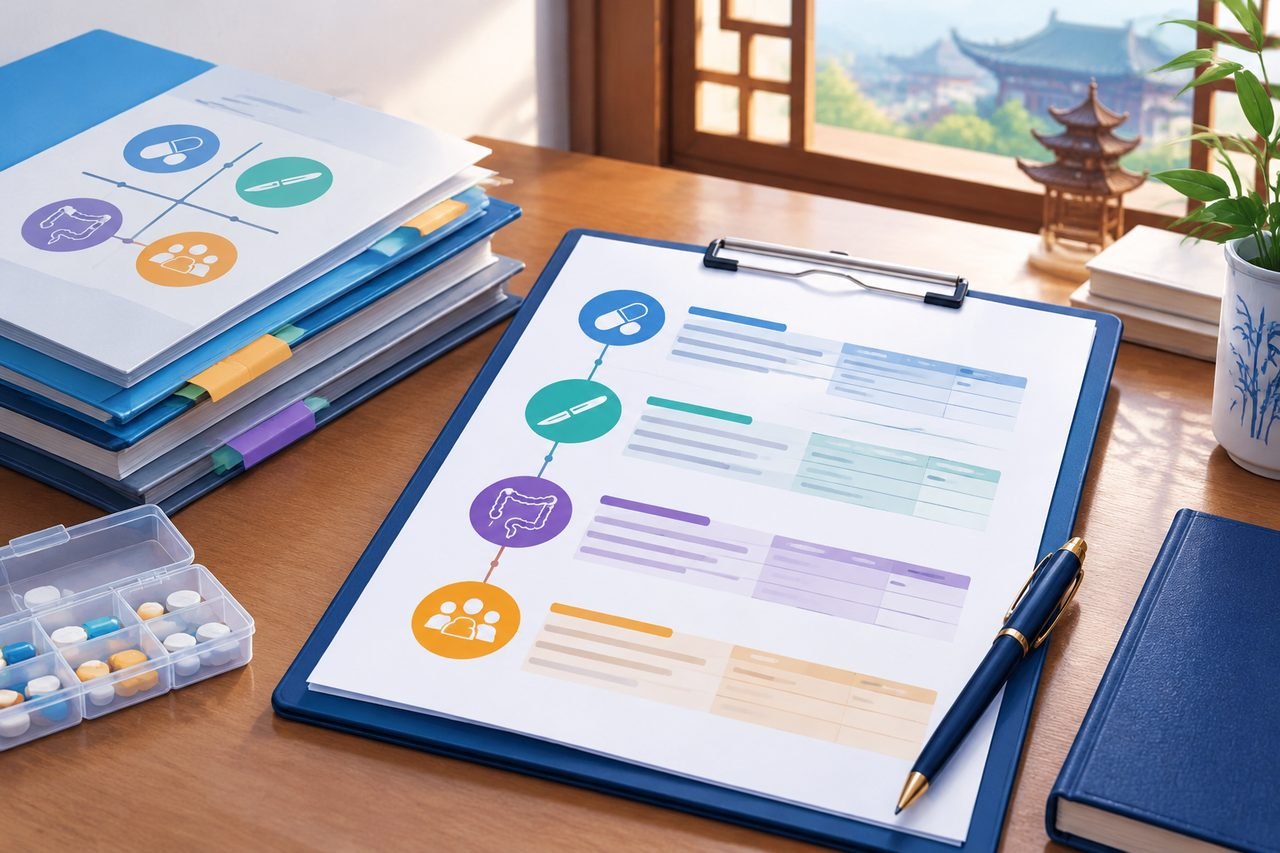
Why a medicine and surgery history is the document that matters
A Chinese gastroenterology or colorectal team reading an overseas Crohn's disease file is not trying to reconstruct your whole illness. It is trying to answer a narrower question: what has already been tried, what happened, and what remains. That is why a chronological medicine and surgery summary is more useful than a general letter describing years of symptoms.
Crohn's disease care can involve medicines or surgery, and the treating team selects an individual approach. That single sentence from the NIDDK treatment overview is the reason your history matters so much: because the approach is individual, the specialist needs to see the specific sequence you have already followed. A generic statement such as "treated with biologics and then surgery" gives the team almost nothing to work with.
Think of the summary as a handover document, not a plea for treatment. It should let a clinician who has never met you understand your disease trajectory in a few minutes. Everything else — imaging, endoscopy reports, pathology — supports that summary rather than replacing it.
How to describe previous Crohn's medicines without prescribing
You are not being asked to recommend a medicine or to justify your past treatment. You are recording what was given and what happened. For each medicine, the useful fields are the name, the approximate start and stop dates, the reason it was started, the response you observed, and the reason it was stopped or changed. If you do not know the reason, write "reason not recorded" rather than guessing.
Two distinctions change how a specialist reads the list. First, whether a medicine was stopped because it was not working, because of an adverse effect, or because of cost or access. Second, whether you are currently taking it. A medicine stopped for intolerance tells a different story from one stopped for lack of response, and a current medicine is part of your present safety picture.
Do not adjust, stop or restart any medicine in order to prepare a file. If you are unsure what you are taking, ask your current prescriber or pharmacist for a current medication list and send that. A Chinese hospital will form its own view of suitability; your job is accuracy, not persuasion.
If you have received medicines through a clinical trial or a named access programme, say so plainly and note that the records may sit with the trial site rather than your local clinic. That is a records question, not a treatment claim.
Describing previous Crohn's surgery and its result
Surgical history is where an overseas file can be hardest to assemble, because the operation note and the discharge summary may sit with different departments or different hospitals. For each operation, the specialist wants the date, the hospital, the procedure performed, the reason it was performed, the findings, and what the current anatomy is. The last point matters most: whether you have a stoma, what type, whether it is temporary or intended to be permanent, and whether any bowel has been removed.
The result of surgery is not only the operative report. It is also what happened afterwards — whether symptoms improved, whether the disease returned, and what surveillance or treatment followed. If a follow-up endoscopy or imaging study was done after the operation, include that report, because it shows the team the postoperative baseline rather than only the operation itself.
If you do not have the operative note, do not attempt to reconstruct it from memory. Ask the hospital where you had surgery for a copy, and if that is not possible, say clearly in your summary that the note is unavailable and describe only what you were told at the time. A clinician can work with a stated gap; a clinician cannot work with an invented detail.
Endoscopy and pathology: what the reports actually show
Endoscopy and pathology reports are the objective backbone of a Crohn's disease file. A specialist reading them wants the date, the centre, the extent and location of disease described, and the pathologist's conclusion. The images themselves are often less useful than the written report, because the report states what the endoscopist saw and where.
Pathology deserves separate attention. If biopsies were taken, the report should state the site of each biopsy and the diagnosis given. If a previous report was inconclusive or used different terminology, send it as it is rather than summarising it into a cleaner diagnosis. A Chinese pathologist or gastroenterologist may wish to review the slides or blocks directly, and that is a question to ask the receiving hospital rather than something to arrange on your own.
Keep the reports in their original language and add a short English or Chinese summary of the key findings if translation is available. Do not translate a diagnosis into a different one. If a term is unclear, mark it as unclear.
Ongoing care coordination and what to ask the receiving team
Crohn's disease is usually managed over years, so the practical question for an overseas patient is not only "what has happened" but "who is responsible now". Before you travel or send records, clarify with the receiving hospital how follow-up would be arranged, who would hold your file, and how your current treating clinician at home would be kept informed. These are administrative questions, and the answers differ between hospitals, so ask the specific provider rather than assuming a standard process.
It also helps to separate two different requests. One is a records-based opinion, where a specialist reviews your file while you remain at home. The other is an in-person assessment and any treatment planning that follows. They are not the same step, and a records review does not establish that a hospital will accept you for treatment or that any particular therapy is available.
When you contact a hospital or a coordination service, ask what the written scope of any review includes, who the payee is, and what is explicitly excluded or still undecided. Ask how the team would want your records formatted and whether they need original reports or accept copies. Do not assume that a consultation, a test or a medicine is bundled into one figure; ask for the written scope instead.
If your symptoms are worsening, that takes priority over planning an overseas enquiry. Seek local medical assessment first, and treat the China enquiry as a parallel administrative step rather than a reason to delay care.
A short administrative example of a usable summary
A workable summary is one page, not a diary. It can be organised under four headings: current status, medicines, surgery, and supporting reports. Under current status, state your diagnosis as given, the date it was confirmed, your main current symptoms, and your current treating clinician. Under medicines, list each drug with dates, response and reason for stopping. Under surgery, list each operation with date, procedure, findings and current anatomy. Under supporting reports, list the endoscopy, pathology and imaging reports you can send, with dates and centres.
This structure is deliberately administrative. It does not ask you to interpret your disease or propose treatment. It simply gives the receiving team the sequence it needs in order to decide what further information or assessment is appropriate.
If you would like help checking whether your summary and records are complete before you approach a hospital, ChinaSpecialistCare's editorial team can review the available diagnosis, records and your main question, identify missing information and suggest a relevant next step. That initial review is free and is not a diagnosis or a promise of acceptance. You can start with a short summary through the enquiry form, email or WhatsApp, and share fuller records only after first contact.
Sources & scope of this guide
References and official service information relevant to this guide.
This is general planning information and has not been individually reviewed by a doctor. Medical decisions and personal treatment advice come from your treating clinicians.