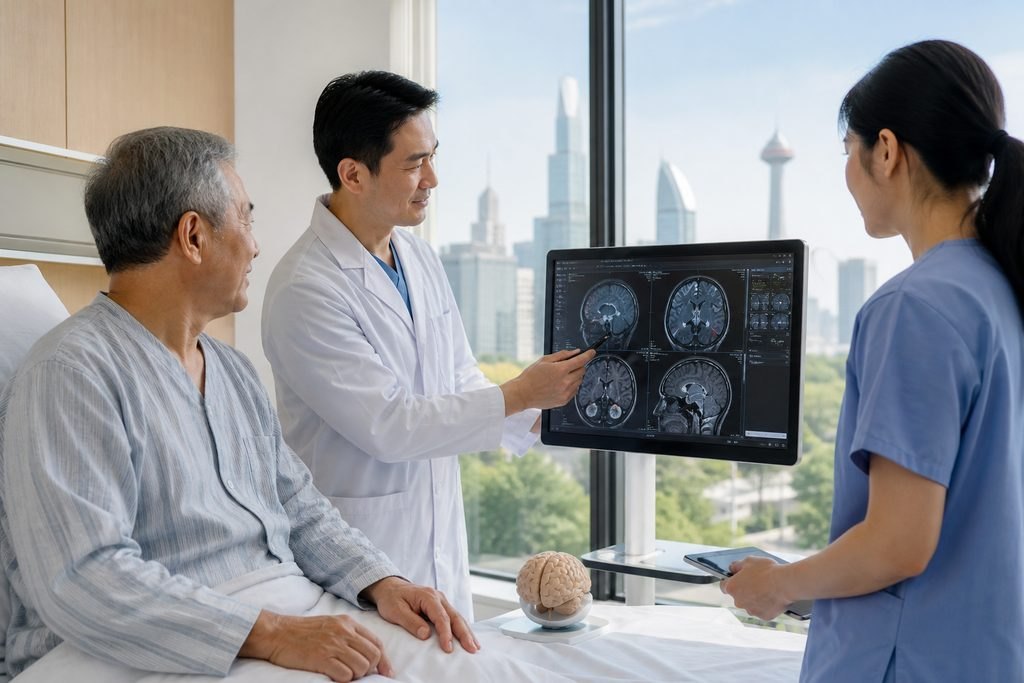
What your existing records can and cannot answer
Before anyone discusses electrodes or a pulse generator, the clinical team needs to understand the problem it is being asked to treat. Your existing records are the starting point for that. They can show the working diagnosis, how long the condition has been managed, which medicines have been tried and at what doses, what benefit or side effects followed, and what imaging or other tests have already been done. For a movement disorder such as Parkinson's disease, that history is not background paperwork; it is the evidence base for the first clinical question, which is whether a device-based treatment is even the right category of option.
What old records cannot do is answer the present question. A report from two years ago does not describe your symptoms this month. A scan done elsewhere may not be in a format the receiving team can review, or may not include the sequences that team wants. A letter summarising a consultation is not the same as the underlying test data. So the useful move is not to send everything you own, but to send a short summary first and then ask which specific documents the team wants in full.
This distinction matters because it changes what you prepare. If you assume old records settle suitability, you may arrive without the current clinical information the team needs. If you assume nothing old is useful, you may repeat tests unnecessarily or lose the timeline that shows why earlier treatments were stopped.
A practical way to organise this is to separate your file into three parts: the diagnosis and its history, the treatments already tried with their results, and the current problem in your own words. Ask the receiving team which of those three they want first. That question is more useful than sending a complete archive and hoping someone reads it.
What a new assessment is actually trying to decide
A new assessment for deep brain stimulation is not a single test with a pass or fail result. It is a structured clinical judgement about whether the likely benefit justifies the risks and the commitment for this particular person. Deep brain stimulation uses implanted electrodes and a pulse generator. It may help selected Parkinson's symptoms, but it does not cure the disease. That sentence contains the whole tension of the decision: the treatment can change symptoms, and it also introduces a device, a procedure and long-term follow-up into someone's life.
The assessment therefore has to answer several separate questions. Is the diagnosis correct and complete? Are the symptoms being targeted the kind that respond to stimulation? Have the available non-surgical options been used properly? Is there any reason this person should not have implanted hardware or undergo the procedure? What does the person actually expect from it, and are those expectations realistic?
These questions are not answered by any one scan or form. They are answered by a clinician who can examine you, review the record, and discuss trade-offs. That is why a records-based opinion and an in-person assessment are different products. A remote review can clarify whether travelling for assessment is worth considering. It cannot substitute for the examination and discussion that suitability depends on.
It also helps to be clear about what you are asking for. If your question is 'am I a candidate', the honest answer at the records stage is often 'this needs assessment'. If your question is 'what would assessment involve and what would it need from me', that can be answered much earlier, and it is the more useful question to bring to a first enquiry.
The device question: which system, and who decides
Deep brain stimulation is not one identical product. Different systems exist, and the choice interacts with the clinical target, the programming approach, the imaging used for planning, and what follow-up support is realistically available where you live. When a hospital proposes a device, the relevant questions are not only 'which brand' but 'why this one for me', 'what does the plan assume about programming', and 'what happens if it needs adjustment or replacement'.
This is also where overseas patients can lose clarity. A device may be available in the country where surgery happens but not be routinely supported in the country where you return. Programming is a specialist activity, and not every clinic at home will manage a system it did not implant. That is not a reason to avoid the conversation; it is a reason to have it before committing.
Ask the treating team to state, in writing, what they propose and what that proposal assumes. Specifically: which device, what the planned target is, how many programming sessions are anticipated in the initial period, what the patient or family is expected to do between sessions, and what the team can offer once you are no longer in China.
You should also ask your own neurologist or movement disorder specialist at home what they are willing to take on. Their answer is part of the decision, not an afterthought. If no local clinician will manage programming, that changes the practical picture considerably, and it is better to know before the procedure than after.
Programming and continuing care after you travel home
The surgery is the beginning of a long relationship with the device, not the end of treatment. After implantation, the system is adjusted over time. Settings that work well initially may need revision. Symptoms change. Medicines may change. Someone has to manage all of that.
For an overseas patient, the central practical question is: who will do this once I am home? There is no universal answer, and it is not something a coordination service can decide. It depends on the device, on the local clinic's experience, on whether the manufacturer provides support in your country, and on whether a clinician there is willing to take responsibility for a system implanted elsewhere.
So the questions to put to the treating team in China are concrete. What programming schedule do they propose for the first months? What information will they give you to hand to a clinician at home? Will they communicate with that clinician if questions arise? What is their policy if the device needs attention after you have left?
And the questions to put to your local team are equally concrete. Would you be willing to follow a patient with a device implanted abroad? What records would you need? What would you do if programming became difficult? A clear 'no' is useful information. So is a conditional 'yes, if I receive the operative and programming records'.
None of this guarantees that continuing care will be straightforward. It does mean you are making the decision with the follow-up picture visible rather than assumed.
What to prepare before asking for a review
You do not need to assemble a complete medical archive to start. A brief summary is enough for a first enquiry, and it lets the team tell you what else is relevant. What helps most at that stage is a short, clear account of the diagnosis, the main current problem, the treatments already tried, and the specific question you want answered.
If the enquiry moves forward, the team will usually want the underlying documents rather than your summary of them. That typically includes clinical letters, imaging reports and, where relevant, the images themselves, plus a medication list with doses and timing. Ask which format they need and whether translated documents are required. Do not send passport numbers, payment details or a full archive through a first contact form.
It is also worth writing down your own questions before any appointment. Patients often leave a consultation remembering the answer to the first question and forgetting the rest. A short list keeps the discussion on the decisions that matter to you.
One administrative note: if you are comparing routes, ask each provider what its written estimate or plan includes, what is excluded, and what remains undecided. Do not assume that a quoted figure covers the device, programming sessions, follow-up or travel. Those are questions for the named provider, and the answers belong in writing.
- Your working diagnosis and when it was made.
- The main symptom you want addressed now.
- Medicines tried, with doses, benefits and side effects.
- Imaging and tests already done, and where the originals are held.
- The specific question you want the review to answer.
- Whether a clinician at home would support follow-up.
Where this leaves the decision, and the next step
Old records and a new assessment answer different questions, and both are necessary. The records establish what has happened and what has already been tried. The assessment asks whether deep brain stimulation is suitable now, which device is proposed, and how programming and continuing care would work after travel. Neither step promises acceptance, and no outcome is guaranteed.
If you are considering care in China, the sensible first move is a short summary of your situation and your main question. An initial enquiry is free and does not commit you to anything, including a proxy consultation. The hospital decides suitability, and the treating clinicians decide what assessment you need.
You can start by describing your diagnosis, your current main symptom and what you want to know. From there, the relevant next step can be identified, whether that is gathering specific records, seeking a records-based opinion, or planning an in-person assessment.
Sources & scope of this guide
References and official service information relevant to this guide.
This is general planning information and has not been individually reviewed by a doctor. Medical decisions and personal treatment advice come from your treating clinicians.