Why a personal recommendation is not the right request
International patients often arrive at a first neurosurgical appointment hoping the specialist will simply say yes or no. That is not how a responsible assessment works. The treating team can explain what deep brain stimulation does, what it cannot do, what the evidence shows for a patient with your history, and what could go wrong. The decision to proceed remains yours, made with the information the team provides.
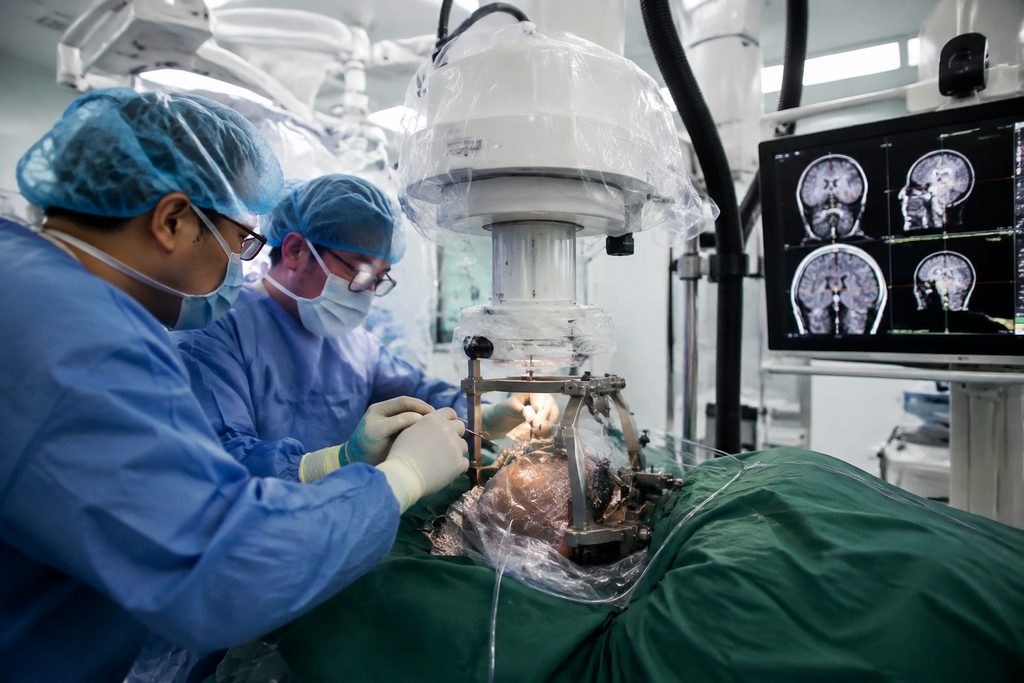
Deep brain stimulation uses implanted electrodes and a pulse generator. It may help selected Parkinson's symptoms, but it does not cure the disease. That single sentence already tells you why a clinician cannot promise a benefit: the therapy modifies symptoms in selected patients, and the selection itself is a clinical judgement based on your diagnosis, imaging, response to medication and overall health.
So the useful question is not "should I have this?" but "what exactly are you proposing, what are the risks in my case, what alternatives remain, and what happens after I leave China?" Those four questions are answerable. A vague reassurance is not.
This guide is about how to ask those questions clearly. It is not a statement that you are suitable for surgery, that an appointment is available, or that travelling to China for this procedure is appropriate for you.
Asking about risks without inviting a sales answer
Risk conversations go wrong when the patient asks a broad question and the clinician answers with general statistics. Ask instead about the risks that apply to you. A useful phrasing is: "For a patient with my diagnosis, my imaging findings and my other medical conditions, which risks are most relevant, and how would you monitor for them?"
You want the team to separate categories. Surgical risks relate to the operation itself. Device-related risks relate to the implanted hardware. Programming-related issues relate to how the stimulation is set and adjusted over time. Each category has its own questions, and lumping them together produces an answer that is hard to use.
Ask what would make the team stop or postpone the procedure. A team that can describe its own stopping criteria is giving you more information than one that only lists benefits. Ask what happens if the first programming session does not produce the expected response, and what the plan would be then.
Ask who will be responsible for each part of your care. In many settings the surgical team, the neurologist and the programming specialist are different people. Knowing who does what helps you understand where the risks sit and who to contact when something changes.
Do not accept a risk discussion that only covers the operation. The period after implantation, including programming and medication adjustment, is part of the treatment. If the team cannot describe that period clearly, that is itself important information.
What to ask about alternatives before agreeing to surgery
Alternatives are not only other operations. They include optimising medication, adjusting the timing or combination of existing drugs, physiotherapy, speech therapy, and other non-surgical approaches. Ask the team to explain what has already been tried in your case and what remains untried.
A useful question is: "If I decide not to proceed now, what would you recommend instead, and what would change your advice in the future?" This forces the conversation away from a binary choice and towards a plan. It also tells you whether the team sees surgery as the only option or as one option among several.
Ask whether any alternative could be tried first and reviewed. If the answer is that nothing else is likely to help, ask why. You are entitled to understand the reasoning, not just the conclusion.
Ask about the consequences of waiting. Some patients want to know whether delaying surgery for six or twelve months would meaningfully change their options. The team should be able to explain what would be monitored during that period and what would trigger a reassessment.
Ask whether a second opinion from another neurologist or neurosurgeon would be useful. A team confident in its recommendation will not object to you seeking one. This is not a sign of distrust; it is part of making a serious decision carefully.
Device scope: what is being implanted and why
Deep brain stimulation involves a specific device, not a generic category. Ask the team to name the system they propose, explain why that system is appropriate for you, and describe what the device can and cannot do. The general device arrangement involves electrodes connected to a pulse generator. Everything beyond that is a detail you should confirm with the team.
Ask whether the device is approved for your indication in China and whether it is available at the hospital where you would be treated. Availability is a hospital-specific question, not something you can assume from a general description of the therapy.
Ask about the programming arrangements. Who adjusts the settings, how often, and using what equipment? If you plan to return home after surgery, ask whether your local team would be able to program the device and whether the manufacturer provides support in your country. Do not assume compatibility; ask.
Ask what happens if the device needs revision, replacement or removal. Batteries have a finite life, and hardware can fail. Understanding the revision pathway before implantation is part of informed consent.
Ask for the written device information, including the model, the manufacturer and the warranty terms. You will need this for your records and for any future care outside China.
Programming and specialist care after you travel home
This is the question international patients can leave until too late. Deep brain stimulation is not a one-time intervention. After implantation, the device is programmed and adjusted over time, and that process can interact with medication changes. If you return home shortly after surgery, you need a clear plan for who will manage that process.
Ask the China team: "What programming schedule do you recommend for the first year, and how would that work if I am in another country?" Ask whether they can provide remote support, whether they can communicate with your local neurologist, and what records they would send.
Ask your local neurologist, before you travel, whether they are willing and able to take over programming and follow-up. Some centres have the equipment and expertise; others do not. Finding out after surgery is far more difficult than finding out beforehand.
Ask what would constitute an emergency related to the device and who you should contact. Ask for written instructions covering the period immediately after surgery and the first months at home.
Ask whether the team would require you to return to China for any planned programming visits. If so, understand the schedule and the practical implications before you commit. Do not assume that all follow-up can be done remotely.
Preparing records and questions for a China consultation
A productive consultation starts with a clear record. Bring your diagnosis and its history, your current medication list with doses and timing, imaging reports and the images themselves where possible, and any previous assessments by neurologists or neurosurgeons. If you have had a response to medication documented, include that; it is often relevant to the discussion.
Write your questions down before the appointment. A short list is more useful than a long one. Prioritise: what are the risks in my case, what alternatives remain, what device is proposed, and how would programming and follow-up work after I return home. Add any question specific to your situation.
Ask the team to put the key points in writing. A written summary of the proposed plan, the risks discussed and the follow-up arrangements is more reliable than your memory of a conversation, especially across a language barrier. If interpretation is needed, arrange it in advance.
Be clear about what you are and are not asking for. You are not asking the clinician to decide for you. You are asking for the information you need to decide. A team that respects that distinction will give you a more useful consultation.
If you want to understand the procedure itself before the appointment, the deep brain stimulation reference page describes the general approach. Use it to prepare questions, not as a substitute for an individual assessment.
A brief initial enquiry is free and can help identify what records are missing and what the next practical step would be. It does not commit you to treatment, and it does not replace the hospital's own suitability assessment.
Sources & scope of this guide
References and official service information relevant to this guide.
This is general planning information and has not been individually reviewed by a doctor. Medical decisions and personal treatment advice come from your treating clinicians.