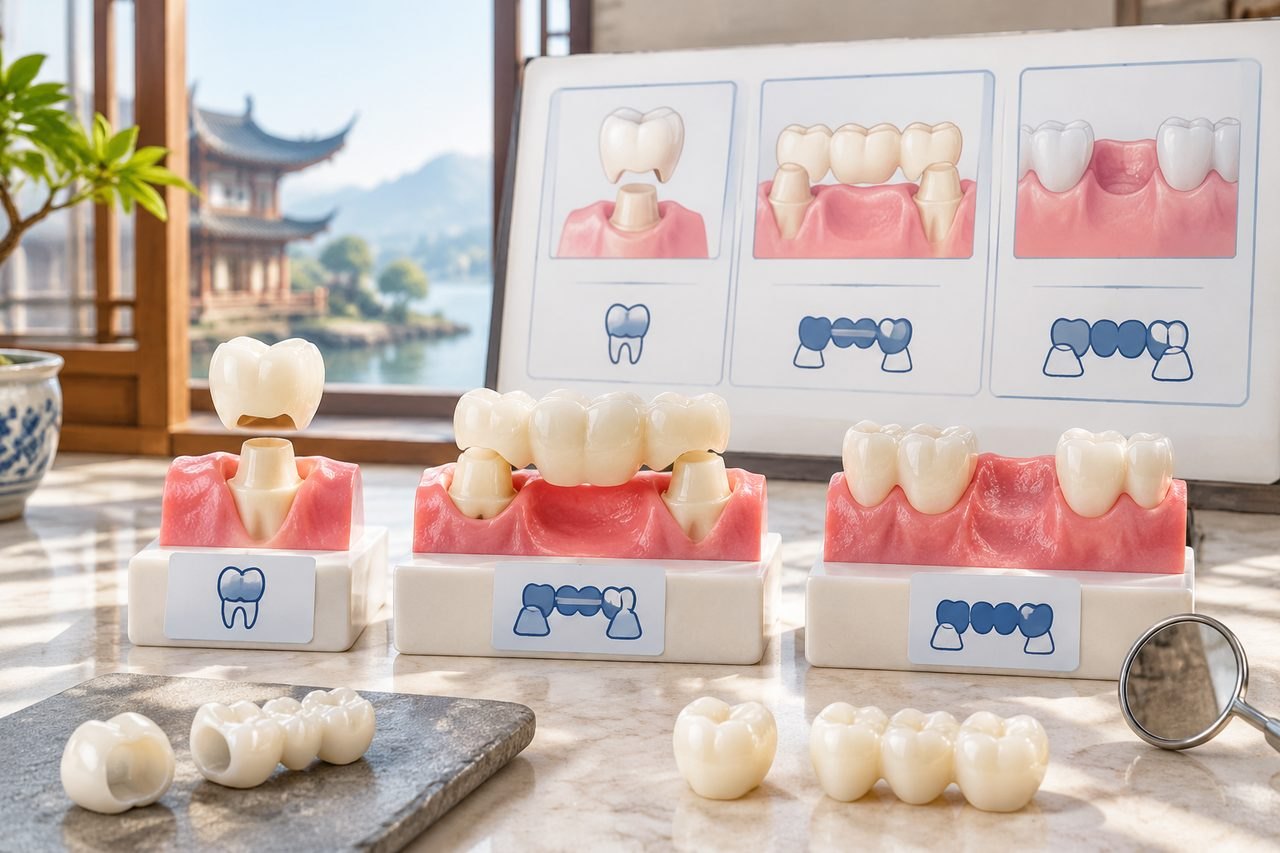
Why the teeth involved change the whole plan
A dental estimate for crowns and bridges is not a single item. It is a list of teeth and the work planned for each one. If that list is vague, the quote is vague too. Two patients can both be told they need a bridge, yet one plan involves one missing tooth and two supporting teeth, while another involves several missing teeth and a longer span. The laboratory work, the number of appointments and the final result all follow from that list.
This is why the phrase teeth involved belongs in your first question, not your last. It tells you whether the clinician is treating one tooth, replacing a gap, or rebuilding part of your bite. It also tells you whether the plan is fixed or still being decided. A crown covers a tooth. A bridge replaces missing teeth and relies on neighbouring teeth for support. Those are different jobs, even when they appear on the same estimate.
For an overseas patient, the practical consequence is simple. You cannot compare a plan, prepare records or judge whether a trip is realistic until you know which teeth are being restored and what each one is expected to carry. Ask for the tooth list in writing, using the same numbering your dentist uses, so there is no confusion between a general description and the actual treatment plan.
Crowns, bridges and the supporting teeth
A crown is made for an individual tooth. It covers the tooth and is intended to restore its shape and function. A bridge is different: it replaces one or more missing teeth, and the replacement is held in place by teeth or implants next to the gap. The teeth that hold the bridge are often called the supporting or abutment teeth. Their health matters because the bridge depends on them.
This distinction affects what you should ask. For a crown, the question is which tooth, why it needs covering, and what the clinician expects the crown to do. For a bridge, the questions multiply. Which teeth are missing? Which teeth will support the bridge? Are those supporting teeth healthy enough to carry that role? Has the clinician discussed alternatives, such as an implant or a different design?
You do not need to decide the clinical answer yourself. You do need to know whether the plan has been explained in those terms. If the estimate says only bridge, without naming the missing teeth and the supporting teeth, ask for that detail before you travel or pay a deposit. The treating clinician decides suitability; your job is to make sure the decision is based on a clear plan you can follow.
Temporary and final restorations: what happens in between
Dental laboratory work may involve a temporary restoration before the final one is fitted. That temporary stage is not a minor detail. It affects how many visits you may need, how long you may be without a permanent restoration, and what you should avoid doing while the temporary is in place. If you are planning care in China from another country, this stage is often the part that decides whether the schedule fits your trip.
Ask directly: will there be a temporary crown or bridge? How long is it expected to stay? What should I avoid eating or doing while it is in place? What happens if it comes loose before the final restoration is ready? These are practical questions, not challenges to the clinician. The answers tell you whether the plan assumes you can stay in the area for the whole sequence or whether part of it can be managed differently.
The final restoration is the one intended to last. Ask what material is planned, why that material was chosen for these teeth, and what the clinician expects from it. Material choice is a clinical decision based on the tooth, the bite and the patient's situation. You can still ask for the reasoning in plain language, and you can ask whether more than one material option was considered.
Do not assume that a temporary filling or a temporary crown means the underlying treatment is complete. A temporary restoration is exactly that: temporary. Confirm what still needs to happen before the final restoration is fitted, and confirm who will fit it.
What the estimate should name before you compare anything
A useful estimate for crowns and bridges should let you answer a few basic questions without guessing. Which teeth are included? Is the plan for a crown, a bridge, or both? Is a temporary restoration part of the plan? What is the final restoration expected to be? Are later adjustment or maintenance visits included, and if so, how many? If the estimate cannot answer these, it is not yet ready to compare with another plan.
This matters because a lower headline figure can reflect a smaller plan, not a better value. A quote that covers one crown is not comparable to a quote that covers a bridge spanning three teeth. A quote that includes the temporary stage is not comparable to one that does not mention it. Before you compare anything, make the scope match. Ask each provider to state the teeth involved and the stages included in writing.
For care in China, ask the hospital or clinic what its written quote includes and what remains undecided. Ask who receives payment for which part of the care, and ask whether the quote can change if the clinical plan changes after examination. These are normal questions. A clear provider will answer them in writing rather than leaving you to infer the scope from a short message.
Records and questions to prepare before an enquiry
You do not need a complete archive to start a conversation. A short summary is enough for an initial enquiry: what you have been told, which teeth are involved as far as you know, and what you want to find out. From there, the provider can tell you which records would help. Common items include recent dental X-rays, any treatment plan you have already received, and notes about previous dental work on the same teeth.
Ask the receiving clinician which images or records they need to assess your case. Do not assume a particular scan or test is mandatory for everyone. Requirements depend on the teeth, the planned restoration and the clinician's own assessment. If you have older X-rays, ask whether they are recent enough to be useful or whether new images would be needed.
Prepare a short list of questions you want answered in writing. Which teeth are included in the plan? What is the temporary and final restoration? How many visits are expected, and can the sequence be explained in stages? What adjustment or maintenance visits should I expect afterwards? What would change the plan? These questions give the clinician something concrete to respond to and give you a clearer basis for deciding whether to travel.
Keep the enquiry focused on your own situation. An initial enquiry is free and does not require buying a proxy consultation. The hospital decides whether your case is suitable for treatment there, and that decision follows its own assessment.
- Which teeth are included, and what is planned for each one?
- Is a temporary restoration planned before the final one?
- What material is planned for the final restoration, and why?
- How many visits are expected, and what happens at each stage?
- What adjustment or maintenance visits should I expect afterwards?
- What records does the clinician need to assess my case?
Adjustment, maintenance and the limits of a remote plan
Crowns and bridges are not always finished on the day they are fitted. The bite may need adjustment, and the restoration may need review after it has been in use. Ask what follow-up is expected, who provides it, and what you should do if something feels wrong after you return home. This is especially important for a bridge, where the supporting teeth and the fit of the restoration both matter over time.
A remote plan has limits. A clinician reviewing records from another country can discuss the likely options, but a final plan depends on examination. That is not a reason to avoid asking questions. It is a reason to treat any pre-travel estimate as a starting point that the treating clinician will confirm or revise. Ask what could change the plan and what would happen if it does.
If you have pain, swelling, a loose restoration or another urgent problem, seek local care first. An overseas enquiry should not delay assessment of an urgent dental issue. Once the urgent problem is addressed, you can return to planning with clearer records.
The practical next step is to write down what you already know about the teeth involved and send a short summary through the enquiry form, email or WhatsApp. Ask which records would help and request a written outline of the teeth included, the temporary and final restoration, and the expected follow-up. That gives you a real basis for deciding whether care in China fits your situation.
Sources & scope of this guide
References and official service information relevant to this guide.
This is general planning information and has not been individually reviewed by a doctor. Medical decisions and personal treatment advice come from your treating clinicians.