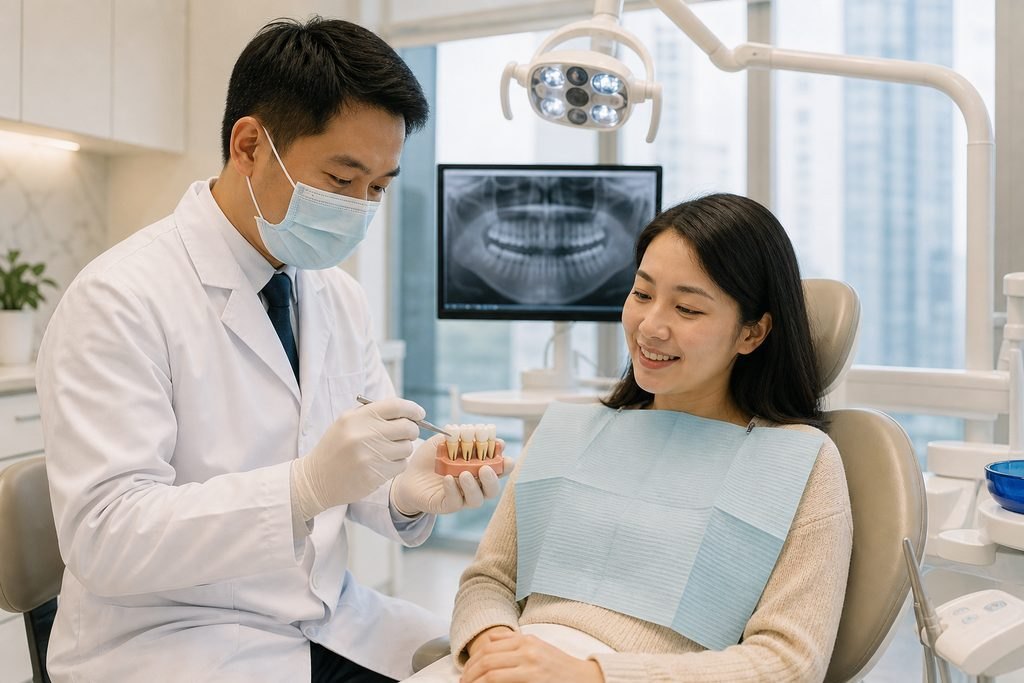
Why the risk conversation belongs to the treating dentist
A crown covers a tooth; a bridge replaces missing teeth. That much is general. What a crown or bridge means for your mouth depends on which teeth are involved, their condition, your bite, your gum health and what the dentist can see on examination and imaging. No website, including this one, can tell you whether a crown or bridge is suitable for you.
This matters because the same words describe very different situations. A single crown on a heavily restored back tooth is not the same decision as a multi-unit bridge replacing several missing teeth. The risks a dentist should discuss with you include what happens to the prepared tooth, how the restoration fits, how it is cleaned, and what happens if it fails or needs adjustment. Those are clinical judgements, not general information.
So the useful move is not to collect a list of risks from the internet. It is to ask the dentist who examines you to name the risks for your specific teeth, and to explain what would change their recommendation. If they cannot or will not do that, that is itself information about the consultation.
Questions that separate a real risk discussion from a sales conversation
A risk discussion should be specific. Ask the dentist to point to the teeth involved and explain, for each one, what the restoration is intended to do and what could go wrong. Ask what happens if the tooth under a crown later needs root canal treatment, and whether the crown would need to be replaced. Ask how a bridge is supported and what happens to the supporting teeth over time.
Ask about alternatives in plain terms. For a missing tooth, alternatives might include a bridge, a removable partial denture, or an implant, but which of these is appropriate depends on the site, the bone, your health and your preferences. Ask the dentist to explain why they are recommending one option over another for you, and what the trade-offs are. If an alternative is not suitable, ask why.
Ask what happens if you decide to do nothing, or to delay. Sometimes monitoring or a temporary measure is reasonable; sometimes delay carries its own risk. You are entitled to hear that trade-off before you decide.
- Which teeth are involved, and what is the condition of each one?
- What are the risks for these specific teeth, not for crowns or bridges in general?
- What alternatives exist for my situation, and why are they or are they not suitable?
- What happens if I delay or choose no treatment now?
- What would make you change your recommendation?
Materials, temporary restorations and visit stages
Dental laboratory work may involve a temporary restoration before the final one is fitted. Ask what the temporary is made of, how long it is expected to stay in place, and what you should do if it comes loose or breaks. Ask what the final restoration is made of, and why that material is proposed for your teeth. Different materials have different properties, appearances and care needs; the dentist should explain the choice for your case.
Ask how many visits are planned and what happens at each one. A plan may involve preparation, impressions or scans, fitting of a temporary, and later fitting of the final restoration. The number of visits and the interval between them depend on the laboratory work, the material and the clinical situation. Ask the dentist to write down the stages and what is expected of you between them.
If you are travelling to China for treatment, ask how the stages fit with your travel dates. Do not assume that everything can be completed in one trip. Ask what happens if a stage needs to be repeated, and whether that would require you to stay longer or return. Get the answer in writing before you commit.
What the estimate should include, and what it should leave open
Ask for a written estimate that names the teeth included and the restoration planned for each. Ask whether the estimate covers the temporary restoration, the final restoration, any laboratory work, and the visits needed to fit and adjust them. Ask what is not included, and what would cause the estimate to change. If a cost is undecided, ask why and when it will be decided.
Do not accept a single figure without a scope. A useful estimate lets you see which teeth are being treated, what is being made, and what happens if the plan changes. If the dentist cannot provide that, ask for it before you agree to anything.
Keep the estimate separate from any coordination or travel costs. Hospital or clinic fees, laboratory fees and any coordination service fees are different things. Ask each provider what they charge and what their fee covers.
Ask how the estimate would change if a tooth turns out to need root canal treatment before the crown is made, or if a planned bridge abutment cannot support the design. Ask whether a replacement restoration after a failure would be charged again, and on what basis. These are the scenarios that turn a headline figure into a real budget, and the treating dentist is the person who can price them for your teeth rather than for a generic case.
Ask whether the quote is tied to a specific material and a specific laboratory. If the material changes after you arrive, or if the laboratory sends back work that does not fit, ask who bears the cost of remaking it and whether that would extend your stay. Get the answer in writing, because a verbal assurance about a remake is difficult to rely on once you have left the clinic.
Ask what payment schedule applies: whether any amount is due at preparation, at fitting, or after adjustment, and whether a deposit is refundable if you decide not to proceed. Ask for the schedule in the same document as the scope, so the two can be read together. If the clinic cannot state a schedule, treat that as an open item to resolve before you commit rather than a detail to settle later.
Finally, ask what records you will receive at the end: which teeth were treated, which materials were used, and what the dentist recommends for review. Ask for these in a form a dentist at home can read. A short written summary of the work done is more useful to a future clinician than a receipt, and asking for it at the start is easier than requesting it after you have gone home.
Adjustment and maintenance: the questions people forget
A crown or bridge is not finished when it is fitted. Ask how the bite will be checked, what you should do if it feels high or uncomfortable, and how soon you should report a problem. Ask how to clean around the restoration, and what products or techniques the dentist recommends for your situation.
Ask about maintenance visits. How often should the restoration be reviewed, and what will be checked? Ask what signs would mean the restoration needs repair or replacement, and who you should contact if you are back home. If you live outside China, ask how a local dentist would be able to assess or adjust the work, and what records you should take with you.
Ask about the long-term plan for the teeth involved. A bridge may affect the supporting teeth; a crown may need replacement at some point. Ask the dentist to explain what they expect over time, and what you can do to reduce the chance of problems. These are clinical questions for the treating dentist, not general rules.
How to prepare for the consultation and what to do next
Before the consultation, gather any recent dental records you have: X-rays, treatment notes, and a list of previous dental work. Ask the receiving clinic whether they want these in advance and in what format. Do not send a complete medical archive at first contact; a brief summary and your main question are enough to start.
During the consultation, take notes or ask for the plan in writing. If you need an interpreter, arrange one and make sure the dentist knows that questions are being translated. Ask the dentist to confirm the plan in writing, including the teeth involved, the materials, the stages, the estimate scope and the maintenance advice.
An initial enquiry through ChinaSpecialistCare is free and does not commit you to treatment. You can share a short summary of your situation and ask for help identifying the right questions or the relevant next step. The hospital and its clinicians decide suitability, and any treatment plan is theirs to make. For the procedure itself, see the crowns and bridges reference page.
Sources & scope of this guide
References and official service information relevant to this guide.
This is general planning information and has not been individually reviewed by a doctor. Medical decisions and personal treatment advice come from your treating clinicians.