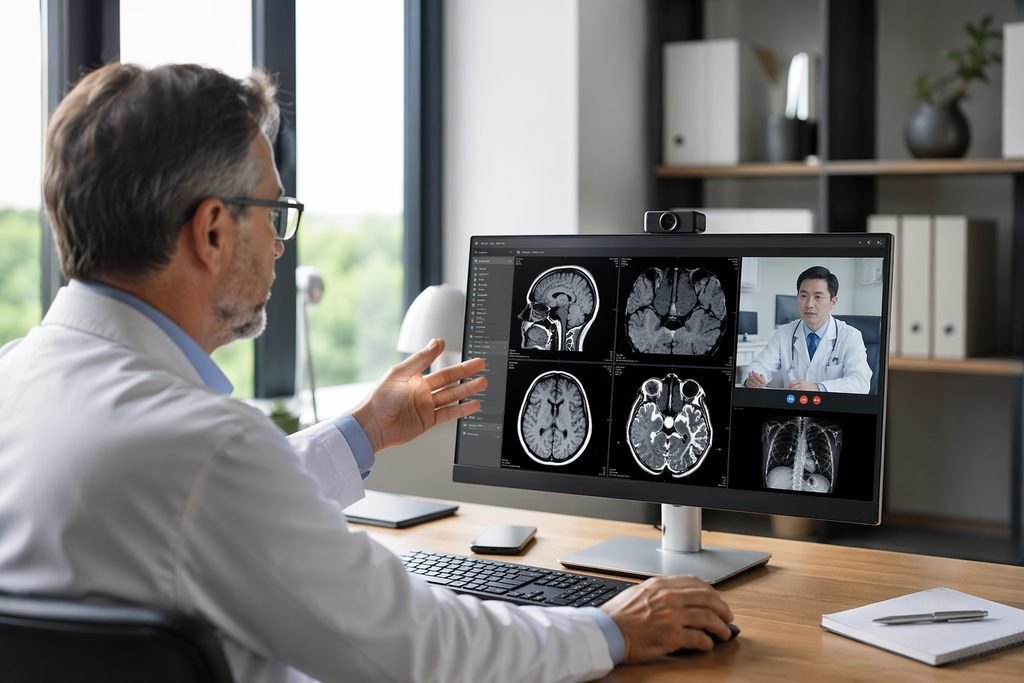
Why the original DICOM files matter more than a photo of the report
A radiology report is a radiologist's written interpretation of an imaging study. It tells a clinician what was seen and what was concluded, but it does not let a second clinician scroll through the actual slices, change the windowing, measure a lesion, or compare one scan against another. DICOM is the standard file format that carries the image data plus technical metadata such as slice thickness, acquisition parameters and patient positioning. When a hospital in China reviews a case remotely, the specialist usually needs both the report and the DICOM files to form an independent view.
Sending only a photograph of a report, a PDF summary or a few exported JPEGs limits what the reviewer can assess. A JPEG is a compressed picture of one view; it cannot be reformatted into different planes or measured reliably. If the original DICOM study is available, that is the version to send. If it is not available, say so clearly rather than sending a substitute and implying it is the full study.
The practical question is not 'which single image should I send' but 'which complete study, with which report, for which clinical question'. A hospital reviewing a possible spinal problem needs the full spine sequence, not one selected slice. A hospital reviewing a lung nodule needs the full chest CT series, including any prior chest CT for comparison. The treating clinician decides what is sufficient; your job is to send the original files and describe what you have.
Match the imaging study to the clinical question
Before exporting anything, write down the specific question the review is meant to answer. 'Is this lesion operable?' 'Does this fracture need surgery?' 'Is the current treatment plan appropriate?' 'Is there a second opinion on the pathology?' The question shapes which studies are relevant. Sending every scan you have ever had, without context, makes the review slower and can bury the study that matters.
For most reviews, the relevant set is: the most recent imaging of the affected area, the radiology report for that study, and any earlier imaging of the same area that shows change over time. If the case involves a tumour, the reviewer may also need the pathology report, the operative note if surgery has already happened, and the current medication list. If the case involves a joint, the reviewer may need the standing X-rays, the MRI, and any previous arthroscopy report. These are examples of what a clinician might ask for, not a universal checklist. The receiving hospital will tell you what it needs for its own assessment.
Do not send a study that is not yours, and do not send a family member's images in the same file set without labelling them clearly. If you are sending images for more than one person, separate the files by patient name and date of birth. Mixing records creates a real risk that the reviewer looks at the wrong person's scan.
How to export DICOM files from a hospital or imaging centre
Most imaging centres can provide a copy of your study on a CD, DVD or USB drive, or through a patient portal download. Ask for the DICOM files, not a PDF report and not a set of JPEG images. The DICOM files are usually in a folder with many individual slice files and a DICOMDIR index file. Keep the folder structure intact when you copy it; renaming or flattening the folders can make the study unreadable to the receiving software.
If you are downloading from a portal, check whether the download is the full DICOM series or a compressed viewer package. Some portals offer only a web viewer that does not export the original files. In that case, ask the imaging centre for a DICOM copy. If the centre charges a fee for the copy, that is a charge from the imaging provider, not from ChinaSpecialistCare.
When you have the files, test that they open. A free DICOM viewer can confirm that the study loads and that the correct patient name and study date appear. If the files do not open, go back to the imaging centre before sending them. Sending a corrupt or incomplete export wastes a review cycle.
- Ask for the original DICOM files, not only a report or JPEG images.
- Keep the folder structure and DICOMDIR file intact.
- Check that the study opens in a DICOM viewer before sending.
- Label each study with the patient name, study date and body area.
What to send alongside the images
The DICOM files alone are not a case. The receiving clinician needs the radiology report that interprets those images, because the report contains measurements, comparisons and the radiologist's impression. If the report is in a language other than English, ask whether a translation is needed and who will provide it. A machine translation of a medical report can change meaning; a clinician reviewing the case needs to know which parts are translated and by whom.
Send a short clinical summary in your own words or your treating doctor's words: the main symptom or diagnosis, when it started, what treatment has been tried, current medications, allergies, and the specific question you want answered. Keep it to one page. The reviewer does not need your full life history; they need the facts that change the interpretation of the images.
Also send any relevant prior imaging reports and, where applicable, pathology reports, operative notes and discharge summaries. If you do not have a document, say so. A missing record is a gap the clinician can ask about; a substituted or guessed document is a safety problem.
File size, transfer method and privacy
DICOM studies can be large. A single CT or MRI series may be hundreds of megabytes; a full study with multiple series can exceed a gigabyte. Email attachments usually cannot handle that. Common transfer options include a secure file-sharing link, a cloud folder with access controls, or a physical drive sent by courier. The receiving hospital or coordination team will tell you which method it accepts. Do not assume every provider accepts every method.
Before uploading, remove or avoid including unrelated personal documents. Send only the imaging and clinical records relevant to the review. Use a transfer method that requires a password or access link rather than a public folder. If you are sending physical media, keep a copy for yourself and use a trackable courier.
Privacy rules differ between countries. The receiving hospital will explain what it needs and how it handles records. If you are unsure whether a particular file should be shared, ask before sending it. Do not send passport numbers, payment card details or a complete medical archive in an initial enquiry. A short summary and the relevant imaging study are enough to start.
What the hospital can and cannot confirm from images alone
A records-based review can help a clinician understand the imaging findings, compare them with the report, and advise on whether further assessment in China is worth considering. It cannot confirm a diagnosis from one image, cannot establish surgical suitability without the full clinical picture, and cannot confirm hospital acceptance in advance. The treating hospital decides whether it can accept the case, what further tests it needs, and what treatment it can offer.
If the review raises a question that needs a physical examination or a test not yet done, the clinician will say so. That is not a failure of the review; it is a limit of what remote records can show. Ask what additional information would make the assessment more complete, and whether that information can be obtained locally before travel.
For an initial enquiry, a brief summary is enough. You do not need to buy a proxy consultation to ask whether your records are suitable for review. The free initial case review checks the available diagnosis, records and your main question, identifies missing information and suggests the relevant next step. It is not a diagnosis or a promise of acceptance.
If you want to proceed, the next step is to send a short summary through the enquiry form, email or WhatsApp. The team will explain how to share the DICOM files and reports after first contact.
Sources & scope of this guide
References and official service information relevant to this guide.
This is general planning information and has not been individually reviewed by a doctor. Medical decisions and personal treatment advice come from your treating clinicians.