
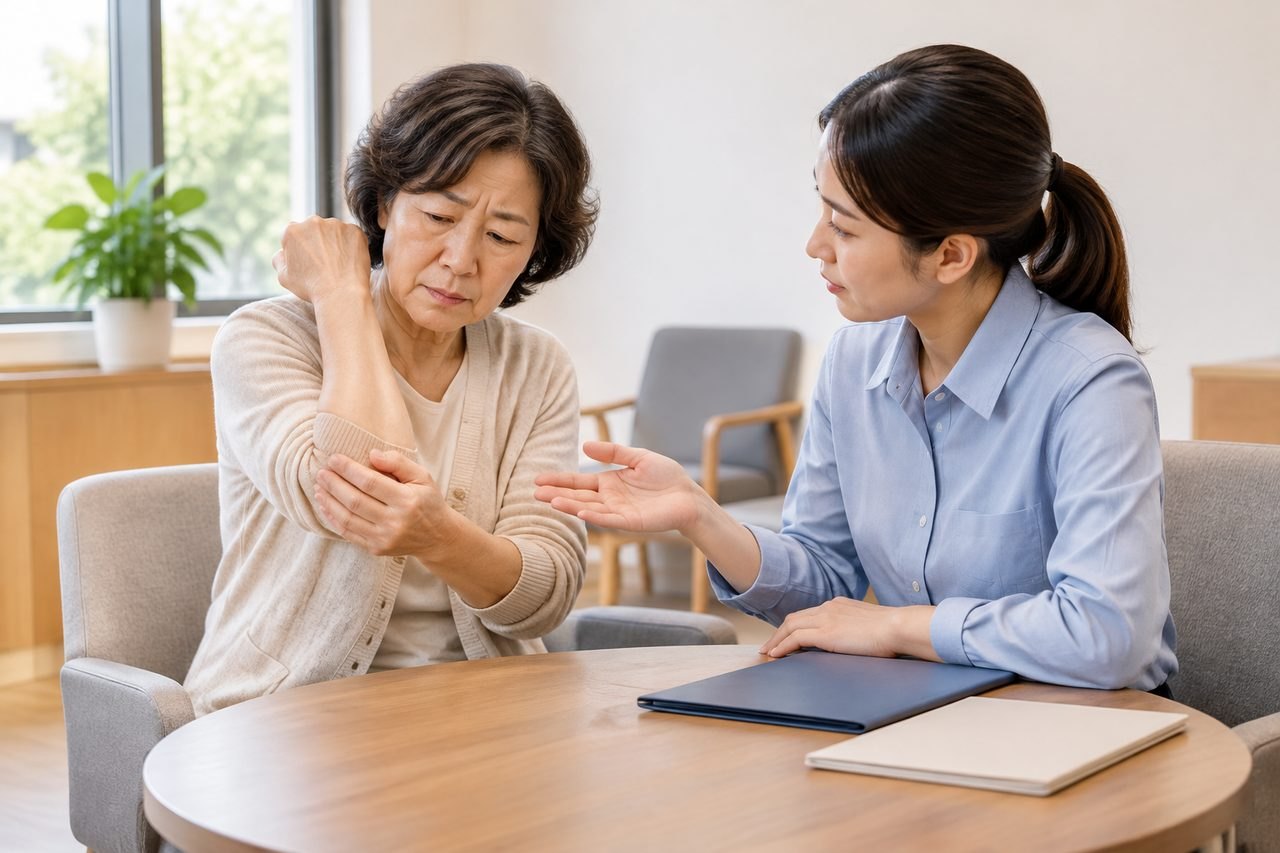
Why the cause of elbow pain changes the plan
Elbow pain is a symptom, not a diagnosis. The elbow joins three bones and depends on tendons, ligaments, nerves and cartilage working together. Pain on the outer side of the elbow, pain on the inner side, stiffness after trauma, swelling, locking, or tingling into the hand can point in different directions. Tendon problems, nerve compression, joint surface damage and fractures are assessed differently.
That matters for an overseas patient because the useful question is not simply 'where can I get elbow treatment in China?' It is 'which assessment does my elbow need, and can that assessment be arranged at a hospital that handles this problem?' A clinician will normally start with history and physical examination, then decide whether imaging or other tests add information. You cannot reliably choose a treatment route from a symptom description alone.
Some elbow problems settle with activity modification and rehabilitation; others need a procedure. The treating clinician decides which applies to you after examining the elbow and reviewing relevant records. A coordination service can help you reach that assessment, but it does not make the clinical decision.
What to record before you contact a hospital
A short, clear summary helps the receiving team decide whether your case fits their service and what to arrange first. You do not need to send a complete medical archive at the first enquiry. Start with the essentials and share more when the hospital asks.
Describe where the pain sits and when it began. Note whether it followed a fall, a sports or work activity, or came on gradually. Say what makes it worse, such as gripping, lifting, typing, throwing or leaning on the arm, and what relieves it. Mention any swelling, bruising, locking, weakness, numbness or tingling in the forearm or hand, because those details change what the clinician will examine.
List what has already been tried: rest, physiotherapy, splints, injections or medicines, and whether they helped. Include relevant history such as previous elbow injury, inflammatory joint disease, diabetes or nerve problems, and any medicine you take. If you have had imaging, note the type and date rather than describing the report from memory.
Keep the original images and reports, not only a summary letter. If records are in another language, ask the hospital whether it needs a translation and in what form. Confirm that question directly rather than assuming a rule.
- Onset: sudden after injury or gradual over weeks
- Location: outer, inner, back of elbow, or widespread
- Aggravating and relieving factors
- Swelling, locking, weakness, numbness or tingling
- Previous treatment and response
- Existing imaging, reports and relevant medical history
Which specialty and hospital route fits your elbow
Elbow problems are commonly assessed within orthopedics, and some hospitals have a dedicated upper-limb or elbow service. Hand and upper-limb surgery is a related area when nerve, tendon or reconstructive problems are involved. The hospital's own department structure determines who sees you, so ask which clinic handles elbow pain and whether the clinician has a focus on the elbow specifically.
Public tertiary hospitals and private international hospitals are both possible routes in China. They differ in environment, language support and how appointments are arranged, and those differences matter to an overseas visitor. Neither route guarantees a particular clinician or a particular outcome. Ask what is confirmed at the time of booking and what remains subject to the hospital's own scheduling.
If your case is complex, involves more than one specialty, or you want a records-based opinion before travelling, a review involving relevant specialties may be arranged. Its scope and fee are agreed first. This is a way to gather information, not a substitute for examining the elbow, and it does not establish that a procedure is suitable or available.
What imaging can and cannot tell you
Imaging answers specific questions. Plain X-rays show bones and joint alignment and are often used when fracture, arthritis or loose bodies are considered. Ultrasound can assess tendons and fluid and is operator-dependent. MRI gives detailed soft-tissue information but is not needed for every painful elbow, and it does not by itself decide treatment.
A scan report is interpreted alongside your history and examination. A finding on imaging may be incidental and unrelated to your pain, which is why the clinician examines you rather than treating the report in isolation. If you arrive with imaging already done, the receiving team may accept it, repeat it, or request a different study depending on quality and timing. Ask what they will require for your case.
Do not order tests for yourself in advance on the assumption that they will be needed. Ask the hospital which investigations its clinicians typically request for a problem like yours, and let the treating team decide. If a test needs a specialist's order, the hospital will explain how that is arranged.
Questions to ask before booking an appointment
A useful enquiry is specific. Ask which clinic will see you, what records to send first, and whether the appointment includes an examination and a plan or only an initial assessment. Ask whether an interpreter is available and how clinical discussions are handled if you do not speak Chinese.
Ask what the written quote covers for any proposed treatment, and which charges are paid to the hospital rather than to a coordination service. Ask about the expected number of visits and whether follow-up can be done locally or remotely, but treat any answer as provisional until the clinician has seen you.
If surgery is mentioned, ask what the proposed procedure involves, what alternatives exist, what the recovery and rehabilitation expectations are for your situation, and what the clinician needs to confirm before deciding. These are legitimate questions. A responsible clinician can discuss evidence-based risks and expected outcomes without guaranteeing a result.
Also ask what happens if the assessment shows that your problem is better managed without a procedure. A good plan should include that possibility.
- Which clinic and clinician will assess the elbow
- What to send before the appointment
- Whether interpretation is available
- What the written quote covers and who is paid
- Alternatives if a procedure is proposed
- How follow-up and rehabilitation would be arranged
Practical arrangements and a realistic next step
Once the hospital confirms an appointment, plan around the visit rather than around an assumed timeline. Ask how many days the assessment is expected to take, whether results are discussed at the same visit, and what you should bring in original form. Confirm the hospital's address, registration process and payment method in writing.
Travel, accommodation and interpretation can be discussed as separate arrangements. Our team provides information and non-clinical coordination; diagnosis, suitability and treatment decisions belong to the treating hospital and licensed clinicians. Hospital fees and our coordination fees are separate, and we do not collect or refund hospital payments.
An initial enquiry is free and needs only a brief summary of your elbow problem and your main question. Our team checks the available information, identifies what is missing and suggests a relevant next step. That is not a diagnosis or a promise of acceptance. If your elbow pain follows a significant injury, or you develop severe pain, marked swelling, deformity or loss of feeling in the hand, seek urgent local medical assessment before planning travel.
Sources & scope of this guide
References and official service information relevant to this guide.
This is general planning information and has not been individually reviewed by a doctor. Medical decisions and personal treatment advice come from your treating clinicians.