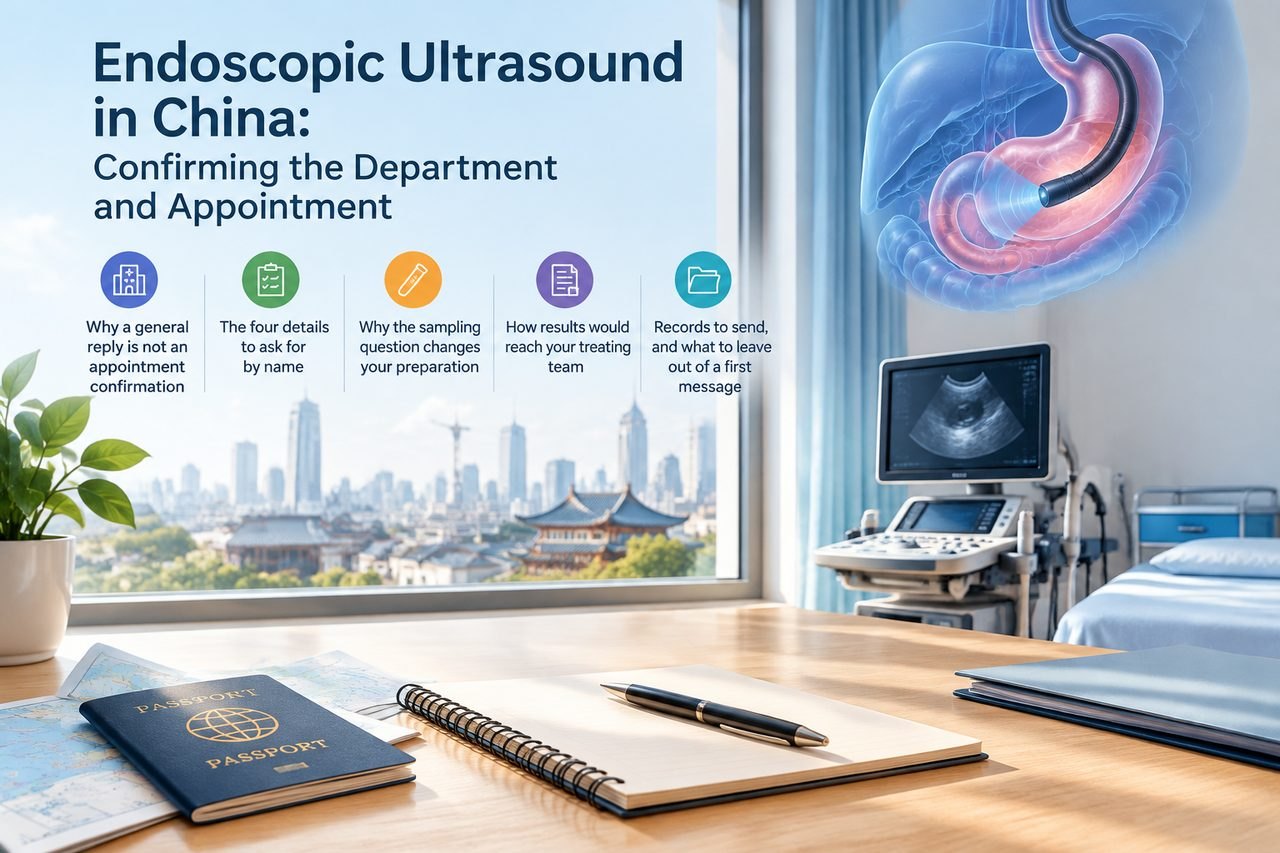
Why a general reply is not an appointment confirmation
When you send an enquiry about endoscopic ultrasound to a hospital in China, the first response often comes from an international office, a general enquiry desk or a coordinator rather than from the department that performs the examination. That reply may confirm that your message arrived and that someone will follow up. It does not tell you which department owns the case, which campus you would attend, or what has actually been booked.
This matters because endoscopic ultrasound sits between specialties. It combines an endoscope with ultrasound to examine digestive structures and nearby organs, so the examination may be handled by a gastroenterology or endoscopy unit, and the clinical question behind it may belong to a digestive, pancreatic, biliary or chest specialty. The department that reviews your records is not automatically the department that schedules the procedure room.
A useful confirmation therefore separates three things that a friendly reply tends to blur: the clinical department that has accepted your case, the physical campus and unit where the examination would take place, and the appointment type. Only when those are named can you judge whether the plan matches what your own doctor asked about.
The four details to ask for by name
Instead of asking whether an appointment is possible, ask for the specific fields. First, the department: is this gastroenterology, the endoscopy centre, a pancreaticobiliary unit, or another specialty? Second, the campus or branch, because large hospitals in China often run several sites and an international clinic address is not always the address where the examination is performed. Third, the appointment type: is this a specialist consultation to discuss whether endoscopic ultrasound is appropriate, or a booked slot for the examination itself? These are different visits with different preparation.
Fourth, ask whether the proposed examination includes tissue sampling. Endoscopic ultrasound can be used to look at structures, and a separate sampling step such as fine-needle aspiration may be proposed to obtain cells or fluid for laboratory analysis. Whether sampling is included changes the consent discussion, the preparation, the staff involved and how long the appointment occupies the room. Do not assume it is included, and do not assume it is excluded. Ask what is planned for your case and who decided it.
A short written request works better than a phone call: ask the hospital to reply in writing with the department name, campus, appointment type and whether sampling is part of the plan. If any of those is still undecided, ask them to say so explicitly rather than leaving it blank.
- Department and unit that has accepted the case
- Campus and building where the examination would take place
- Appointment type: consultation or the examination itself
- Whether tissue sampling or another intervention is planned
Why the sampling question changes your preparation
If sampling is planned, the clinical team needs to explain what they intend to sample and why, what alternatives exist, and what the limitations are. Endoscopic ultrasound does not by itself establish a diagnosis, and a planned biopsy does not predict a result. Those are questions for the treating clinician, not something an enquiry reply can settle.
Preparation is individual. Fasting instructions, medication adjustments, sedation arrangements and whether you need an escort depend on the specific plan and on your own health. Do not follow a generic instruction found online, and do not stop prescribed medication on your own. Ask the department to send its own written preparation instructions once the appointment type and sampling plan are confirmed.
There is also a consent point that is easy to postpone. If sedation is planned, the discussion about what will happen, what the alternatives are and what the risks are should take place before sedation, while you can still consider it properly. Ask when that conversation will happen and who will hold it. If you need interpretation, say so in advance so the discussion is not compressed into the minutes before the procedure.
How results would reach your treating team
Confirming the appointment is only half of the administrative question. The other half is the route by which the findings and any laboratory results travel back to the clinician who is actually managing your condition. Ask the hospital to describe that route before you travel: who prepares the report, whether an English-language version is available, how images and any pathology slides are released, and whether you or your home clinician receive them directly.
If tissue is sampled, the laboratory result is a separate document from the examination report, and it may be issued by a different department. Ask how the two are linked and what identifier ties them to your case. This is a practical question, not a clinical one, and it is reasonable to ask it in writing.
Your own treating team at home remains responsible for interpreting results in the context of your history and for deciding what happens next. A hospital in China can perform the examination and issue its report; it does not take over your ongoing care unless you and the clinicians agree otherwise. Say clearly, in your enquiry, who should receive the results and in what form.
Records to send, and what to leave out of a first message
To answer the department and appointment questions, the hospital needs enough context to route your case. A brief summary is usually the right starting point: the main question your doctor wants answered, the relevant imaging or endoscopy reports you already have, any pathology reports, and a short list of your current diagnoses and medicines. Ask the receiving clinician which existing records they want to see rather than sending everything at once.
Do not send passport numbers, card details or a complete medical archive in a first message. Those belong to a later, secure stage once a department has taken the case and told you what it needs. If a document is missing, ask what the absence means for the decision instead of assuming you must delay all assessment until the file is complete.
If you are working with a coordination service, it can help with records, interpretation and placing a specialist appointment request. It does not decide suitability, does not prescribe and cannot promise that a hospital will accept the case or that a slot exists. Those decisions sit with the hospital and its licensed clinicians.
What to do before you book travel
Treat the appointment as confirmed only when you hold a written reply naming the department, the campus, the appointment type and the sampling plan, together with the hospital's own preparation instructions. A provisional clinical stage and a confirmed booking are different things, and it is reasonable to ask which one you have.
Before buying flights or a hotel, ask the hospital what would change the plan: if the reviewing clinician decides the examination is not appropriate, if sampling is added or removed, or if the appointment has to move. Ask who would tell you and how quickly you would be informed. Do not assume a single trip covers every step, and do not treat an enquiry reply as permission to travel.
If your symptoms worsen or become urgent, seek local medical care rather than waiting for an overseas appointment. An overseas enquiry should not delay assessment that you need now.
A practical next step is to send a short summary through the enquiry form, email or WhatsApp, and ask directly for the department, campus, appointment type and sampling plan in writing. An initial enquiry is free and does not require buying a proxy consultation; the hospital decides whether the examination is suitable for you.
Sources & scope of this guide
References and official service information relevant to this guide.
This is general planning information and has not been individually reviewed by a doctor. Medical decisions and personal treatment advice come from your treating clinicians.