Why the Scope of the Examination Changes Your Decision
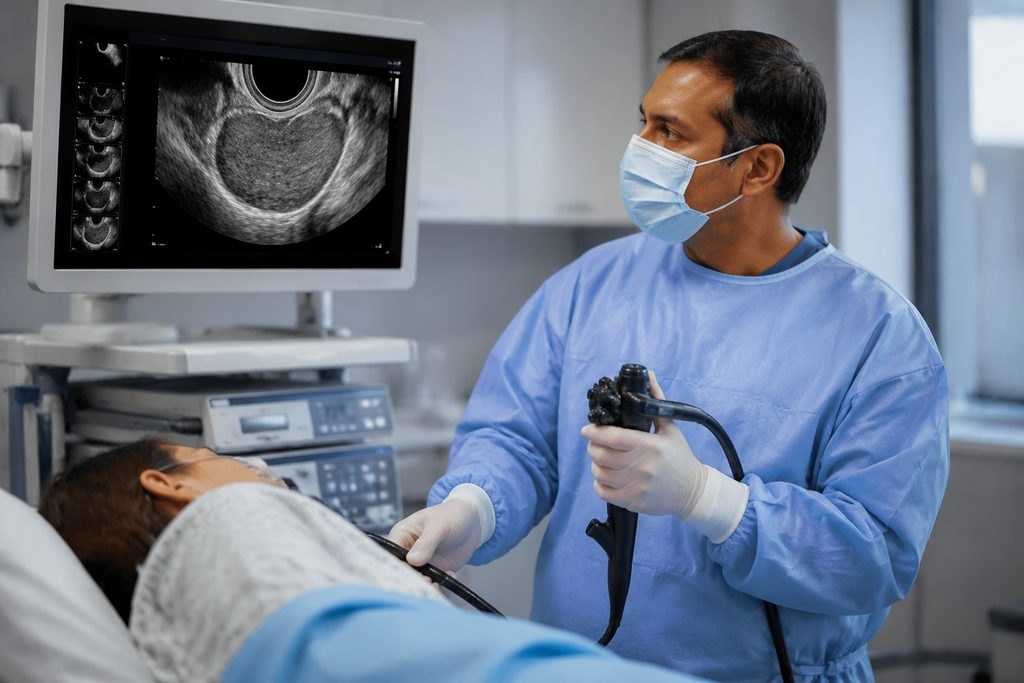
Endoscopic ultrasound is not one single procedure. It is a way of examining the digestive tract wall and nearby organs using an endoscope with an ultrasound probe at its tip. The clinical purpose can range from looking at a structure, to measuring it, to guiding a needle into a specific area for tissue sampling. Those are different clinical acts with different preparation, different risks and different implications for what happens next.
For an overseas patient, the practical question is not only whether EUS is available in China. It is whether the examination being proposed for you matches the question your treating team needs answered. If your doctor at home has asked whether a pancreatic cyst contains certain cells, a purely diagnostic EUS without sampling may not answer that question. If the question is about the size or layer of a lesion, sampling may not be needed at all.
This is why the scope of the examination belongs in the first conversation, not the last. A clear answer tells you what the procedure is intended to do, what it cannot do, and what information will leave the room with you.
Examination Versus Sampling: Two Different Questions to Ask
The supplied clinical source describes EUS as combining an endoscope with ultrasound to examine digestive structures and nearby organs. That description covers the examination itself. It does not automatically include tissue sampling, and it does not mean every EUS is performed to look for cancer.
Ask the clinical team directly: is the proposed examination diagnostic only, or does it include a needle-based sampling step such as EUS-guided fine needle aspiration or biopsy? If sampling is included, ask who will perform it, what tissue or fluid is being targeted, and what the sample is expected to show. If sampling is not included, ask what the examination can and cannot tell your treating team.
These are not administrative details. They determine whether the trip is likely to produce the information your case needs. A patient who travels for an examination that cannot answer the referring clinician's question may need a second procedure. A patient who expects sampling but receives a diagnostic scan only may leave with incomplete information.
You do not need to decide which is clinically correct. You need the treating team to state clearly what is proposed and why, so you can compare that with what your own clinicians have asked.
What Preparation and Safety Questions Belong to the Treating Team
Preparation for EUS is individual. It can depend on the area being examined, whether sedation is planned, whether sampling is included, and what medicines you take. There is no single preparation routine that fits every patient, so the instructions you receive should be specific to your case.
Ask the team that will perform the examination what preparation applies to you specifically. If you take anticoagulants, antiplatelet medicines, insulin or other regular medication, ask how those should be managed around the procedure. Do not change any prescribed medicine on your own based on general information.
Sedation and recovery instructions also come from the treating team. Ask what type of sedation is planned, whether you need someone to accompany you afterwards, and what you should not do in the hours following the examination. These are safety instructions, not travel logistics, and they should be given before the appointment, not after.
If you have a condition that affects swallowing, breathing or sedation tolerance, say so during the enquiry. The team needs that information to assess whether the proposed examination is suitable for you.
How Results Should Reach Your Treating Team
An examination only helps if its findings reach the people who will act on them. Before you travel, ask how the report will be produced, in what language, and how it will be shared with your clinicians at home. Ask whether images, measurements and any pathology results will be included, and whether a written summary can be prepared for your referring doctor.
If tissue sampling is part of the examination, the pathology result may take additional time to finalise. Ask the team what to expect and how the result will be communicated. Do not assume a fixed reporting deadline; confirm the process with the provider handling your case.
It also helps to ask what happens if the examination findings are inconclusive. Some results require further tests, a repeat procedure or a different type of assessment. Knowing this in advance prevents surprises and helps you plan realistically.
Bring copies of your existing imaging, endoscopy reports, pathology results and relevant blood tests. These give the treating team context and may reduce the need to repeat investigations. Ask which records they want before you travel, and how to send them securely.
Questions That Clarify Scope Before You Commit
A short, specific list of questions will get you clearer answers than a general request for information. You can send these to the hospital or coordination team handling your enquiry. The aim is not to collect a brochure. It is to establish what the proposed examination is designed to do, who will do it, and what will reach your treating team afterwards.
Start with the scope question. Ask whether the proposed EUS is diagnostic only or includes tissue sampling such as a needle-based aspiration or biopsy. Ask which anatomical area will be examined and what clinical question the examination is intended to answer. If sampling is included, ask what tissue or fluid is targeted and what the sample is expected to show. If it is not included, ask what the examination can and cannot tell your treating team.
Then ask about the practical conditions attached to that scope. Who performs the procedure, and what happens if sampling is needed but was not planned in advance? Can the plan be adjusted on the day, or would it require a separate appointment? These answers tell you whether one trip is likely to produce the information your case needs or whether the plan may need to be revisited.
Preparation and sedation questions belong to the same conversation. Ask what preparation applies to you specifically, what type of sedation is planned, and what you must arrange afterwards. If you take anticoagulants, antiplatelet medicines, insulin or other regular medication, ask how those should be managed around the procedure. Do not change any prescribed medicine on your own based on general information.
Reporting is the other half of scope. Ask how the report will be written, in what language, and how it will reach your treating team. Ask whether images, measurements and any pathology results will be included, and whether a written summary can be prepared for your referring doctor. If sampling is part of the examination, ask how and when the pathology result will be communicated, and what happens if the findings are inconclusive.
Finally, ask what the written estimate includes and what remains undecided until the clinical team reviews your records. A quote that covers the examination but not a sampling step, or that leaves the reporting route unclear, is not yet a complete picture. Ask the named provider how its own quote is structured rather than assuming a standard format.
These questions are not a substitute for clinical assessment. They are how you confirm that the examination being offered matches the information your case needs, and how you avoid discovering a gap only after you have travelled.
A Practical Next Step for an Overseas Enquiry
If you are considering EUS in China, start with a brief summary of your situation: your main symptom or finding, what your current clinicians have asked, and the specific question you need answered. You do not need to send a complete medical archive at first contact. An initial enquiry is free and does not require buying a proxy consultation.
The hospital decides whether the proposed examination is suitable for you. A records-based review can help clarify what information is missing and what the next step might be, but it does not establish final eligibility or guarantee that a particular procedure will be performed.
Use the enquiry to ask the scope question directly: does the proposed examination include tissue sampling or another intervention, and how will the results reach your treating team? A clear answer to that question is the most useful thing you can obtain before making any travel decision.
You can review the general procedure reference for context, then send your specific scope question through the enquiry route. Keep your local clinical care in place while you explore options abroad.
Sources & scope of this guide
References and official service information relevant to this guide.
This is general planning information and has not been individually reviewed by a doctor. Medical decisions and personal treatment advice come from your treating clinicians.