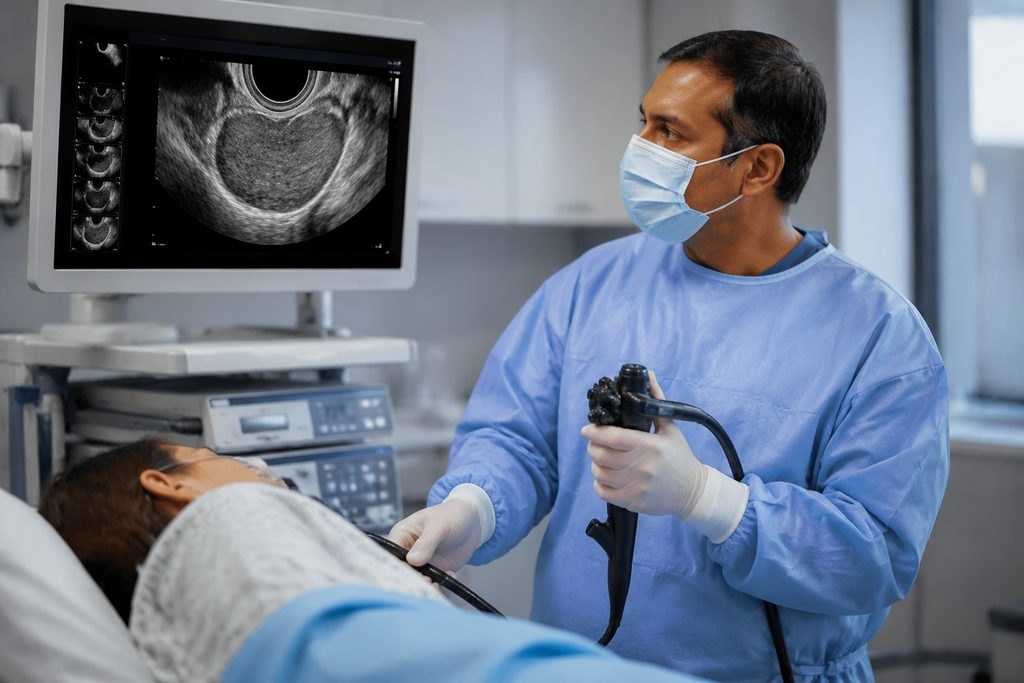
What your home team actually needs from an EUS in China
Endoscopic ultrasound combines an endoscope with ultrasound to examine digestive structures and nearby organs. That description covers a wide range of examinations. The report your home gastroenterologist, surgeon or oncologist receives may be a short narrative summary, a structured report with measurements, a set of stored images, or a pathology result from a biopsy taken during the same procedure. These are not interchangeable. A narrative summary alone may not answer the question your home team is trying to resolve.
The practical first step is therefore not booking the examination. It is asking your home clinician a precise question: what would you need from an EUS performed overseas to make your next decision? The answer might be the full report with images on a disc, a specific measurement, a pathology block or slides, or a written opinion from the endosonographer. Once you know that, you can ask the China provider whether they can produce it.
This matters because the value of travelling for the examination depends on whether the output is usable at home. If your home team needs histology and the planned examination is diagnostic imaging only, the trip may not answer the question. If they need images in a particular format, that should be confirmed before the appointment rather than requested afterwards.
Ask whether the planned examination includes sampling
Endoscopic ultrasound is sometimes performed as an imaging examination and sometimes combined with a separately proposed tissue sampling or other intervention. These are distinct decisions with different preparation, different consent discussions and different risks. Do not assume that an appointment described as 'EUS' includes a biopsy. Ask directly whether the proposed examination involves tissue sampling, and if so, what type and from which site.
The reason to separate these questions is that consent and preparation differ. A purely diagnostic examination and one that includes sampling may require different fasting instructions, different medication adjustments and different arrangements for someone to accompany you afterwards. The treating team must give you those instructions; they depend on your individual circumstances and cannot be assumed from a general description.
It is also worth asking what happens if sampling is attempted but does not yield a usable sample. Will a repeat procedure be proposed, and would that require a further appointment? You do not need to decide in advance, but knowing the possibility helps you plan realistically and helps your home team understand what a negative or inconclusive result would mean.
Confirm how findings, images and pathology will reach your home team
Confirm the release of reports and images before travel, rather than leaving that discussion until discharge. Before you travel, ask the China provider three specific questions in writing. First, what documents will be issued after the examination, and in what language? Second, will images be provided in a format your home hospital can open, and on what medium? Third, if tissue is sampled, how will the pathology report be released, and can slides or blocks be requested?
Then ask how the material will be transferred. Options may include a printed report collected in person, a disc, a secure electronic transfer, or release to a named clinician. Which of these is possible depends on the hospital, so treat any answer as specific to that provider rather than a general rule. Ask who at the China hospital authorises release, and whether a signed authorisation from you is required.
Finally, ask your home team how they prefer to receive overseas records. Some clinicians accept a disc and a translated report; others want the original pathology material sent directly. Knowing their preference before the examination avoids a second round of requests after you have returned home.
Prepare the records and questions your home team should send
Your home team holds information that the China endosonographer needs to interpret the examination properly. Ask them to provide a short clinical summary, relevant prior imaging and reports, any previous endoscopy or pathology results, and a clear statement of the question the examination is meant to answer. A one-page summary is often more useful than a large unorganised file.
The clinical summary should say what has already been established and what remains unresolved. If a previous endoscopy was performed, include the report and any pathology result, because the China endosonographer needs to know which areas have already been examined and sampled. If prior imaging exists, include the images themselves rather than only the radiologist's conclusion, so the new examination can be planned against what is already known.
Alongside the records, send your own written questions. For example: does the examination need to include sampling to answer the clinical question? Which site should be sampled? What findings would change the plan at home? These questions help the China team understand the purpose of the examination rather than performing it in isolation. A written question also gives the endosonographer something specific to address in the report, which makes the report more useful when it reaches your home clinician.
List the medications you currently take, including anything that affects bleeding risk, and ask both teams whether any adjustment is needed before the examination. Do not change or stop any medicine on your own. The treating team must give that instruction, and it depends on your individual circumstances.
If translation is needed, ask in advance who will translate the clinical summary and the resulting report, and whether the translation will be a certified medical translation. Do not assume that a translation produced for travel purposes will be accepted for clinical use. Ask your home team whether they need the original-language report alongside the translation, because some clinicians want both.
Keep a single folder, electronic or printed, containing the summary, the images, the pathology results and your written questions. Bring a copy to the China appointment and leave a copy with your home team. If a document is requested later, you will know immediately whether it exists and where it is.
What a reply from the China provider does and does not confirm
When the China hospital replies, it may confirm that an appointment can be arranged, that a particular examination is available, or that a report can be issued. It does not confirm that the examination is clinically appropriate for you, that sampling will be performed, that a particular diagnosis will be reached, or that your home team will accept the result. Those are separate judgements made by the relevant clinicians.
Similarly, a reply confirming that records can be sent does not confirm the format, the language or the timing. Ask for those details specifically. If the answer is vague, ask again with a concrete question: 'Will the report be issued in English, and will images be provided on a disc?' Vague confirmations are difficult to rely on when planning travel.
If a step cannot be completed before you travel, for example if the pathology release process cannot be confirmed in advance, decide whether you are willing to proceed with that uncertainty. It may be reasonable to travel and resolve it locally, or it may be better to postpone until the communication route is clear. That is your decision, informed by what your home team needs.
A practical sequence and the limits of coordination
A sensible order is: ask your home team what they need; ask the China provider whether they can provide it; confirm the examination scope, including whether sampling is included; confirm the report, image and pathology release route; then decide whether to travel. Each step depends on the previous one, so avoid booking before the communication route is clear.
ChinaSpecialistCare can help with non-clinical coordination, such as requesting a specialist appointment, arranging interpretation, or helping you share records with a China hospital. We do not decide clinical suitability, prescribe treatment, or guarantee that a hospital will accept a case or release records in a particular format. An initial enquiry is free and does not require purchasing a proxy consultation.
If you would like to start, send a brief summary of your situation and your main question. The team can then explain what information is missing and suggest the relevant next step. Clinical decisions remain with the treating clinicians in China and at home.
Sources & scope of this guide
References and official service information relevant to this guide.
This is general planning information and has not been individually reviewed by a doctor. Medical decisions and personal treatment advice come from your treating clinicians.