What EUS images can show, and what they cannot
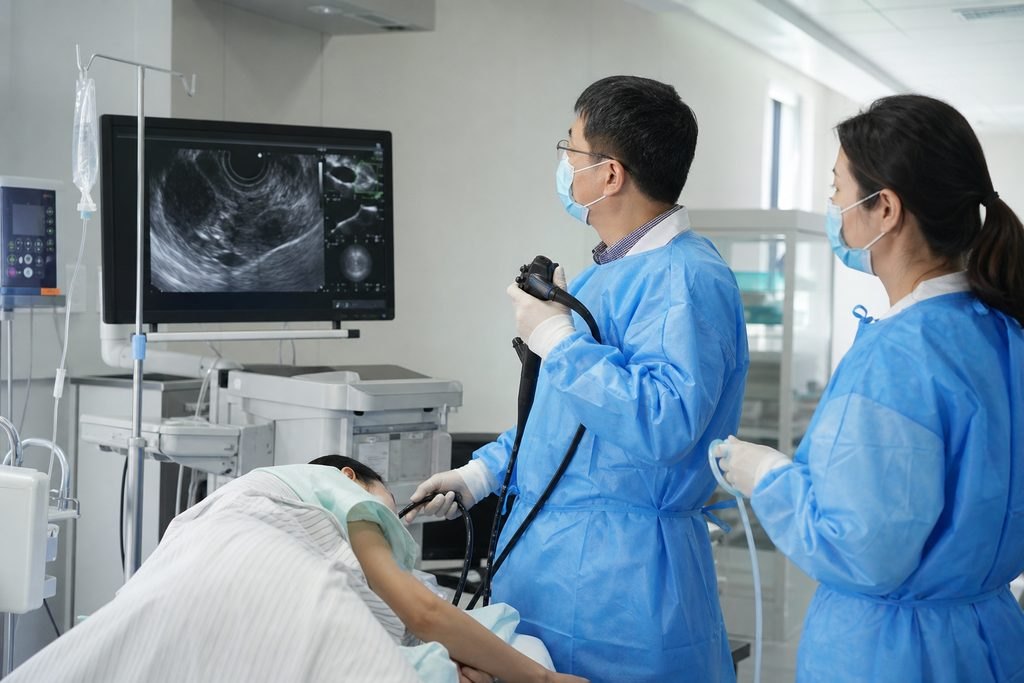
An endoscopic ultrasound examination places an ultrasound probe at the tip of an endoscope. From inside the digestive tract, the probe can examine the wall of the esophagus, stomach, duodenum or rectum, and structures lying close to it, such as the pancreas, bile ducts and nearby lymph nodes. That close range is the main reason a clinician may propose EUS rather than an external ultrasound or CT scan: the probe sits next to the area of interest instead of sending sound waves through the abdominal wall.
The images produced are a map, not a verdict. They can show the size, shape, border and internal texture of a structure, and whether it appears to arise from one layer of the gut wall or from outside it. They can show fluid collections, cysts, dilated ducts or enlarged lymph nodes. What they often cannot show on their own is the nature of the tissue. A mass that looks concerning on ultrasound may be inflammation; a lymph node that looks enlarged may be reactive. Imaging describes appearance, and appearance alone does not always distinguish between conditions that need very different treatment.
This is why the phrase 'understanding imaging findings' matters for your decision. If you are considering EUS in China, the useful question is not only 'what will the scan show?' but 'what will we do with what it shows?' The answer depends on whether the examination is purely diagnostic or whether it is planned to obtain a tissue sample at the same time.
Examination and sampling are two separate decisions
Endoscopic ultrasound can be performed as an imaging examination alone. In that case, the endoscopist examines the area, records images and describes what is seen. A report is produced, and your treating team uses it alongside your other scans, blood tests and history.
A different plan is EUS with tissue sampling. Here, a fine needle is passed through the endoscope under ultrasound guidance to reach a target such as a pancreatic mass, a lymph node or a fluid collection, and cells or fluid are removed for laboratory examination. This is sometimes called EUS-guided fine needle aspiration or fine needle biopsy. It is a separate procedure step with its own purpose, its own small set of risks, and its own preparation requirements.
The distinction changes what you need to ask. If you assume sampling is included and it is not, you may travel for an examination that answers only part of the question. If you assume it is not included and it is, you may not have completed the preparation that sampling requires. Neither assumption is safe. Ask directly whether the proposed examination includes tissue sampling or another intervention, and if so, what the target is and what the sample will be tested for.
It also matters who is asking. A gastroenterologist may propose EUS to characterise a finding. A surgeon may propose it to plan an operation. An oncologist may propose it to obtain tissue for diagnosis before treatment. The same examination can serve different purposes, and the sampling decision follows from the purpose.
Why the sampling question changes your preparation
Preparation for EUS is not identical for every patient. Fasting instructions, medication adjustments and whether you need someone with you afterwards depend on the plan, your other health conditions and the sedation approach the treating team chooses. If sampling is planned, the team may also need to review your blood clotting results and any blood-thinning medicines well before the appointment. Those are clinical decisions for the treating clinicians, not something to arrange from an article.
The practical consequence for an overseas patient is that you should not treat 'EUS' as a single fixed package. Ask the hospital what its written plan includes: the examination itself, any sampling step, sedation, laboratory processing of a sample, and the report. Ask what is not yet decided and what still depends on findings at the time. A written scope is more useful than a verbal summary, because it lets your home clinician see exactly what was proposed.
There is also a consent conversation to complete before sedation, not after. You should understand what the examination is for, what the alternatives are, what the small risks of the procedure are, and what happens if the findings are inconclusive. If you need interpretation, arrange it for that conversation rather than only for the procedure day.
How findings should reach your treating team
An EUS report is most useful when it travels with the images, not instead of them. Ask how the report and the image set will be provided to you, in what format, and whether an English-language report or translation can be arranged. These are questions for the specific hospital, because reporting formats and language support differ between institutions. Do not assume a particular format will be available.
Then ask how the findings will reach the clinician who will act on them. If you are being assessed in China and treated at home, your home team needs the images and the report, not a summary. If you are being treated in China, the endoscopist and the treating team should be able to discuss the case directly. Ask whether that discussion is part of the plan or whether you are expected to carry documents between departments yourself.
It is reasonable to ask what the report will contain. A useful report describes what was examined, what was seen, the size and location of any finding, and whether a sample was taken. It should also state the limitations of the examination. If a target could not be reached or a sample was not adequate, that belongs in the report, because it changes what your treating team can conclude.
Finally, ask what happens next if the findings are unclear. Sometimes the honest answer is that further tests or a repeat examination may be needed. Knowing that possibility in advance helps you plan, and it prevents an inconclusive result from feeling like a failure of the trip.
Records to prepare before asking for an EUS review
A records-based review can help a specialist judge whether EUS is a reasonable next step and what the examination should target. It cannot confirm suitability, and it does not replace the hospital's own assessment. What it can do is identify missing information early, before you make travel plans.
Prepare a short summary of your main question first. Then gather the records that describe the problem: recent imaging reports and the actual image files where available, endoscopy or colonoscopy reports, pathology reports from any previous biopsy, relevant blood test results, and a list of your current medicines with doses. If you have had previous treatment for the same problem, include a brief timeline of what was done and what the response was.
You do not need to send a complete medical archive at first contact. A brief summary with the key reports is enough for an initial review, and the team can tell you what else would be useful. Keep the original files; send copies.
- Your main question in one or two sentences.
- Recent imaging reports, and image files if available.
- Previous endoscopy or biopsy reports and pathology results.
- Current medicines and doses, including blood thinners.
- A short timeline of relevant treatment so far.
Questions to put to the hospital before you commit
The most useful preparation is a short list of questions sent in writing, so the answers can be checked against the written plan. Ask whether the proposed examination includes tissue sampling or another intervention, and if so, what the target is. Ask what preparation is required and whether any of your current medicines need review beforehand. Ask who will perform the examination and who will interpret the images.
Ask how and when the report and images will be provided, and in what language. Ask what the written plan includes and what remains undecided. Ask what the alternatives to EUS are in your situation, and what happens if the findings are inconclusive. Ask how the results will be shared with your treating team at home, if that applies.
These questions are not a substitute for the hospital's clinical assessment. Suitability for EUS, for sedation and for any sampling step is decided by the treating clinicians after they review your records and, where needed, examine you. No outcome can be guaranteed, and an initial enquiry does not commit you to any procedure.
If you would like help identifying the right questions and preparing a short summary for review, you can start with a free initial enquiry. The team checks the available diagnosis, records and your main question, identifies missing information and suggests a relevant next step. You can share records after first contact, and a proxy consultation is optional rather than a prerequisite.
Sources & scope of this guide
References and official service information relevant to this guide.
This is general planning information and has not been individually reviewed by a doctor. Medical decisions and personal treatment advice come from your treating clinicians.