
What an endoscopic ultrasound can and cannot tell from your file
Endoscopic ultrasound combines an endoscope with ultrasound to examine digestive structures and nearby organs. That definition matters for your question, because it describes a procedure that looks at anatomy from inside the body, not a test that can be completed by email. A specialist reading your earlier scans can form a view about which structures have been imaged, whether a previous study was adequate, and whether an endoscopic approach might add information. What no one can do from a file alone is reproduce the real-time view an endoscope gives, judge how your individual anatomy will appear on the day, or decide whether a tissue sample will be taken.
This is why the records you send should be chosen to answer a narrow question: what has already been looked at, and what gap remains? A well-organised file helps the specialist see whether the question is about the pancreas, bile ducts, stomach wall, mediastinum or another area, and whether earlier imaging already addressed it. A disorganised file, or one containing only a summary letter, often leads to a request for the original images before any useful opinion can be given.
It also helps to separate two things that patients often merge. An endoscopic ultrasound examination and a tissue sampling procedure are related but distinct. Some EUS examinations are done to look and measure; a biopsy, fine-needle aspiration or other sampling may be proposed separately depending on what is seen. Sending your records does not commit you to sampling, and it does not tell you in advance whether sampling will be recommended. That is a decision the endoscopist makes with you, usually after discussing what the images show and what the sample would be used for.
The earlier scans and reports that usually help most
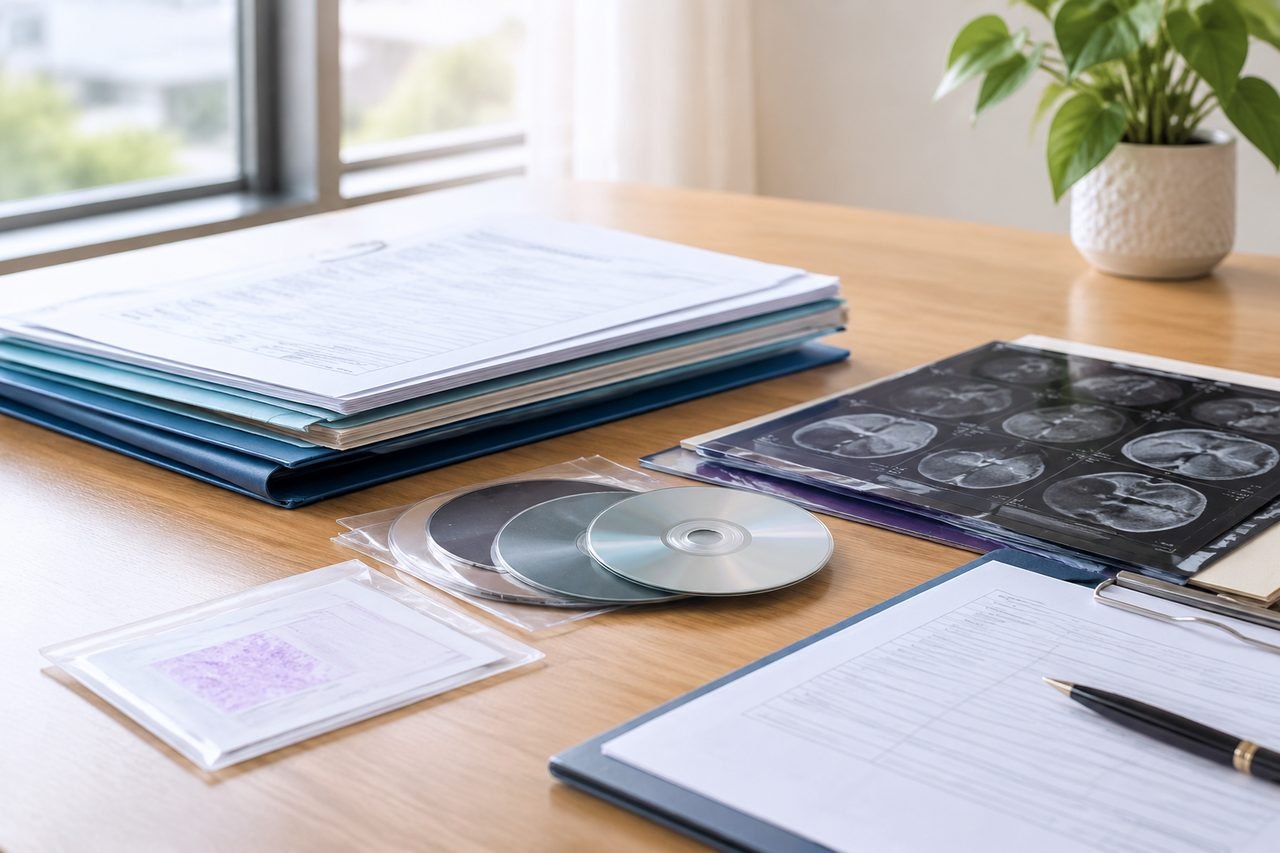
Start with imaging that already exists. If you have had a CT, MRI, MRCP or transabdominal ultrasound of the abdomen, send both the radiologist's report and the images themselves, ideally on the original disc or via a secure download link. Reports describe findings in words; images let a new specialist check the actual slices, measure structures and compare technique. A report alone may leave the reviewing clinician unable to judge whether a finding was subtle or clear, or whether the study covered the relevant area.
Next, send any previous endoscopy or EUS reports. If you have already had a gastroscopy, colonoscopy, ERCP or an earlier endoscopic ultrasound, those reports show what was seen, what was sampled and what the endoscopist concluded at the time. If a previous EUS was done, the report may state which station or structure was examined and whether a sample was taken. That history changes what a new team would consider repeating or extending.
Pathology reports matter if any tissue has ever been sampled. A biopsy or cytology report from a previous procedure can be more informative than a summary line in a discharge letter, because it states the specimen type, the description and the conclusion. If the original slides or blocks are available, a Chinese hospital may ask whether they can be reviewed; whether that is possible, and how, is a question to confirm with the receiving team rather than assume.
Blood results and medication lists complete the picture. Recent liver and pancreatic enzyme tests, full blood count, coagulation studies and tumour markers, if they have been done, help the clinician understand your current state. Your medication list should include prescribed medicines, over-the-counter products and any blood-thinning or anticoagulant drugs, because these affect procedure planning. Do not stop or change any medicine on your own; the treating team gives instructions about that.
- CT, MRI, MRCP or ultrasound reports plus the original image discs or download links
- Previous gastroscopy, colonoscopy, ERCP or EUS reports
- Biopsy, cytology or histopathology reports, and whether slides or blocks can be requested
- Recent blood tests relevant to the digestive system, liver and clotting
- A current medication list, including anticoagulants and blood thinners
- A short summary of your main symptom or question, in your own words
What remains uncertain when the specialist has only your records
A records-based opinion can clarify a lot, but it has limits you should understand before you plan around it. The reviewing clinician cannot feel your abdomen, cannot see how you respond during an examination, and cannot know how your individual anatomy will appear once the endoscope is in place. Findings that look concerning on a scan may look different on direct examination, and findings that look minor on a scan may need closer inspection. Treat the review as a step that narrows the question rather than a final answer.
It is also uncertain, before review, whether EUS is the right next test at all. A specialist might conclude that your existing imaging already answers the question, that a different test would be more useful, or that a repeat scan with a different technique is needed first. Alternatively, the review might confirm that EUS is appropriate and that a tissue sample should be discussed. None of these possibilities can be settled by the patient in advance, and none should be presented as a likely outcome before a clinician has seen the file.
Another uncertainty is timing and preparation. Endoscopic ultrasound is performed with sedation or anaesthesia, and the preparation instructions depend on the area being examined and the clinician's plan. Whether you need to fast, for how long, and what adjustments are needed for diabetes medicines or anticoagulants are questions for the treating team. Do not apply rules from a different hospital or country to your Chinese appointment; ask what this provider requires.
Finally, the review cannot confirm hospital acceptance or a final treatment plan. A specialist can give an opinion on the records, but the hospital decides whether to accept you as a patient and what it proposes after seeing you. Treat any pre-travel opinion as a basis for planning, not as a guarantee of what will happen on arrival.
How to organise the gaps without ordering new tests yourself
The practical task before you send anything is to work out what is missing, not to fill every gap with a new test. Go through your records and list what you have for each relevant area: imaging, endoscopy, pathology, blood tests and medication. Where a report exists but the images do not, note that. Where a procedure was done but the report is missing, request it from the hospital that performed it. Where a pathology report exists but the slides are held elsewhere, note whether they can be requested. This list is more useful to a reviewing clinician than a pile of unrelated documents.
Do not arrange new scans or blood tests on your own initiative in the hope of making the file complete. A test done without a clear clinical question can add cost, delay and confusion, and it may not be the test the specialist would have chosen. If the reviewing clinician needs something further, they will say what and why. Your role is to supply what already exists and to be honest about what does not.
When you send records, include a short cover note. State your main symptom or question in a few sentences, list the documents you are sending, and note anything you know is missing. This helps the receiving team route your file to the right specialist and avoids the common problem of a file arriving without context. Keep the note factual; you do not need to interpret your own scans.
If you are sending images, check that the disc or link actually opens and contains the full study, not just a few screenshots. A partial set of images can be less useful than a clear report. If you are unsure how to export images from your hospital's system, ask its records department for help before you travel.
Questions to ask before you commit to travelling for EUS
Once a specialist has reviewed your records, the useful conversation is about what the review did and did not establish. Ask whether the existing imaging is adequate for the question being asked, and if not, what specifically is missing. Ask whether the proposed procedure is diagnostic only or whether tissue sampling may be part of it, and under what circumstances sampling would be recommended. Ask what preparation the procedure requires and how your current medicines should be managed. Ask who will discuss the findings with you afterwards and in what language.
It is reasonable to ask how the hospital handles the records you send, who reviews them, and whether a preliminary opinion can be given before you book travel. It is also reasonable to ask what the hospital's written plan and estimate include, so that you understand the scope of what you are agreeing to. These are administrative and planning questions, not clinical ones, and the hospital or your coordination contact can answer them.
Avoid asking for a guaranteed diagnosis, a promised outcome or a fixed answer about whether cancer will be found. Endoscopic ultrasound can provide information that helps a clinician assess a problem, but it does not predict results in advance, and no responsible clinician will promise a finding before the examination. If a service offers certainty before review, treat that as a warning sign.
If your symptoms are worsening, or if you develop new severe pain, vomiting, jaundice or bleeding, seek local medical care promptly rather than waiting for an overseas appointment. Travel planning should not delay assessment of an urgent problem.
A practical next step
Gather the reports and images you already have, write a short summary of your question, and send that brief summary through the enquiry form, email or WhatsApp. An initial enquiry is free and does not require buying a proxy consultation. The team can check what you have, point out obvious gaps and suggest the relevant next step, while the treating hospital and its clinicians decide whether endoscopic ultrasound is suitable for you and what it will involve.
Sources & scope of this guide
References and official service information relevant to this guide.
This is general planning information and has not been individually reviewed by a doctor. Medical decisions and personal treatment advice come from your treating clinicians.