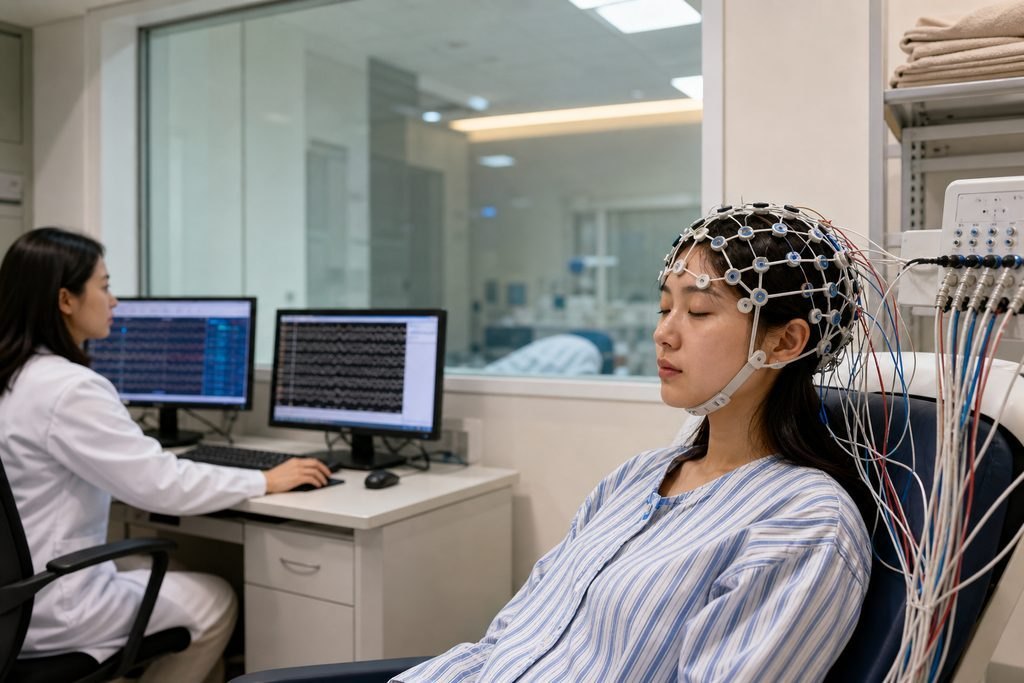
What an epilepsy surgery assessment is actually deciding
Epilepsy surgery is not a single operation. It is a treatment route considered for selected people whose seizures are not controlled by medicines, and assessment weighs potential benefits against risks. That sentence is the whole clinical frame. Everything else in this guide is about how you present your own history so a specialist can begin that weighing process.
The assessment is not asking 'do you want surgery?' It is asking a set of narrower questions. Where do the seizures start? Is that area safe to operate on, or does removing it risk speech, memory, movement or vision? Are the EEG findings, the MRI findings and the seizure description pointing to the same place? Has the person already tried enough appropriate medicines, at adequate doses, for long enough?
Those questions cannot be answered from a folder of PDFs alone. A specialist reading records can form a provisional view, identify what is missing, and say what would need to happen next. That is different from confirming that surgery is suitable, and different again from confirming that a hospital will accept you for assessment.
This distinction matters when you are planning care in another country. You are not trying to prove you are a surgical candidate before you travel. You are trying to give the receiving team enough accurate information to decide whether a full assessment is worth arranging.
The records that genuinely change a specialist's view
Not all records carry equal weight. A specialist can do more with a well-described seizure history and original EEG and MRI data than with a stack of discharge summaries that repeat each other. The aim is to make your file readable and traceable, not enormous.
A seizure diary is often the single most useful document you can prepare yourself. It does not need to be elegant. For each event, note the date, the time, what happened before it, what the person was doing, what an observer saw, how long it lasted, and how the person was afterwards. Distinguish events that look different from each other. If a family member or partner witnesses the seizures, their description is valuable because the person having the seizure may not remember it.
For EEGs, the report alone is a summary. The original recordings and the technologist's notes are what allow another centre to review the findings rather than accept a conclusion. Ask the performing hospital what format they can provide and whether the raw data can be exported. If only a report exists, say so plainly rather than presenting it as equivalent.
For MRI, the same principle applies. The images themselves, ideally on disc or via a secure transfer, matter more than the radiologist's paragraph. If your epilepsy protocol MRI was done some time ago, or was a general brain scan rather than a dedicated epilepsy study, that is a question for the receiving clinician, not something to resolve by arranging a new scan yourself.
Medicine history is frequently under-documented. A simple table of every anti-seizure medicine tried, the dose, how long it was taken, whether it helped, and why it was stopped gives the specialist the information needed to judge whether medical treatment has been adequately explored.
- Seizure diary with dates, descriptions, duration and observer accounts
- Original EEG recordings and reports, not summaries alone
- MRI images on disc or transferable format, plus the report
- A medicine table: drug, dose, duration, response, reason stopped
- Any video of a typical event, if you already have one
- Relevant history: febrile seizures, head injury, infections, family history
What remains uncertain when only records are reviewed
A records-based opinion has real limits, and understanding them prevents disappointment. The specialist cannot examine you, cannot test your memory or language function in person, cannot observe a seizure, and cannot run the investigations that a full assessment may require.
This means several things stay open. Whether your seizures are focal or generalised may be clear from your records, or it may remain contested. Whether the MRI abnormality is the cause of the seizures, or an incidental finding, may need further review. Whether you are a candidate for surgery at all is a conclusion the treating team reaches after its own assessment, not something a remote review can settle.
There is also a practical uncertainty about what a Chinese centre would want to repeat. Some tests may be accepted from your home country; others may need to be redone because the original data is unavailable, the protocol differs, or the team needs its own baseline. You cannot know this in advance, and you should not assume either way. The honest position is that the receiving team decides, and you can ask them directly what they would require.
Language adds another layer. EEG and MRI reports written in another language may need translation, but a translated summary is not the same as the original data. Ask whether the centre wants the original files alongside any translation.
Organising the gaps without ordering tests yourself
When you review your own records, you will notice holes. A missing EEG from three years ago, an MRI report without images, a medicine you cannot remember the dose of. The instinct is to fill these gaps immediately by arranging tests. Resist that instinct, at least until a clinician has said what is actually needed.
Ordering tests independently can waste money and create confusion. A scan done without the right protocol may not answer the question the specialist is asking. An EEG done at a centre without epilepsy expertise may add little. Worse, a new test result arriving out of sequence can complicate rather than clarify the picture.
What you can usefully do is document the gaps clearly. Make a short list: what is missing, when it was done, where it was done, and whether you can obtain it. That list is itself useful information for the receiving team, because it tells them what they would need to arrange if you proceed.
For records you can obtain, request them now rather than later. Hospitals vary in how quickly they release images and recordings, and some charge an administrative fee. This is a practical task you can complete while clinical decisions are pending, and it does not commit you to anything.
Questions that change the next step
The value of a specialist conversation lies in the questions it answers. Before you commit to travel, you want to know whether the assessment is likely to be productive, what it would involve, and what the alternatives are if surgery is not recommended.
Ask directly whether your seizure type and MRI findings make you a plausible candidate for assessment, or whether the records suggest a different direction. Ask what the assessment would typically include at that centre, and which parts could be done before travel versus in person. Ask what the team would need from you to give a meaningful opinion.
Ask about the alternatives as well. Surgery is one option among several for drug-resistant epilepsy, and a specialist may recommend further medication trials, dietary approaches, or device-based treatments instead. You are entitled to understand why one route is being suggested over another.
Ask who makes the final decision. In complex epilepsy cases, the decision is often made by a multidisciplinary team rather than one surgeon. Knowing this helps you understand the process and ask the right questions at the right stage.
Preparing for the practical side of assessment in China
If you and the receiving team agree that assessment is worth pursuing, practical preparation begins. This is not the same as booking surgery. It is arranging the conditions under which a proper assessment can happen.
You will need to confirm what the hospital requires for registration, what records to bring in original form, and whether an interpreter is needed for consultations. If you take regular medication, ask the treating team how prescriptions are handled during your stay; do not assume your home supply will be sufficient or that the same brands are available.
Travel timing should follow clinical advice, not precede it. If seizures are frequent or poorly controlled, the safety of travelling is a clinical question for your current treating team. Do not treat an overseas assessment as a reason to delay urgent local care.
For patients who want an initial view before committing to travel, a records-based review can clarify whether the available information supports further assessment. This is a non-clinical intake step, not a diagnosis, and it does not replace the hospital's own evaluation. You can begin with a brief summary through the enquiry form, then share records once the team has responded.
The relevant procedure reference on this site is Epilepsy Surgery, which describes the treatment route in more detail. Use it alongside this guide, not instead of direct clinical advice.
Sources & scope of this guide
References and official service information relevant to this guide.
This is general planning information and has not been individually reviewed by a doctor. Medical decisions and personal treatment advice come from your treating clinicians.