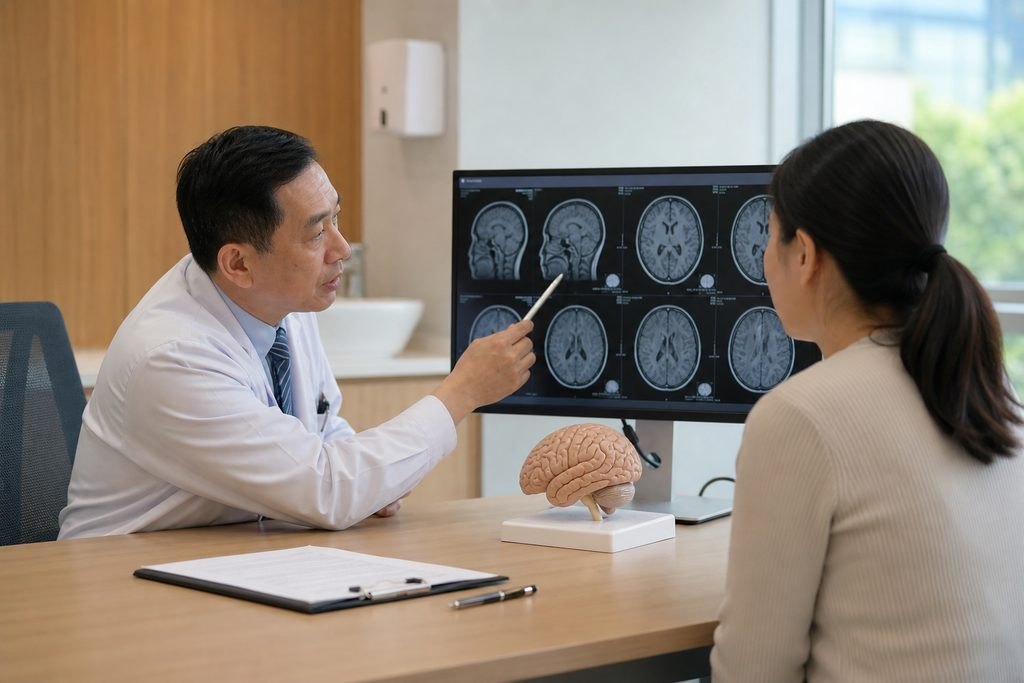
Why the risk conversation must be personal, not general
A general article cannot tell you whether epilepsy surgery is right for you, and it should not try. The clinical decision belongs to the treating team, based on your seizure history, diagnostic studies and how your seizures affect your life. What this guide can do is help you prepare questions that produce usable answers rather than vague reassurance.
The starting point is the same in any health system: epilepsy surgery can be considered for selected people whose seizures are not controlled by medicines, and assessment examines potential benefits and risks. That sentence contains two ideas you should keep separate when you speak to a clinician. The first is whether you are among the people for whom surgery is a reasonable option at all. The second is what the specific operation would mean for you: which risks are relevant, how likely they are in your situation, and what happens if you choose not to operate.
Overseas patients often arrive at this conversation with a folder of scans and a hope for a clear yes or no. A better preparation is a list of questions whose answers will actually change your decision. If a clinician cannot answer a question because a test has not been done, that is useful information too. It tells you what the next step in assessment is, rather than leaving you to guess.
Which presurgical assessments are needed, and who decides
Presurgical evaluation is not a single test. It is a process that builds a picture of where your seizures start, whether that area can be safely addressed, and how your brain functions around it. Different patients need different combinations of investigations, and the exact list depends on your history and previous results. Ask the team to explain which assessments are needed in your case and why each one matters.
A practical question is: "Based on the records I have sent, what is missing before you can give a view?" This is more useful than asking for a universal checklist, because no responsible clinician will apply the same test list to every patient. You can also ask whether any assessment can be done locally before travel and which parts must be done at the treating hospital. The answer will shape both your planning and your expectations.
It also helps to ask who coordinates the evaluation. In a complex case, several specialties may be involved, and you should know which clinician is responsible for pulling the information together and communicating the conclusion to you. If you are considering care in China, ask how the hospital handles records in your language and whether an interpreter will be present for the discussions that matter most.
How to ask about risks without demanding a guarantee
Risk questions are often phrased as "Is this dangerous?" That question invites a reassuring answer rather than a useful one. Try instead: "What are the main risks of this operation for someone with my seizure history and my imaging findings?" Then ask a follow-up: "How uncertain are those estimates, and what would make them better or worse in my case?"
You are entitled to ask about evidence-based risk estimates. A clinician can discuss what is known from experience and published evidence, and can also explain the limits of that knowledge. What no one can offer is a guarantee of a particular outcome. If you hear a number, ask what it is based on and whether it applies to patients like you. If you hear only generalities, ask which specific factors in your history the team is weighing.
It is also reasonable to ask about the risks of not operating. Continued seizures carry their own consequences, and the balance between surgical and non-surgical paths is part of the assessment. Ask the team to explain how they think about that balance in your case, and what would change their recommendation. This keeps the discussion honest without asking anyone to decide for you.
Alternatives: what they are and what they are not
Alternatives to surgery are not a single fallback option. They may include continuing or adjusting medication, further diagnostic work, or other approaches that the treating team considers appropriate. The important question is not "What else exists?" but "What are the realistic alternatives for me, and what are their own risks and burdens?"
Ask the team to compare the options they consider relevant, including what each would require from you in terms of monitoring, follow-up and lifestyle. If a clinician says surgery is the only option, ask why the other possibilities are not suitable in your case. If a clinician says surgery is not appropriate, ask what would need to change for it to be reconsidered. Both answers tell you something concrete.
Be cautious about any source that presents one approach as universally superior. The choice depends on the individual. Your job in the consultation is to understand the reasoning, not to select a treatment from a list. If you feel rushed, say so and ask for the discussion to be continued after you have had time to consider the information.
Continuing neurological care after the visit
An assessment visit is not the end of the process. Whether or not surgery goes ahead, you will need a plan for ongoing neurological care. Ask how the treating team would coordinate with your neurologist at home, what information they would send, and how often they would expect to review your situation. If you do not have a local neurologist, ask what the team recommends for follow-up in your own country.
Medication is a common source of confusion. Do not change any prescribed treatment on the basis of an article or a remote opinion. Ask the treating team how any proposed changes would be managed, who would supervise them, and what you should do if you experience new or worsening symptoms. If you are travelling, ask what arrangements are needed before you return home.
It also helps to clarify who to contact with questions after the visit and how quickly you should expect a response for non-urgent matters. Urgent or worsening symptoms need local emergency care, not an overseas enquiry. Make sure you understand the difference before you travel.
Preparing your records and your questions before you travel
Good preparation makes the consultation more productive. Gather your seizure history, including when seizures started, how they have changed, and which medicines you have taken and for how long. Include the results of any previous investigations, such as imaging and EEG reports, and a clear list of your current medications with doses. If your records are not in English or Chinese, ask about translation before you travel.
Write your questions down and bring them to the appointment. Prioritise the ones whose answers would change your decision. A short, focused list is more useful than a long one you cannot cover in the time available. If you are using a coordinator to help with appointments, make clear that clinical questions must be answered by the treating team, not by a non-clinical service.
Finally, keep your expectations realistic. An initial enquiry is free and does not commit you to anything. A records-based opinion is optional and does not guarantee hospital acceptance or a particular outcome. The hospital decides suitability after its own assessment. Your next step is to send a brief summary of your situation and ask which records the team would like to review first.
Sources & scope of this guide
References and official service information relevant to this guide.
This is general planning information and has not been individually reviewed by a doctor. Medical decisions and personal treatment advice come from your treating clinicians.