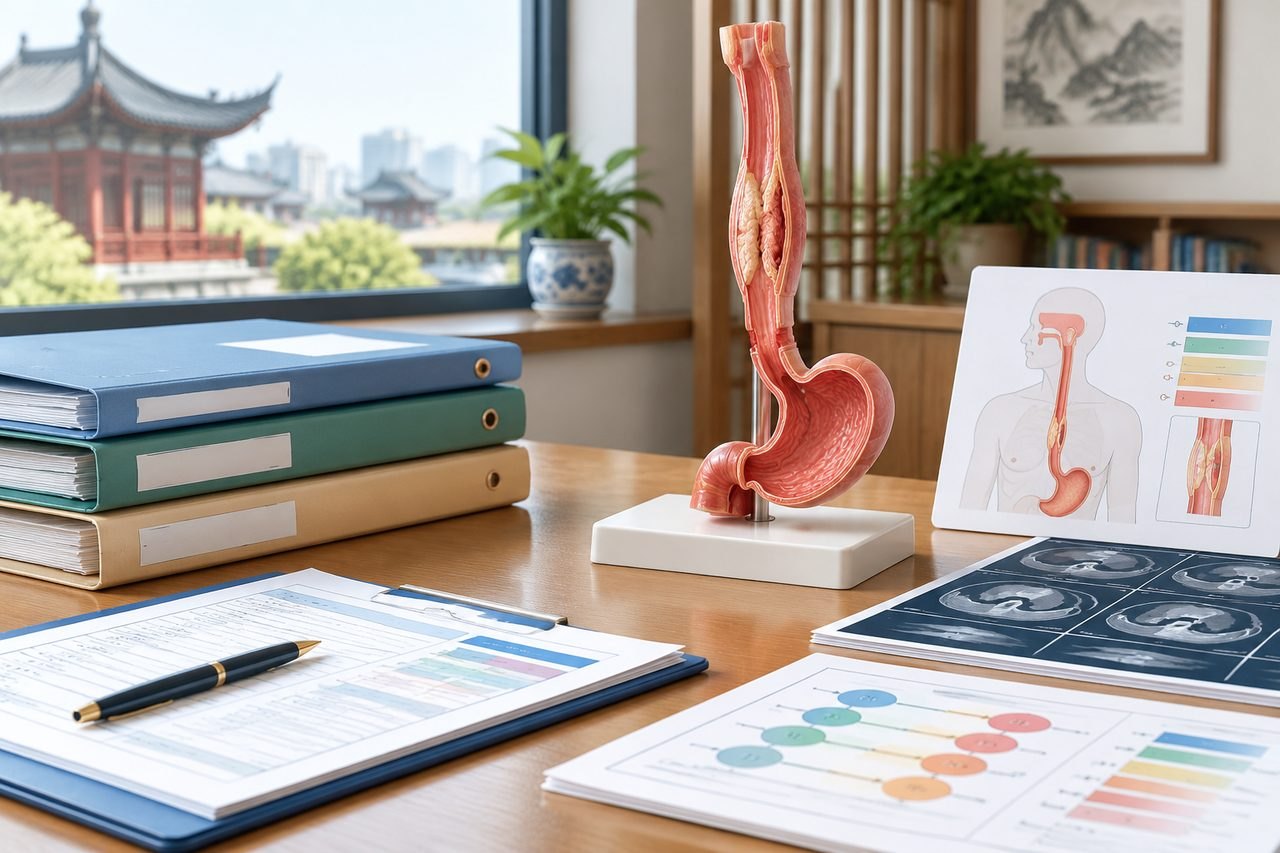
What Staging Records Actually Tell a Surgical Team
An esophagectomy removes part or all of the esophagus, and the proposed extent needs an individual discussion. That single sentence explains why staging records sit at the centre of any surgical review. The records are not a formality attached to a diagnosis. They are the evidence a surgeon uses to decide whether removing part of the esophagus is a reasonable option at all, and if so, how much tissue the operation would involve.
Staging describes the cancer's local depth, whether nearby lymph nodes are involved, and whether disease has been found elsewhere in the body. Each of those three questions changes the surgical conversation in a different way. A tumour confined to the esophagus raises one set of decisions. A tumour with involved nodes raises another. Evidence of distant spread usually shifts the discussion away from surgery and toward systemic treatment, though the treating team makes that judgement.
This is why a pathology report alone is rarely enough for an esophagectomy review. The pathology report describes the tissue sample. Staging records describe the whole patient's disease distribution. A surgeon reading only the biopsy may know what the cancer is but not how far it has gone, and the operation's scope depends on the second question as much as the first.
For an overseas patient, the practical consequence is straightforward. Before a China hospital can give a meaningful opinion on esophagectomy suitability, it needs the imaging and reports that establish stage, not just the diagnosis. Missing staging records do not necessarily block clinical assessment, but they limit how specific any surgical opinion can be.
Which Records Belong in a Staging File
A staging file for esophageal cancer review typically includes the endoscopy report with its description of the tumour's location and appearance, the biopsy pathology report with histology and any available markers, and cross-sectional imaging such as CT of the chest and abdomen. Many teams also use endoscopic ultrasound, PET-CT, or both, depending on the question being answered. Which of these a particular hospital requires is a question for that hospital, not a universal checklist.
The value of each item is different. Endoscopy shows the tumour's position along the esophagus, which matters because the esophagus runs from the neck to the stomach and the surgical approach changes with height. Pathology confirms the cancer type. CT and PET-CT address spread. Endoscopic ultrasound addresses depth and nodal involvement near the tumour. A file missing any one of these leaves a specific question unanswered.
Records should be shared as complete reports with images where possible, not summaries. A radiologist's impression is useful, but the treating surgeon may want to review the actual images. If imaging was done at a facility that provides discs or secure digital access, those are worth requesting before any review.
Language matters here. Reports in a language the receiving team cannot read may need translation, and the hospital should be asked what it accepts and whether it arranges translation itself. This is an administrative question with a real clinical consequence: a surgeon who cannot read the staging report cannot use it.
How Staging Changes the Proposed Operation
The extent of an esophagectomy is not a fixed package. Surgeons describe operations by which portion of the esophagus is removed, how the stomach or another organ is used to reconstruct the digestive tract, and which lymph node fields are addressed. Staging findings feed directly into those choices.
A tumour high in the esophagus may require a different reconstruction than one near the junction with the stomach. Nodal involvement may change how extensive the lymph node dissection is. Evidence of spread beyond the esophagus may mean the team recommends treatment before surgery, or a non-surgical pathway entirely. None of these decisions can be made from a diagnosis alone.
This is also why two patients with the same diagnosis can receive different surgical plans. The plan reflects stage, tumour location, the patient's general condition, and the treating team's judgement. An overseas patient asking whether esophagectomy is possible in China is really asking a staged question: possible given what stage, and possible with what extent.
A records-based review can clarify what the staging shows and what questions remain. It does not establish final surgical eligibility, and it does not replace the hospital's own assessment. The hospital decides suitability after reviewing the case.
Nutrition and the Coordination Question Before Surgery
Esophageal cancer often affects swallowing, and nutrition status can influence how a surgical team approaches treatment. This is why nutrition arrangements belong in the same conversation as staging, not in a separate administrative track.
Patients should ask how the hospital would assess nutritional status before surgery, what support options exist if swallowing is impaired, and how nutrition would be managed during the hospital stay and after discharge. These are questions for the treating team, because the answers depend on the individual's condition and the hospital's practice.
The coordination question is broader. Before the hospital stay, who reviews the staging records, who decides on the surgical plan, and what additional tests the hospital would want? After the stay, how would follow-up, any further treatment such as chemotherapy or radiotherapy, and nutritional support be arranged? For an overseas patient, knowing who owns each step reduces the risk of arriving without a clear plan.
It is reasonable to ask the hospital, in writing, how the operation, nutrition support, and any further treatment would be coordinated before and after the hospital stay. A written answer gives the patient something concrete to compare and prepare around.
What an Initial Enquiry Can and Cannot Do
An initial enquiry to ChinaSpecialistCare is free and non-clinical. The team checks the available diagnosis, records, and the patient's main question, identifies missing information, and suggests a relevant next step. This is not a diagnosis and not a promise of hospital acceptance.
If the staging file is incomplete, the useful outcome of an enquiry is a clear list of what is missing and why it matters. That is different from a clinical opinion. A records-based specialist opinion, where a doctor takes the records to a relevant hospital specialist while the patient remains at home, is a separate optional step and is not a prerequisite for every appointment or operation.
Patients should not delay necessary local care while pursuing an overseas enquiry. If symptoms are worsening, local assessment takes priority. An overseas review is a planning activity, not an emergency pathway.
The hospital, not the coordination team, decides whether an esophagectomy is suitable, what extent is proposed, and what additional tests are needed. The coordination role is to help the right records reach the right clinical team and to keep the patient informed about what remains to be confirmed.
Practical Preparation Before a China Review
Start by assembling the staging file in one place: endoscopy report, pathology report, and the imaging reports and images that establish stage. Note the date of each study, because a surgical team will want to know how current the staging is.
Then write down the specific questions the patient wants answered. Whether surgery is suitable. What extent of esophagus would be removed. How nutrition would be managed. What further treatment might follow. How follow-up would work after returning home. These questions turn a general enquiry into a focused review.
Ask the hospital what it needs and what it provides. Which records does it require? Does it need translated reports? Does it review images remotely? What does its written estimate include, and what remains undecided until after clinical assessment? These are provider-specific questions, and the answers should come from the hospital in writing.
Finally, keep expectations aligned with what staging records can and cannot show. They can support a more specific surgical discussion. They cannot guarantee suitability, define an outcome, or replace the treating team's assessment. The next step is to gather the staging records, share a brief summary through the enquiry form, email, or WhatsApp, and ask what information the relevant hospital would need to review the case.
Sources & scope of this guide
References and official service information relevant to this guide.
This is general planning information and has not been individually reviewed by a doctor. Medical decisions and personal treatment advice come from your treating clinicians.