
Home / Thoracic Surgery / Esophagectomy
Thoracic surgery patient guide · 食管切除术

Esophagectomy in China

Considering esophagectomy in China? Start with staging records, surgical scope and nutrition arrangements. This guide helps you identify the relevant records, questions for the receiving team and the scope of an individual estimate before a visit is agreed.

Chinese esophageal surgeon explaining esophagectomy and reconstruction to an international patient and family

Medical cost reference

Indicative · not a quotation

Esophagectomy costs in China

US$14,500–42,000

Original USD reference

Other currencies are approximate equivalents, not a quote or payment rate. Reference FX: ECB · 2 October 2026. Local snapshot, not live.

Esophagectomy; resection, reconstruction, intensive care and additional treatment need confirmation.

This published reference range is a starting point for planning, not a fixed price or a China-wide average. Cities, public and private hospitals, procedure details and individual care needs affect costs. The hospital must confirm what is included and provide an estimate after reviewing your case.

  • Resection and reconstruction plan
  • Surgical approach and additional treatment
  • Admission, nutrition and recovery support

Hospital medical fees, travel and our coordination services are separate. Any paid specialist review or coordination service is explained and agreed before you proceed.

Your next step

Start with your question

Tell us your diagnosis and what you need. Our free initial review checks the information and helps identify a suitable next step; it is not a specialist opinion or a hospital quotation.

Request a case-based estimate

Not ready to send records? Ask us first. Where hospital review is appropriate, we can help request an estimate. No travel commitment or mandatory proxy consultation.

Planning esophagectomy in ChinaHospital review · individual costs · visit and follow-up

Plan the visit around staging records, surgical scope and nutrition arrangements. Agree the assessment route before travel.

Records for the esophagectomy review

Tell us what you already have: Endoscopy report images and biopsy pathology; Contrast CT and PET DICOM; Endoscopic-ultrasound report if performed. Start with a short summary; after first contact we explain which records the receiving team needs and how to share them.

Confirm the proposed scope and costs

Review the published reference below with the receiving team. Confirm the particular procedure, hospital and items included in your own estimate; the reference is not a confirmed quotation.

Visits and care after returning home

Ask how the operation, nutrition support and further treatment would be coordinated before and after the hospital stay. Tell us if you need interpretation or English-language documents, and confirm the relevant arrangements with the receiving team.

Esophagectomy removes the diseased segment and rebuilds swallowing continuity

The surgeon removes part or most of the esophagus and nearby lymph nodes, then usually reshapes the stomach into a conduit that reconnects the remaining esophagus.

The approach depends on tumor location, stage, prior chemoradiation, stomach suitability, lung and heart reserve and the team’s plan for lymph-node removal and anastomosis.

Stage and treatment sequence come before incision choice

Ask whether surgery follows chemotherapy or chemoradiation, what evidence shows resectability and how nutrition will be supported before and after treatment.

Who may be considered?

Specialist review may help when the diagnosis, symptoms and previous treatment create a focused question about esophagectomy.

  • Resectable esophageal or gastroesophageal-junction cancer after multidisciplinary staging.
  • Selected high-grade dysplasia or early disease not suitable for endoscopic treatment.
  • A localized benign stricture or injury requiring reconstruction in exceptional cases.
  • A patient fit enough for major thoracoabdominal surgery and rehabilitation.

What the specialist team must confirm

Review includes endoscopy and biopsy, contrast CT, PET when indicated, endoscopic ultrasound, treatment response, airway involvement, cardiopulmonary testing, weight loss, swallowing, nutrition, frailty and previous abdominal or chest surgery.

Key points for this treatment
Purposeremove diseased esophagus and nodes
Reconstructionusually stomach conduit
Sequenceoften multimodality cancer care
Recoverynutrition swallowing and lung care
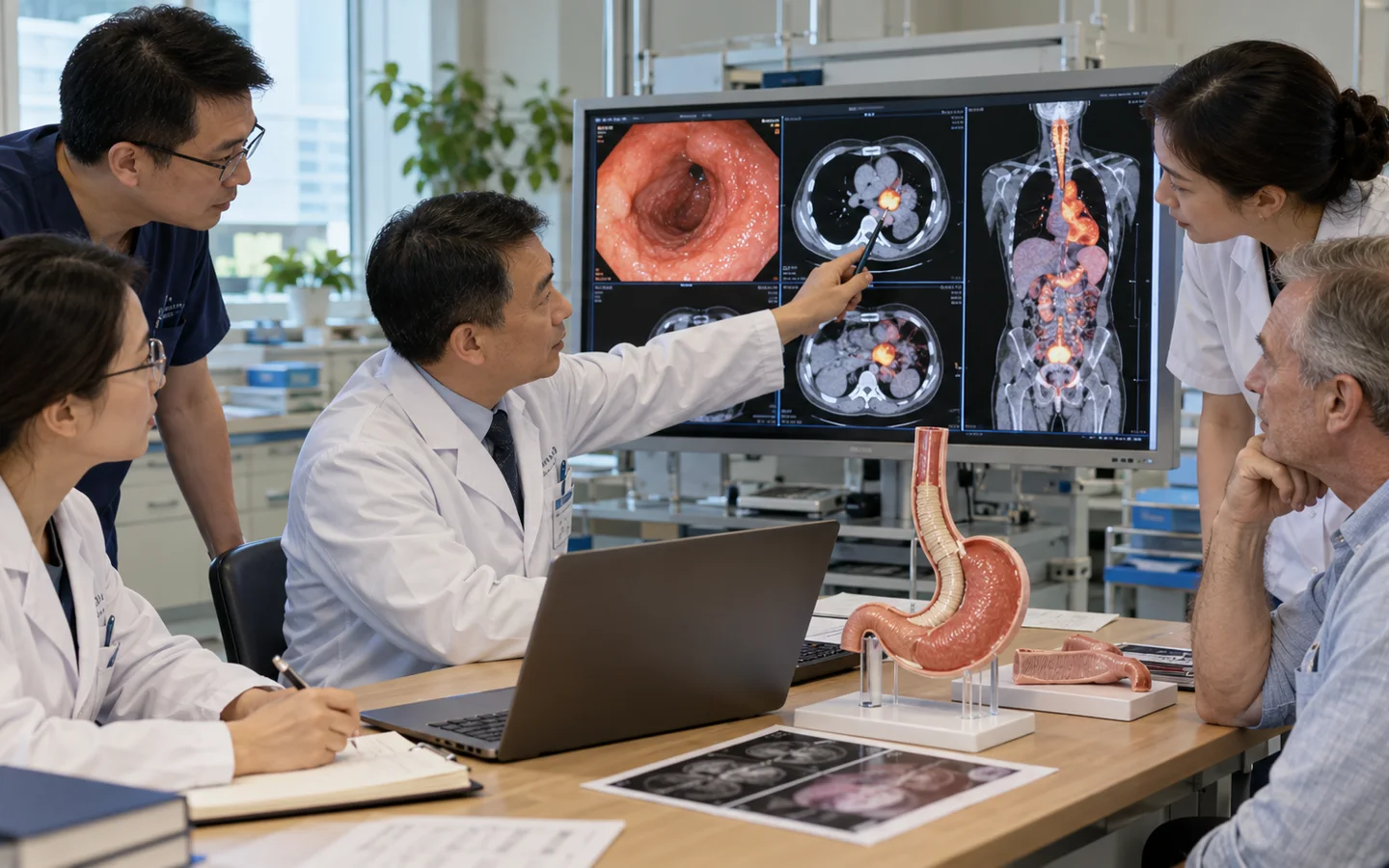
Chinese multidisciplinary upper gastrointestinal team reviewing endoscopy PET CT and a stomach conduit plan
Reconstruction is planned at the same time as resectionThe stomach or an alternative conduit, route through the chest and anastomosis location must be feasible before surgery begins.

From staging and prehabilitation to resection and reconstruction

The multidisciplinary team coordinates oncology, surgery, nutrition and rehabilitation so that treatment intensity matches expected benefit.

StageConfirm resectability and treatment sequence
PrepareImprove nutrition breathing and fitness
ResectRemove esophagus and planned lymph nodes
RebuildCreate conduit and restore swallowing route

Recovery prioritizes lungs, anastomosis and nutrition

Early care monitors breathing, heart rhythm, pain, drains and signs of anastomotic leak. Feeding may use a tube while the new connection is assessed according to the centre’s protocol.

Later recovery involves small frequent meals, weight monitoring, reflux and dumping management, swallowing review and cancer surveillance.

International patient working with a dietitian on small meals and walking after esophagectomy
Eating changes after reconstructionDietitians help patients rebuild intake while monitoring dehydration, weight loss and symptoms related to the new stomach position.
Stable connectionAdvance intake under protocol
Leak concernImage and treat promptly
Weight lossEscalate nutrition support
Cancer reviewFollow final pathology and surveillance

Risks, limits and realistic expectations

Esophagectomy carries risks of leak, pneumonia, bleeding, infection, atrial fibrillation, recurrent-laryngeal-nerve injury, chyle leak, stricture, delayed stomach emptying, long-term nutrition problems and death.

Do not delay urgent local care

Fever, chest pain, new breathlessness, rapid heart rate, inability to swallow, persistent vomiting or wound drainage needs urgent local review.

Before hospital review

Records for esophagectomy assessment

A safe international review depends on dated source reports, original imaging and a complete treatment timeline—not a diagnosis label alone.

Endoscopy report images and biopsy pathology
Contrast CT and PET DICOM
Endoscopic-ultrasound report if performed
Chemotherapy and radiotherapy summaries
Pulmonary and cardiac assessment
Weight nutrition and swallowing history
Previous abdominal or chest operation notes
Current medicines allergies and functional status

Tell us what you need

Ask about your care,
your hospital and your budget.

You can ask about suitability, an expert opinion, an appointment or the likely medical cost. If you are unsure, choose “Not sure — please advise”.

This enquiry is aboutEsophagectomyNot sure — please advise

How a personal estimate is prepared

  1. Tell us about your case.Describe your diagnosis, main question and preferred city, if any.
  2. Share the relevant records.We explain what is needed and how to send it by WhatsApp or email.
  3. Request a hospital estimate.Where appropriate, we help request hospital review and a cost estimate. Any paid review is agreed first.

This is an enquiry, not an order or payment. Proxy consultation is not mandatory. Any service scope is agreed separately before you proceed.

Ask about Esophagectomy

A first enquiry is free. Email and permission to respond are required; the other details are optional. Any paid clinical review or coordination is discussed separately.

Included automatically so we know which procedure you are asking about.
A preference, not a confirmed appointment.
Please do not send passport numbers, card details or full medical files in this first enquiry. We will explain which records are needed next.

Send a short summary first. This is an enquiry, not an order, payment or confirmed appointment.

No booking or payment is made by sending this enquiry.
Editorial transparency

Medical sources

Patient information is based on established government and professional guidance. Content updated 5 October 2026. This is patient information, not an individual clinical assessment.