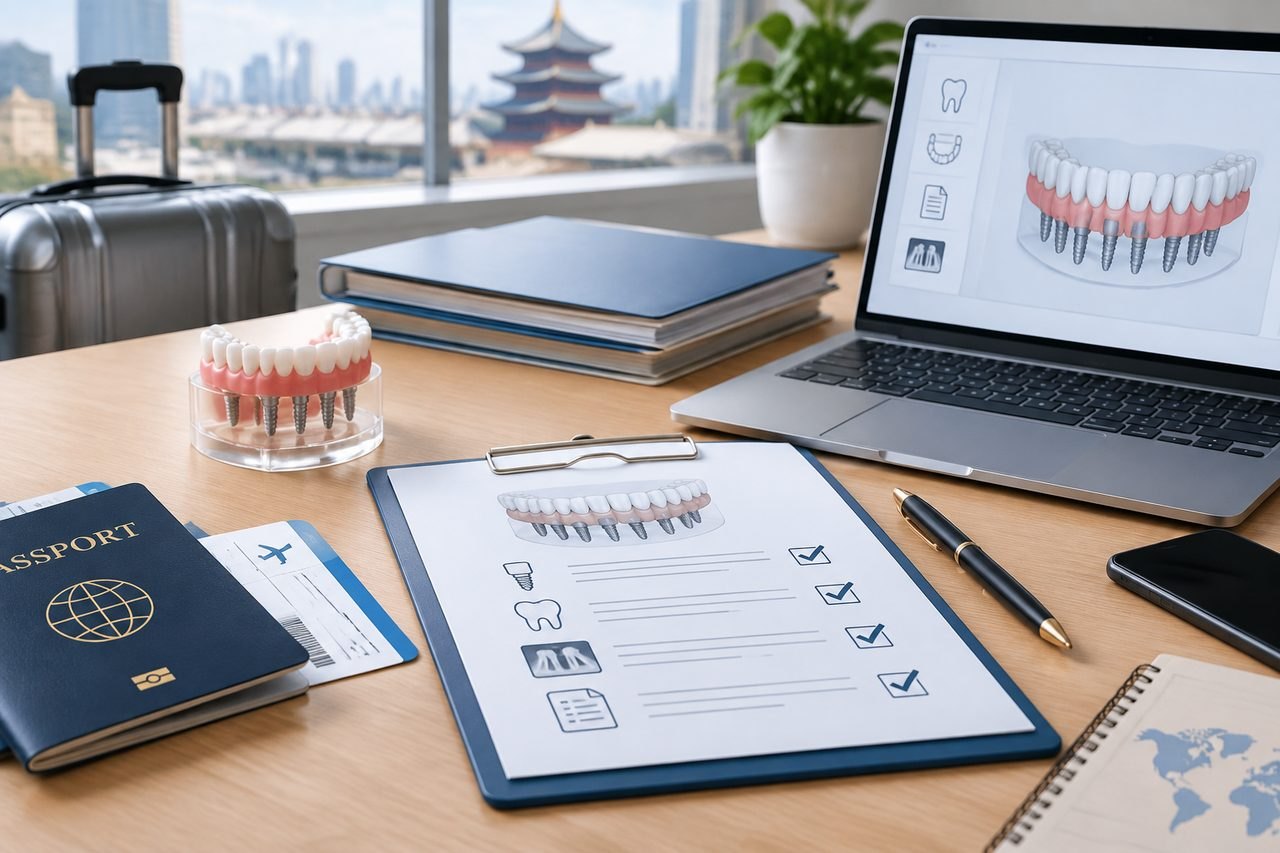
Why the handover matters more than the distance
Full-arch implant treatment is not one appointment. Dental implants support replacement teeth, and placement and the restorative phase are different parts of treatment; ongoing maintenance matters. That means the dentist who checks your implants later needs to know what was placed, what was fitted on top, and what the treating team still planned to do.
A maintenance visit is not the same as a second opinion on the original surgery. The receiving dentist is assessing the current condition and deciding whether they can take over routine care. They may accept, ask for more records, or refer you to a clinic with the specific components or imaging they prefer. None of that is a judgement on the original work; it is normal clinical caution.
The practical risk is not that maintenance is impossible. It is that you arrive at a new clinic with a photograph of a treatment summary and no way to identify the implant system, the abutments, or the prosthesis design. Without those details, the receiving clinician may be limited to a visual check and a discussion rather than a full maintenance assessment.
What to request from the treating team before you leave China
Ask for a written handover while you are still in contact with the treating team. This is easier to obtain before departure than by email months later, when staff change and records move. The handover does not need to be long, but it should be specific enough for another dentist to act on.
Request the implant system name and manufacturer, the component sizes or catalogue references used, and the date of each surgical and restorative stage. Ask for the prosthesis design: whether it is a fixed full-arch bridge, a removable overdenture, or another design, and how it is retained. Ask for the torque values or fixation details if the treating team recorded them, and for the planned maintenance interval they recommend.
Imaging is often the sticking point. Ask for the preoperative and postoperative radiographs, including any CBCT scan, in DICOM format on a disc or secure transfer rather than only as printed images. A panoramic radiograph alone may not show the bone around each implant clearly enough for a new clinician to compare over time.
Also ask for the current status of every implant and every tooth involved. If one site was left to heal, if a provisional prosthesis is still in place, or if a review was planned, that should be written down. A discharge summary that says 'healing well' is reassuring but not enough to plan maintenance.
- Implant system, manufacturer and component references
- Dates of surgical placement and restorative stages
- Prosthesis design and how it is retained
- Radiographs and CBCT in DICOM format, not only prints
- Any unresolved site, provisional stage or planned review
- Recommended maintenance interval and hygiene instructions
Unresolved results and the limits of a remote handover
Some results may still be pending when you leave. A biopsy, a microbiology swab, a laboratory report, or a review appointment may not be complete. Ask the treating team to send those results to you and to your new dentist when they are ready, and ask who will be responsible for sending them.
A records-based handover has limits. The receiving dentist cannot confirm bone levels, soft tissue health, or prosthesis fit from documents alone. They will need to examine you, and they may want new imaging if the existing images are incomplete or too old to compare. That is not a criticism of the original treatment; it is how maintenance monitoring works.
If a result is abnormal or a site is not healing as expected, that changes the priority. Contact the treating team and your new dentist promptly rather than waiting for a routine maintenance visit. Urgent or worsening symptoms take priority over travel plans and should be assessed locally.
How to choose a dentist who will accept the handover
Start with dentists who already place and restore implants, not a general clinic that refers implant cases elsewhere. Ask directly whether they are willing to maintain a full-arch prosthesis placed by another team. Some clinicians prefer to maintain only their own work, and it is better to know that before you book.
Ask what records they want before the first visit. A clinic may ask for the implant system details, the most recent radiographs, and a summary of the restorative stages. If they ask for something the treating team did not provide, request it from China before the appointment rather than arriving without it.
Ask how they would handle a component that needs replacement. Full-arch prostheses use specific abutments, screws, and retention mechanisms. If a component fails, the receiving dentist may need the original system's parts or a compatible alternative. Availability varies by clinic and country, so ask what they stock or can order, and what they would do if the exact part is not available.
Finally, ask about the maintenance schedule they recommend for your situation. The treating team's recommendation and the receiving dentist's assessment may differ. The receiving dentist should make the final call after examining you, and you should understand what that schedule involves in practice.
- Do they maintain full-arch implant prostheses placed elsewhere?
- What records do they need before the first appointment?
- Can they identify or source the implant system and components?
- What would they do if a component is not available locally?
- What maintenance interval do they recommend after assessment?
Communication, consent and who is responsible for what
Before any maintenance procedure, make sure you understand what the receiving dentist proposes and why. Ask whether the plan is monitoring, hygiene treatment, prosthesis adjustment, or something more involved. Ask what the alternatives are and what happens if you choose to wait.
If the receiving dentist wants to contact the treating team, ask how that communication will happen and who will translate if needed. A direct clinical conversation between the two teams can resolve questions about components and sequencing faster than forwarded documents. You may need to authorise the sharing of your records; ask what consent is required.
Clarify who is responsible for what. The treating team in China remains responsible for the original treatment plan and any outstanding results. The receiving dentist is responsible for the maintenance care they provide. If a problem arises, both teams may need to be involved, and it helps to know how to reach each of them.
Keep your own copy of the handover, imaging, and correspondence. If you move again or need a third opinion, you will not have to reconstruct the history from memory.
Practical preparation before your first maintenance visit
Book the maintenance visit for a time when you can stay in the area if the dentist needs to order a component or arrange imaging. A single appointment may be enough for an examination and hygiene treatment, but if a part needs replacing, the clinic may need to order it. Ask about this when you book.
Bring your handover documents, imaging, and a list of your current medications and any relevant medical conditions. If you have had antibiotics or other treatment since the implant surgery, include that. The receiving dentist will want to know about anything that could affect healing or maintenance.
Write down your questions before the visit. Ask what the dentist sees around each implant, whether the prosthesis fits as it should, and what they recommend for home care. Ask what warning signs should prompt you to contact them sooner rather than waiting for the next scheduled visit.
If you are planning to return to China for a review, ask the receiving dentist what they would want the treating team to check. That keeps the two parts of your care connected without either team making decisions for the other.
- Handover documents and imaging in DICOM format
- Medication list and relevant medical history
- Questions about implant status, prosthesis fit and home care
- Warning signs that need earlier contact
- Any request from your new dentist for the treating team
Next step
If you are planning maintenance after full-arch implant treatment in China, start by requesting a written handover from the treating team and asking a local implant dentist what records they need. An initial enquiry with ChinaSpecialistCare is free and can help you identify the relevant next step; it does not replace the receiving dentist's assessment or confirm that any clinic will accept your case.
Sources & scope of this guide
References and official service information relevant to this guide.
This is general planning information and has not been individually reviewed by a doctor. Medical decisions and personal treatment advice come from your treating clinicians.