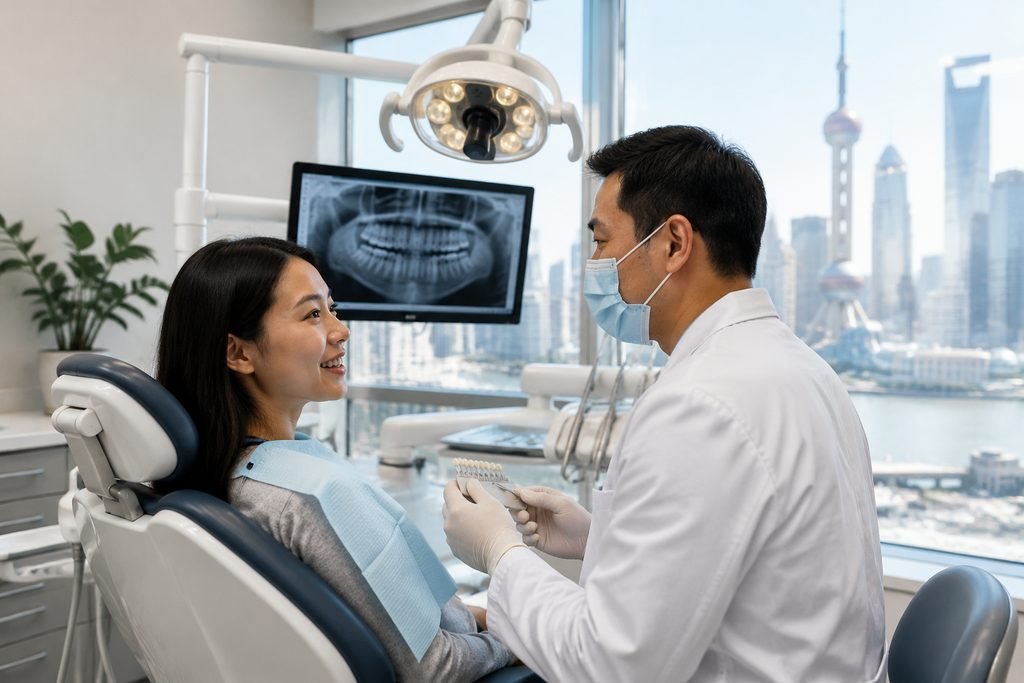
Why a general reply is not an appointment confirmation
When you send an enquiry about full-mouth reconstruction to a hospital or coordination service, the first response is often an acknowledgement: your message has been received, someone will follow up, please send more records. That is a receipt, not a confirmed appointment. For a complex dental reconstruction, the difference matters because the department that assesses you, the campus where you are seen and the type of appointment booked all shape what happens next.
Full-mouth reconstruction is not a single procedure with one standard pathway. It is an individual combination of treatments planned around your bite, your remaining teeth and your goals. Crowns, bridges, dentures and implants address different dental problems and are not interchangeable treatments. Because the plan is individual, the first appointment is usually an assessment rather than a treatment slot. You need to know who is assessing you, where, and what that assessment is expected to cover.
A confirmation should name four things: the clinical department, the hospital campus, the appointment type, and whether the appointment is with a treating clinician or a coordination office. If any of those is missing, you do not yet have enough to book flights or arrange time away from work.
Which department actually handles full-mouth reconstruction
Full-mouth reconstruction sits at the intersection of several dental disciplines. Depending on your case, it may involve prosthodontics (crowns, bridges, dentures and implant-supported restorations), implantology, periodontics (gum health), endodontics (root canal treatment) and oral surgery. Some hospitals organise this under a prosthodontics department; others have a dedicated implant or restorative dentistry unit; some coordinate through a general dentistry or stomatology department that refers internally.
This is why asking for 'the dental department' is not precise enough. Two departments in the same hospital may both see dental patients but plan reconstruction differently. Ask the hospital or your coordination contact to state, in writing, the exact department name and whether that department will hold the initial assessment or whether you will first be seen elsewhere and referred.
It also helps to ask who leads the planning. Is one clinician responsible for the overall reconstruction plan, or will you be assessed by separate specialists whose recommendations are then combined? Neither approach is wrong, but you should know which one applies to you before you travel, because it affects how many visits and how much coordination the plan may involve.
If the reply uses a general term such as 'dental center' or 'stomatology', ask for the specific unit and the name of the clinical lead for your type of case. A department name you can verify is more useful than a friendly but vague reply.
Campus and site: the detail that changes your travel plan
Large hospitals in China often operate across multiple campuses, and dental services may not all be at the same address. A department can exist at one site and not another. If you are told 'the hospital will see you', ask which campus, which building and which clinic reception you should report to.
This is not a minor administrative point. If your assessment is at one campus and a later treatment stage is at another, your accommodation, transport and daily schedule need to reflect that. Ask directly: will all stages of my assessment and treatment take place at the same campus, or could I be asked to attend a different site? If the answer is that this depends on the plan, ask when that would be decided and who would tell you.
Also confirm the appointment type. Is this a consultation-only visit, an assessment that may include imaging or records review, or a treatment appointment? For full-mouth reconstruction, the first visit is typically an assessment, and treatment planning follows. Knowing the appointment type helps you prepare the right records and set realistic expectations for what can be decided on that day.
If you are coordinating through a service rather than contacting the hospital directly, ask that service to confirm the campus and appointment type with the hospital and share that confirmation with you. A coordination reply that does not include the site is incomplete.
What to send so the department can confirm, not just acknowledge
A hospital can only confirm the right department and appointment type if it understands your situation. A short, structured summary helps more than a large unorganised file. Start with your main concern: is it missing teeth, failing restorations, bite problems, difficulty chewing, or a combination? Then list what you already have.
Useful items to mention, if you have them: recent dental X-rays or scans, a list of current teeth and any missing teeth, existing crowns, bridges, dentures or implants, any gum treatment history, relevant medical conditions, and medications you take. You do not need to send everything at first contact. A brief summary with an offer to share records is enough for the hospital to identify the likely department.
Ask what the department specifically wants to see before the assessment. Different units may ask for different records, and asking avoids sending material that is not useful. If you do not have recent imaging, ask whether the hospital will take it during the assessment or whether you should arrange something locally first. Do not assume a particular scan is mandatory; confirm what this provider needs.
If you have been told a treatment is needed but you are unsure whether it is the right plan, say so. A second assessment is a legitimate reason to seek an appointment, and the department can tell you whether it is the appropriate place for that review.
- Your main dental concern in one or two sentences.
- A list of missing teeth and existing restorations.
- Any recent X-rays or scans you can share.
- Gum treatment history and current gum symptoms.
- Relevant medical conditions and medications.
- Your specific question: assessment, second opinion, or treatment planning.
Questions that turn a reply into a confirmed plan
Once you have a response, use a short set of questions to test whether it is a real confirmation. These are not bureaucratic; each answer changes what you do next.
Ask for the exact department name and the name of the clinician or team who will assess you. Ask for the campus address and the clinic or reception point. Ask what type of appointment this is and what it is expected to include. Ask whether the assessment can produce a written plan covering which teeth are involved, what provisional work is proposed, what final restorations are planned, and what maintenance will be needed.
Ask how many visits the plan is expected to involve and whether any stages can be combined. Do not accept a fixed number as a promise; ask what the plan assumes and what could change it. Ask what happens if a tooth cannot be saved or if gum health needs treatment first. Ask who to contact if the plan changes after you arrive.
Finally, ask for the written scope of any estimate: what is included, what is excluded, and what remains undecided until the assessment. A component price for one crown or one implant does not describe the cost of a full-mouth reconstruction, because the plan is individual. Ask the named provider how its written estimate is structured rather than comparing isolated figures.
What ChinaSpecialistCare can and cannot confirm
ChinaSpecialistCare provides information and non-clinical coordination. We can help you prepare a brief summary, request a specialist appointment, and ask a hospital to confirm the department, campus and appointment type in writing. We can also arrange interpretation and practical support around hospital visits if that is useful.
We do not diagnose, prescribe, decide suitability or guarantee that a hospital will accept your case. The treating hospital and its licensed clinicians decide whether full-mouth reconstruction is appropriate, what it involves and when it can be scheduled. An initial enquiry is free and does not require buying a proxy consultation. You can start with a short summary by the enquiry form, email or WhatsApp, and share records after first contact.
If your dental problem is urgent, such as pain, swelling, bleeding or a broken tooth affecting eating, seek local care first. An overseas enquiry should not delay necessary treatment.
For general background on how these treatments differ, the NHS dental treatments page explains that crowns, bridges, dentures and implants address different dental problems and are not interchangeable. That is a useful starting point for understanding why your plan needs individual assessment rather than a single standard package.
Sources & scope of this guide
References and official service information relevant to this guide.
This is general planning information and has not been individually reviewed by a doctor. Medical decisions and personal treatment advice come from your treating clinicians.