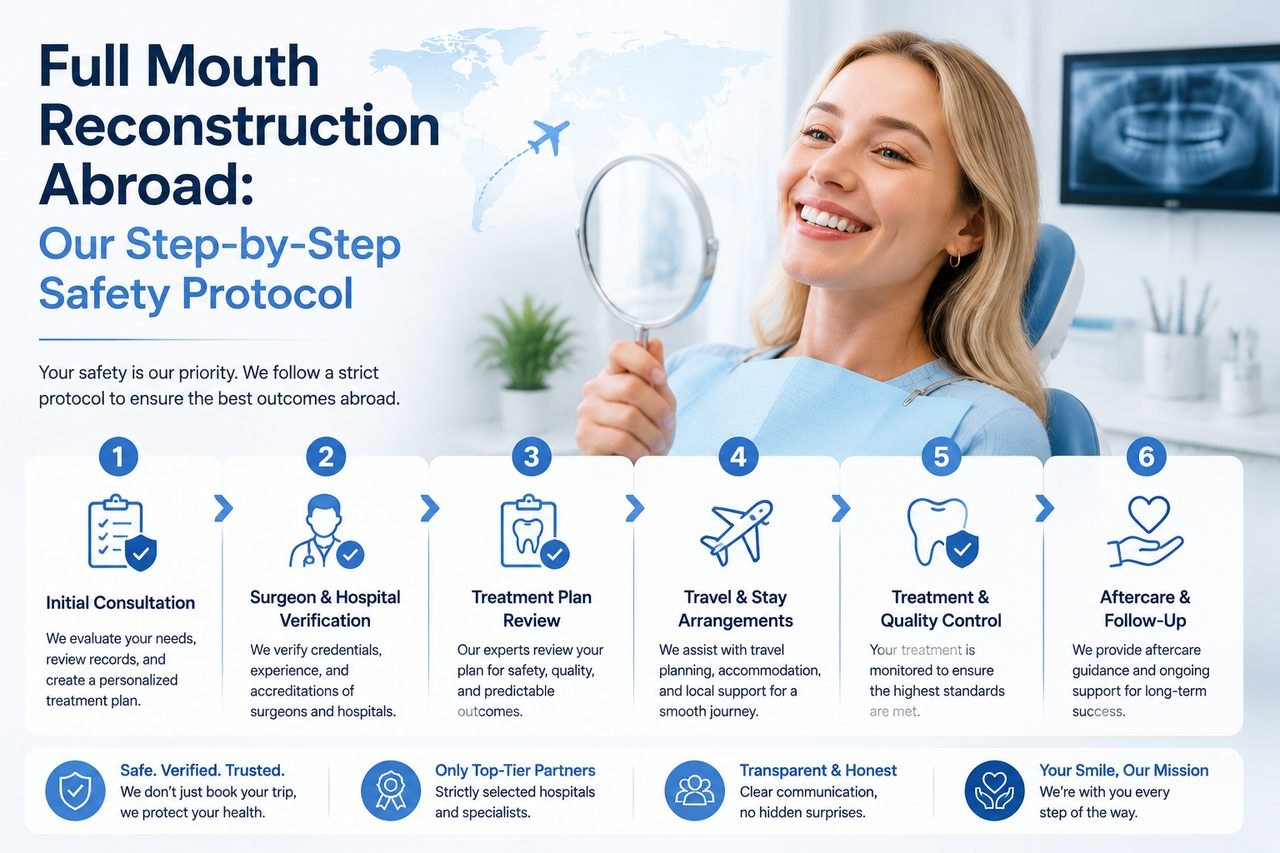
Why a Full-Mouth Reconstruction Plan Can Change After New Records
Full-mouth reconstruction is not one procedure. It is a combination of treatments planned around a specific mouth, and the combination can shift when new information arrives. A fresh scan, updated bite assessment or a clinical examination in China may show that a tooth previously considered restorable now needs a different approach, or that the way the upper and lower teeth meet requires a different sequence.
The NHS dental treatments guidance notes that crowns, bridges, dentures and implants address different dental problems and are not interchangeable. That distinction matters here. If a revised plan moves from one type of restoration to another, the change is not simply a substitution of equal options. It reflects a different diagnosis of what the tooth or gap needs, and it should be explained in those terms.
A changed plan is not automatically a worse plan. It may be more conservative, or it may be more extensive. What matters for an overseas patient is whether the revised version is clearly documented, whether the reason for the change is stated, and whether the new scope still matches your goals and your ability to complete the work.
Reconfirm the Tooth-by-Tooth Scope, Not Just the Headline Plan
When a plan changes, the most useful document is not a summary sentence such as 'full-mouth reconstruction' or 'full-arch treatment'. Ask for a tooth-by-tooth list. For each tooth or space, the revised plan should state what is proposed, what is being replaced from the earlier version, and what is still undecided.
This level of detail protects you in two ways. First, it lets you compare the old and new plans directly rather than relying on memory. Second, it exposes any gap between what you thought you were buying and what is now being offered. A plan that changes from several individual restorations to a different combination should be visible on paper, not only in conversation.
If the revised plan includes provisional work, ask what the provisional stage is for and what it is expected to achieve before final restorations are made. Provisional work can serve different purposes, and the treating dentist should explain the purpose in your case rather than leaving it as a generic step.
Ask also which teeth are being left untreated and why. A full-mouth plan does not necessarily mean every tooth is restored or removed. The boundary of the plan is as important as its contents.
Ask What the New Records Actually Changed and What Remains Uncertain
A revised plan should come with a reason. Ask the treating dentist which finding in the new records led to the change. It may be a change in the bite assessment, a change in the condition of a specific tooth, or a change in how the supporting structures are responding. The answer should point to something concrete in the records, not a general impression.
It is equally useful to ask what remains uncertain. Some decisions in full-mouth reconstruction depend on how the mouth responds during treatment, and a responsible plan will say so. If the dentist cannot yet confirm the final restoration type for a particular tooth, that is a question to revisit at a defined point rather than a reason to abandon the plan.
For an overseas patient, uncertainty has a practical cost. If a final decision depends on a response that can only be assessed in person, ask when that assessment will happen and what happens if the response differs from expectation. You are not asking for a guarantee. You are asking for the decision points to be named in advance.
Reconfirm the Visit Structure and What Must Be Completed in China
A changed plan can change the number and purpose of visits. Ask the treating dentist to set out the revised stages, what happens at each stage, and which stages must take place in China. Do not assume that a revised plan fits the same travel arrangement as the original one.
If the plan now includes provisional restorations, ask how long they are expected to remain in place and what care they need during that period. If the plan now includes a healing interval before final restorations, ask what you are expected to do during that interval and who you contact if something feels wrong.
Ask what would happen if a stage cannot be completed as planned. This is not a hypothetical worry; it is a practical question about continuity. You want to know whether the remaining work can be carried out elsewhere without compromising the overall plan, and what records you would need to take with you.
The treating team decides what is clinically appropriate for your mouth. Your role is to make sure you understand the revised sequence well enough to plan around it.
Request a Written Plan That Separates Provisional Work, Final Restorations and Maintenance
Ask for the revised plan in writing, with three parts clearly separated: provisional work, final restorations, and maintenance. This structure makes it harder for an important element to be overlooked and easier for you to ask focused questions.
For the provisional work, the written plan should say what is being placed, why, and what it is expected to achieve before the final stage. For the final restorations, it should identify the teeth involved and the type of restoration proposed for each. For maintenance, it should describe what ongoing care the restorations will need and what signs should prompt you to seek review.
You can also ask the provider to state, in the same document, what is included in its written estimate, what is excluded, and what remains undecided. This is a question about that provider's own quote, not a general statement about how dental care is billed in China. The answer should come from the provider that issued the estimate.
If you are comparing the revised plan with an earlier version, keep both documents. A side-by-side comparison is the clearest way to see what actually changed.
Confirm Who Owns Each Next Step Before You Commit
After a plan change, responsibilities can become blurred. The treating dentist owns the clinical decisions: which teeth are treated, which restorations are appropriate, and whether the revised plan is suitable for you. The hospital or clinic owns its appointment and admission processes. You own the decision about whether to proceed, and you own the practical arrangements for travel and follow-up.
If you are working with a coordination service, its role is to help with records, interpretation and appointment requests, not to decide clinical suitability or promise that a particular plan will be accepted. An initial enquiry is free and does not require buying a proxy consultation. A proxy consultation is optional and is not a prerequisite for every appointment or operation.
Before committing to the revised plan, confirm three things in writing: the updated tooth-by-tooth scope, the revised visit structure, and the name of the person or team responsible for each remaining decision. If any of those is still unclear, that is the next question to ask, not a reason to stop communicating.
For general information about how full-mouth reconstruction is approached, see the related procedure reference. It complements this guide but does not replace the treating dentist's assessment of your own mouth.
Sources & scope of this guide
References and official service information relevant to this guide.
This is general planning information and has not been individually reviewed by a doctor. Medical decisions and personal treatment advice come from your treating clinicians.