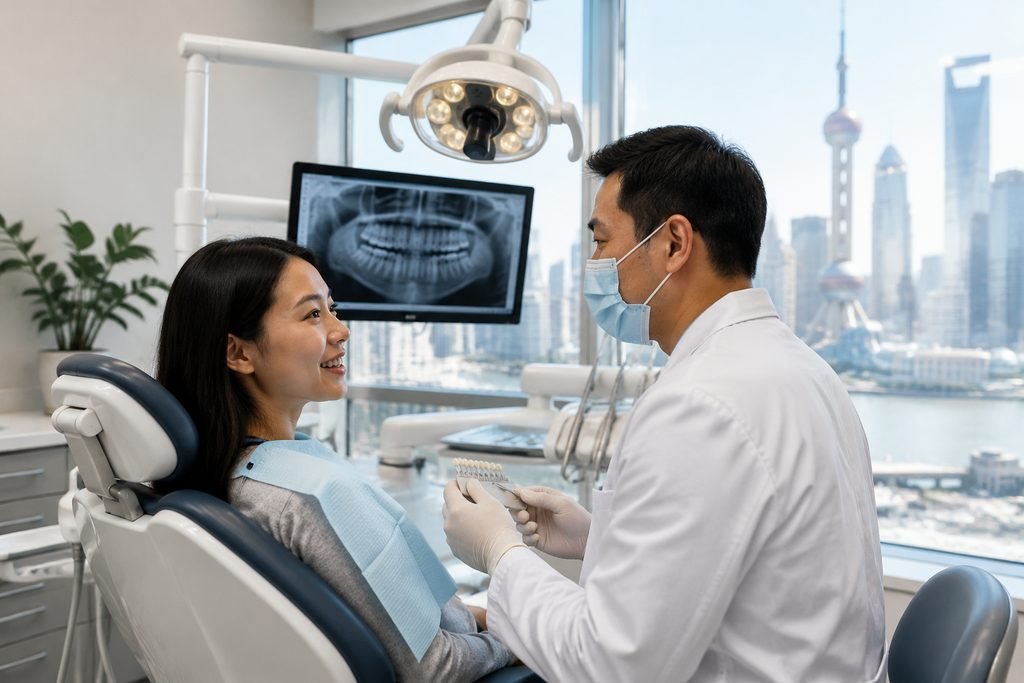
Why full-mouth reconstruction is a plan, not a single procedure
Full-mouth reconstruction is not one treatment with one price. It is an individual combination of restorations chosen for a specific mouth. Crowns, bridges, dentures and implants address different dental problems and are not interchangeable treatments. That single fact changes how you should ask about risk and alternatives.
If a clinic offers you a package name rather than a tooth-by-tooth plan, you cannot yet compare it with anything. Two patients labelled with the same package may need completely different work. The package label hides which teeth are involved, what is provisional, what is final, and which alternatives were considered and rejected.
So the first question is not 'what does it cost?' It is 'what exactly is being proposed for each tooth, and why?' Until that is clear, risk and alternative questions have nothing concrete to attach to.
This is also why you should be cautious about any plan that treats full-mouth reconstruction as automatically meaning All-on-4 implants or extraction of every tooth. Those are specific approaches for specific situations, not definitions of the whole field.
How to ask about risks without asking for a personal recommendation
You can ask a dentist to explain risk in general terms without asking them to decide for you. The useful framing is: 'For the treatment you are proposing on this tooth, what are the main things that can go wrong, how would we know, and what would we do about it?' That question invites explanation rather than a verdict.
Ask separately about short-term and long-term risks. Short-term questions might cover pain, swelling, infection, temporary restorations coming loose, or difficulty eating and speaking during healing. Long-term questions might cover how long a restoration is expected to last, what maintenance it needs, and what happens at the end of its life.
Ask what happens if a restoration fails. Is replacement included in the plan, or is it a new treatment? Ask this before treatment starts, not after. The answer belongs in the written plan.
Ask whether the proposed plan depends on something that has not yet been confirmed. Bite changes, gum health, bone volume and the condition of remaining teeth can all change what is realistic. If the dentist is working from incomplete information, the risk picture is incomplete too.
You can also ask the dentist to describe evidence-based risk estimates for the specific procedures proposed, and to explain the uncertainty around those estimates. A responsible clinician can discuss ranges and unknowns without promising you a personal result. No estimate guarantees an individual outcome.
Finally, ask what happens if you decide to do nothing, or to do less. That is not a challenge to the dentist. It is one of the alternatives, and you are entitled to understand it.
Asking about alternatives in a way that produces a real answer
A vague question like 'are there alternatives?' tends to produce a vague answer. A better question names the decision: 'For this tooth, what are the alternatives to the restoration you are proposing, and what are the trade-offs of each?'
Alternatives can differ in how much tooth structure is removed, how many visits are needed, how long the result is expected to last, and how reversible the decision is. Ask the dentist to compare the options on those dimensions rather than only on appearance.
Ask which alternative the dentist would choose if cost were not a factor, and which if the priority were preserving remaining tooth structure. The answers may differ, and that difference is informative.
Ask what would make the plan change. If a tooth is borderline, ask what finding would tip it toward extraction rather than restoration, or the reverse. This tells you how much of the plan is settled and how much is provisional.
If you are considering care in China, ask how the plan would be staged across visits and what must be completed before you leave. Do not assume a single trip is enough. Ask the provider to state, in writing, which stages are provisional and which are final.
If you have been given a plan elsewhere, ask whether the China-based dentist agrees with it, and on what evidence. A second opinion is a normal part of a large treatment decision.
What a phased plan should show you
A phased plan separates assessment, provisional work, definitive restorations and maintenance. Each phase should have a purpose and an endpoint. If a plan does not distinguish provisional from final work, ask why.
The assessment phase should identify which teeth are involved and what is being assessed. Ask what records the dentist needs and what each record is for. If imaging is proposed, ask what question it is meant to answer.
The provisional phase may include temporary restorations, bite adjustments or a trial of a new bite relationship. Ask how long provisional work is expected to remain in place and what you should do if it fails while you are still in China or after you return home.
The definitive phase should name the final restorations tooth by tooth. Ask which materials are proposed and why, and what maintenance each material needs.
The maintenance phase should state what you need to do, how often, and who can do it. Ask whether your own dentist at home can carry out maintenance and what information they would need.
Ask for the plan in writing, with each tooth identified. A plan that only names a package cannot be checked, compared or followed up.
What to ask about the written estimate
Ask the named provider how its written estimate works. Specifically, ask what is included, what is excluded, and what is still undecided at the time the estimate is issued.
Ask whether the estimate covers assessment, provisional work, final restorations, reviews and any replacement of a failed restoration. If an item is not listed, ask where it would appear.
Ask what would cause the estimate to change. A plan that depends on findings during treatment may need revision, and you should know that before you start rather than after.
Ask how the estimate relates to the phased plan. Each phase should map to a cost line, so you can see what you are paying for at each stage.
Ask about payment timing and what happens if you decide to stop partway through. The answer affects how much you are committing to at the outset.
Do not treat a foreign clinical source as evidence of Chinese prices, fees, access or scheduling rules. Those are provider-specific questions, and the answers belong in the provider's own written documents.
Preparing your questions before you contact a provider
Write your questions down before the consultation. A large treatment decision is easier to handle when you are not trying to remember everything in the room.
Start with the tooth-by-tooth question. Then ask about risks, alternatives, phasing and the estimate. Keep the list short enough that you can actually get through it.
Ask who will carry out each stage and what happens if a different clinician takes over partway through. Continuity matters for a plan that spans multiple visits.
Ask what you should do if something goes wrong after you return home. You do not need a guarantee, but you do need to know the practical route.
If you are travelling to China for care, ask how records will be shared before your visit and what the provider needs from you. A brief summary is enough for an initial enquiry; more detailed records can follow once the provider confirms what is relevant.
You can start with a free initial case review through ChinaSpecialistCare. Our team checks the available diagnosis, records and your main question, identifies missing information and suggests a relevant next step. This is not a diagnosis and not a promise of acceptance. A proxy consultation is optional and is not a prerequisite for every appointment.
For confirmed services and planning, see the related treatment reference in the links below.
Sources & scope of this guide
References and official service information relevant to this guide.
This is general planning information and has not been individually reviewed by a doctor. Medical decisions and personal treatment advice come from your treating clinicians.