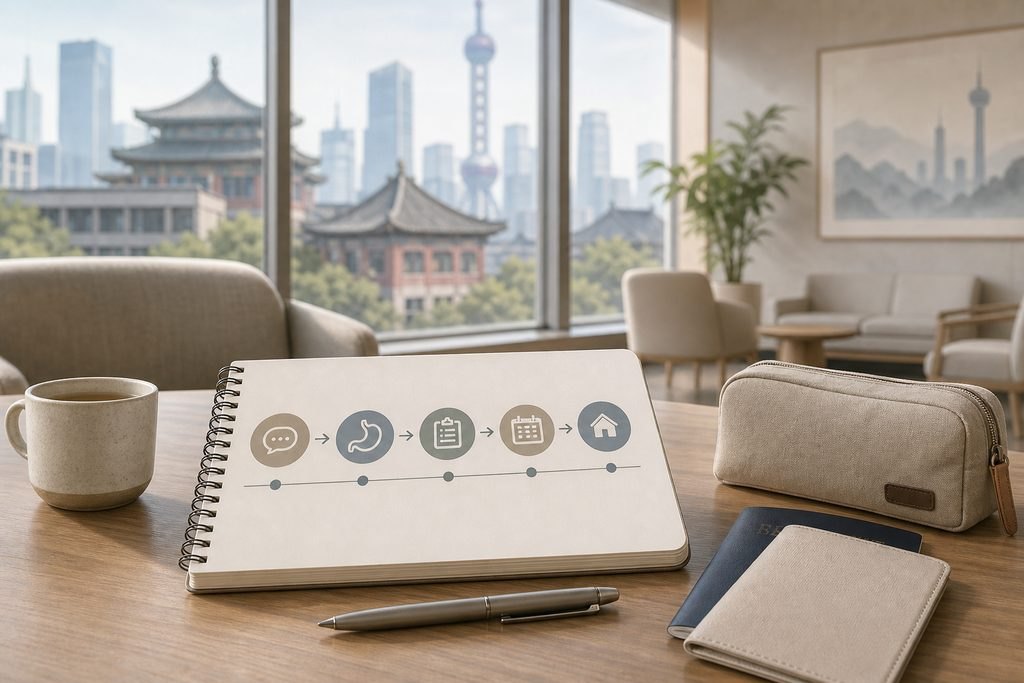
Why the visit sequence matters more than the appointment date
International patients often ask for a gastroscopy date first. In practice, the endoscopy is usually one step inside a short sequence, and the sequence determines how many trips to the hospital you need and when you can plan travel home. A specialist normally reviews your symptoms, prior tests and medication list before deciding whether an upper endoscopy is appropriate and how it should be performed.
The treating hospital decides suitability, preparation and sedation approach. Your role is to arrive with the right records and to confirm, in advance, what happens on each visit. This article focuses on that visit-planning question; the procedure itself is described on the gastroscopy and upper endoscopy reference page.
- Assessment: confirm whether a separate consultation is needed
- Procedure: confirm preparation and admission arrangements
- Results: confirm how findings and any biopsy results will be discussed
What the pre-procedure consultation usually covers
Ask when the clinical assessment will take place and what must be settled before the procedure. The specialist will want to understand your main symptom, how long it has been present, previous endoscopies or imaging, and any relevant medical history. Bring copies of prior reports rather than summaries, because the clinician may need to see the original findings and dates.
Medication is a common planning issue. The treating team must give instructions about any medicines that affect bleeding risk or interact with sedation. Do not change or stop prescribed medication on your own, and do not assume a general rule applies to you. Ask the hospital directly what they require.
This is also the point to confirm practical details: whether sedation is planned, whether an interpreter is needed, and how the report will be issued. The U.S. National Institute of Diabetes and Digestive and Kidney Diseases notes that sedation is commonly used for upper GI endoscopy but may not be needed in every case, so the approach is individual.
- Ask whether the procedure will be with or without sedation
- Ask what medication instructions apply to you specifically
- Ask how and when the written report will be available
- Ask whether biopsy samples are likely and when those results are expected
Records to bring and questions to ask the clinical team
Records help the specialist decide whether the planned test is appropriate and whether any earlier investigation needs repeating. The hospital decides which documents it requires; requirements are not universal, so confirm them rather than assuming.
Useful records typically include previous endoscopy or imaging reports, relevant laboratory results, a current medication list, and any allergy information. If you have had a prior biopsy, the pathology report is often more useful than the endoscopy description alone.
- Previous endoscopy, imaging and pathology reports
- Current medication list, including anything that affects clotting
- Allergy history and relevant past medical history
- Your main symptom and what you want the assessment to answer
Sedation, escort and same-day practicalities
If sedation is used, you will not be able to drive afterward, and the hospital will normally expect a responsible adult to accompany you. This affects how you plan transport and whether you book a same-day onward journey. Do not assume you can travel independently straight after the procedure; confirm the hospital's requirement.
Preparation instructions, including any fasting requirements, must come from the treating team. Do not apply a general fasting rule from another country or another hospital. The NIDDK source confirms that preparation and medication instructions should come from the treating team, and that a prearranged ride home is needed after sedation.
- Confirm whether an escort is required and for how long
- Confirm the exact fasting and medication instructions for your appointment
- Avoid booking onward travel until the hospital confirms you are ready to leave
Reports, biopsy results and the follow-up visit
Visual findings may be described to you soon after the procedure, but biopsy results usually take longer because the tissue must be processed and examined. The NIDDK source notes that biopsy findings may be reported later than the visual findings. Plan your follow-up visit with that in mind, and ask the hospital when results are expected rather than assuming a fixed interval.
The follow-up visit is where the specialist explains the findings and any next steps. If you are travelling home before results are ready, ask how the report can be shared with you and whether a local clinician can receive it. The hospital decides what it can provide; do not assume an English-language report is automatically issued.
- Ask when biopsy results are expected and how they will be communicated
- Ask whether the report can be sent to a clinician in your home country
- Ask what symptoms should prompt you to seek care before the follow-up
When to seek care before or after the procedure
Upper GI endoscopy is generally well tolerated, but the NIDDK source lists possible risks including reactions to sedation, bleeding and perforation. Worsening chest or abdominal pain, breathing difficulty, bloody vomit, black stools or fever after the procedure need prompt medical attention. If you have urgent or worsening symptoms, seek local care rather than waiting for an overseas appointment.
This article is planning information, not medical advice, and it does not confirm that any hospital will accept you or that a gastroscopy is the right test for your situation. The treating clinician makes those decisions.
How ChinaSpecialistCare can help with the sequence
ChinaSpecialistCare provides non-clinical coordination for international patients planning care in China. We can help you organise records, request a specialist appointment and prepare questions for the hospital, using the care-plan route. Hospital consultation fees, tests and treatment are paid to the hospital or provider; our coordination fees are separate.
An initial enquiry is free and does not require buying a proxy consultation. You can start with a brief summary of your situation and main question, and we will identify missing information and suggest a relevant next step. Hospital acceptance and clinical suitability remain decisions for the treating hospital.
Sources & scope of this guide
References and official service information relevant to this guide.
This is general planning information and has not been individually reviewed by a doctor. Medical decisions and personal treatment advice come from your treating clinicians.