Why a short question list beats a long one
The first in-person discussion about a gastroscopy or upper endoscopy in China is a planning conversation, not a test result review. You will likely meet a gastroenterologist or an endoscopy team member who has limited time and no prior knowledge of your history. A long, unfocused list of questions can make it harder for both sides to identify the real decision points.
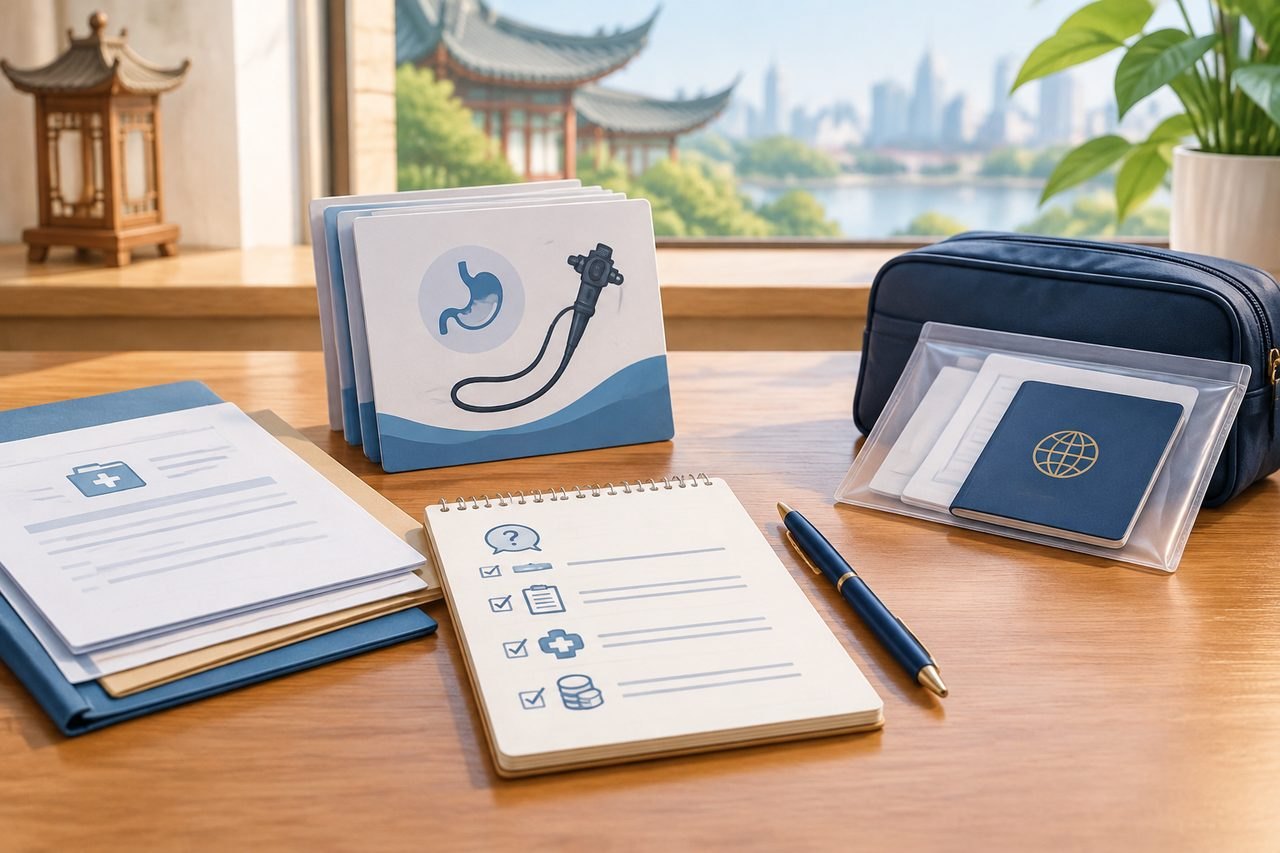
A short list of three to five questions, written down before the visit, helps you stay on track. It also gives the clinician a clear structure to respond to. If you are communicating through an interpreter, a written list reduces the risk of meaning being lost in translation.
The goal is not to cover every possible scenario. It is to leave the room knowing what the clinician recommends, what still needs to be confirmed, and what you need to do next. If you cannot answer those three things after the appointment, the discussion was not complete.
What to bring to the first discussion
Bring a one-page summary of your main concern in plain language. This is not a full medical history. It is a short statement of why you are seeking an upper endoscopy or gastroscopy assessment, how long the issue has been present, and what you have already tried or been told.
Bring copies of relevant existing records. These may include previous endoscopy reports, pathology results, imaging reports, medication lists, allergy information, and any recent blood test results. The exact documents the receiving team wants can vary, so ask them in advance what they need rather than assuming a universal list.
If your records are in a language other than Chinese or English, ask whether a translation is needed and who is responsible for arranging it. Do not assume the hospital will provide translation as part of the appointment.
Keep your documents organised in a folder or digital file. Label each item clearly with the date and the type of report. This makes it easier for the clinician to review your history quickly and for you to refer to specific documents during the conversation.
Questions that clarify the purpose and scope
The most useful first question is simple: what is the purpose of this gastroscopy or upper endoscopy in my case? The answer tells you whether the clinician is looking for a specific diagnosis, following up on a previous finding, or assessing a symptom that has not been explained.
Ask what the appointment will and will not cover. A first consultation may be limited to history-taking and planning. It may not include the procedure itself, sedation assessment, or a full review of every record you brought. Knowing the boundaries prevents misunderstanding.
Ask whether any additional information is needed before a decision can be made. If the clinician says a specific report is missing, write down exactly what is needed, who should provide it, and by when. This turns a vague gap into a concrete action.
Ask who will be responsible for each next step. Is it the hospital, your referring doctor, or you? A named responsibility is more useful than a general instruction to follow up.
How to ask about cost and written scope
Cost discussions in a first consultation can be uncomfortable, but they are necessary for planning. Ask for a written scope of what the quoted fee includes and what it does not include. The written scope should identify the provider, the service, and any items that remain undecided.
Do not assume that a verbal estimate covers everything. Ask specifically whether the quote includes the consultation, the procedure, sedation, pathology, follow-up, and any separate coordination or interpretation services. If an item is not listed, ask whether it is included, excluded, or still to be determined.
If you are working with a coordination service, keep the hospital's medical fees separate from any coordination or interpretation fees. These are different payees and different services. Ask each provider for their own written confirmation.
If the quote changes after the consultation, ask what changed and why. A revised scope should be provided in writing before you agree to proceed.
Communicating through an interpreter
If you do not speak Chinese, an interpreter can help, but the quality and role of interpretation matter. Ask in advance whether interpretation is available, who provides it, and whether it is a clinical interpreter or a general companion.
Before the appointment, share your written question list with the interpreter so they can prepare. During the appointment, ask the interpreter to translate your questions exactly as written, and to tell you if the clinician's answer is unclear or incomplete.
After the appointment, ask for a written summary of what was discussed and what was decided. A verbal summary can be forgotten or misremembered. A written record gives you something to refer to and to share with your family or referring doctor.
If you are using a coordination service for interpretation, confirm the scope and fee separately from the hospital's charges. Interpretation is a coordination service, not clinical care.
What to confirm before you leave
Before the appointment ends, confirm the next step in concrete terms. Who will contact whom, about what, and by when? If a test or report is needed, who will arrange it and where will it be sent?
Ask whether the clinician needs anything else from you. If the answer is yes, write it down and confirm how you will provide it. If the answer is no, ask when you should expect to hear about the next stage.
If the discussion raises a question you did not prepare for, write it down and ask whether it can be addressed now or whether it needs a separate conversation. Do not leave with unanswered questions that could affect your decision.
Finally, ask for a copy of any written plan, estimate, or instruction. Keep it with your records. If you are coordinating care through a service, share the written plan with them so they can help you prepare for the next step.
How ChinaSpecialistCare can support the first discussion
ChinaSpecialistCare can help you organise your records, prepare a short question list, and request a specialist appointment at a suitable hospital. We can also arrange interpretation and practical support during the visit. Our team does not decide clinical suitability or provide medical advice. Hospital fees and our coordination fees are separate. An initial enquiry is free and does not require purchasing a proxy consultation.
The first discussion about a gastroscopy or upper endoscopy in China is a planning conversation, and the quality of that conversation depends less on how many questions you ask than on whether the right questions get answered. A written list of three to five items, a one-page summary of your main concern, and copies of relevant existing records give the clinician a clear starting point. From there, the useful work is confirming purpose, scope, responsibility and the next step in concrete terms.
What separates a productive first discussion from a frustrating one is not the length of the appointment but whether you leave with named responsibilities. If the clinician says a report is needed, you should know who will obtain it and by when. If a fee is quoted, you should know what it covers and what remains undecided. If a follow-up is planned, you should know who initiates it. These details turn a general conversation into an actionable plan.
Cost discussions deserve the same specificity. Ask for a written scope that identifies the provider, the service, and any items still to be determined. Keep hospital medical fees separate from coordination or interpretation fees, because they are different payees and different services. If a quote changes after the consultation, ask what changed and request the revised scope in writing before you agree to proceed. Do not assume a verbal estimate covers everything; ask directly about each component.
If you use an interpreter, share your question list in advance so they can prepare. Ask them to translate your questions exactly as written and to tell you if an answer is unclear or incomplete. After the appointment, request a written summary of what was discussed and decided. A written record is more reliable than memory and can be shared with your family or referring doctor.
Before you leave, confirm the next step in concrete terms: who will contact whom, about what, and by when. Ask whether the clinician needs anything else from you, and if so, how you will provide it. If the discussion raises a question you did not prepare for, write it down and ask whether it can be addressed now or needs a separate conversation. Ask for a copy of any written plan, estimate, or instruction and keep it with your records.
The goal is not to cover every possible scenario in one appointment. It is to leave knowing what the clinician recommends, what still needs to be confirmed, and what you need to do next. If you cannot answer those three things after the appointment, the discussion was not complete. A short, focused question list and a clear record of the next step are the most practical tools you can bring to a first gastroscopy or upper endoscopy discussion in China.
Sources & scope of this guide
References and official service information relevant to this guide.
This is general planning information and has not been individually reviewed by a doctor. Medical decisions and personal treatment advice come from your treating clinicians.