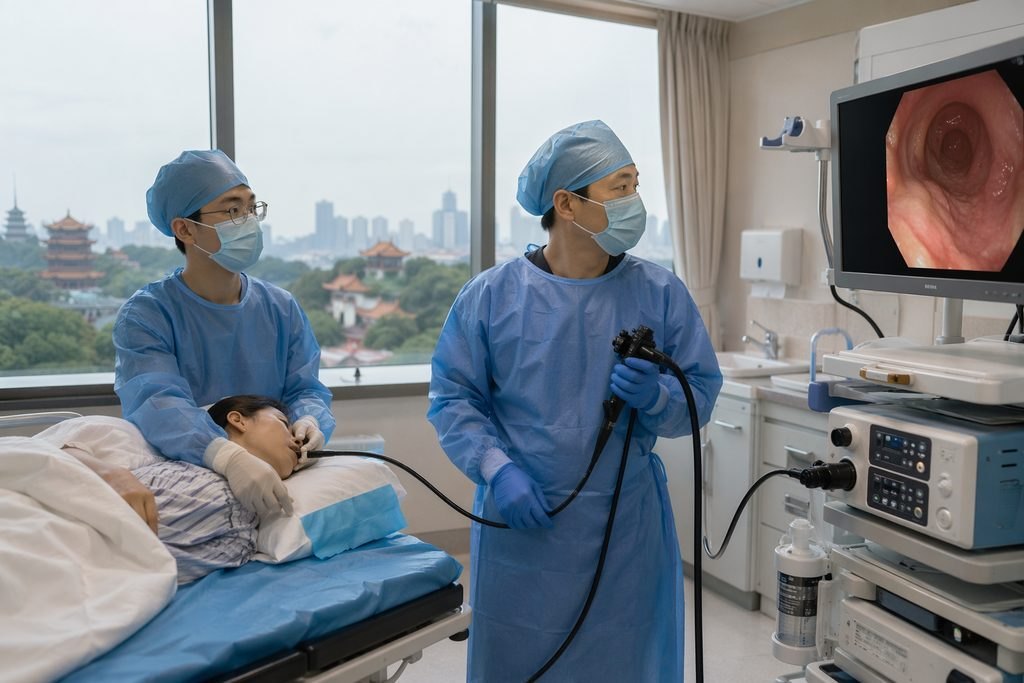
What a real handover between the two teams actually involves
A gastroscopy or upper endoscopy enquiry in China often starts with a patient holding a folder of records from home and a list of unanswered questions. The temptation is to send everything to everyone and hope the right person reads it. That usually produces polite replies and no decisions. A handover works better when it is narrow: one named person at home, one named contact on the China side, and a short written statement of what each side is being asked to do.
The two directions matter equally. Home-to-China information tells the receiving clinician what has already been documented, what was tried, and what the patient wants clarified. China-to-home information gives the original team something concrete to respond to, such as a proposed assessment plan, a request for a specific missing document, or a question about prior findings. Without the second direction, the home team is only sending, never answering.
This guide is administrative. It does not explain what gastroscopy or upper endoscopy involves, which findings matter, or what treatment might follow. Those are clinical matters for the treating clinicians. The question here is narrower and practical: how do you make sure the two medical teams are exchanging the same real documents and the same real questions?
Name the people and the responsibility before you send anything
Before records move, decide who is doing what. A handover with no named owner tends to stall at the first ambiguity. Write down, in plain language, the following roles and share that list with both sides.
The home clinician or clinic contact is the person who can confirm what has been done and answer clinical questions about prior care. The China-side contact is the person who receives documents, confirms what has arrived, and relays questions to the relevant specialist. The patient or a family member is the person who authorises sharing and keeps the master list of what was sent and when.
Responsibility also needs a boundary. The China team decides whether an appointment or procedure is suitable; the home team does not transfer that decision, and the China team does not take over ongoing care at home. Stating this early prevents the common confusion where each side assumes the other is coordinating.
A simple responsibility note can be short. It might say who holds the original records, who may share them, who answers clinical questions, and who confirms the next appointment. Keep it factual and avoid promising outcomes on either side.
- Home-side named contact and their role in answering questions about prior care.
- China-side named contact and their role in receiving documents and relaying questions.
- Patient or family member who authorises sharing and tracks what was sent.
- Written note that suitability and acceptance decisions rest with the treating hospital.
Agree which documents travel and how they are identified
A frequent practical problem in a cross-border handover is not missing records; it is unlabelled records. A scanned report with no date, no patient identifier and no indication of which study it belongs to creates work for the receiving team and delays a useful reply. Before sending, agree a simple identification convention.
Ask the receiving team what it wants to see first, rather than sending an entire archive. Existing report types are examples to confirm with that team, not a universal mandatory list. The point is to let the receiving clinician tell you what is relevant to the specific question being asked.
For each document, record the date it was produced, the facility that produced it, the patient's name as it appears on the document, and a short plain-language label such as the type of study or report. If a document is in a language other than English or Chinese, ask whether a translation is needed and who should provide it. Do not assume a translation is required or that the receiving team will arrange one.
Keep one master index. When the China team says a document is missing, the index tells you quickly whether it was never sent or was sent under a different label. That single list prevents most repeated requests.
Turn clinical questions into written questions the home team can answer
Vague requests produce vague replies. If the China team needs to understand prior findings, the useful move is to convert that need into a specific written question addressed to the named home clinician. The question should be answerable from the records or from the clinician's own knowledge, and it should state why it is being asked.
For example, instead of asking the home team to "send everything about the stomach", a written question might ask whether a particular prior study has been performed, what the documented conclusion was, and whether any follow-up was recommended at the time. The home clinician can answer that directly. The China team can then decide what, if anything, it needs next.
Keep a question log. Each entry records the question, who it was sent to, the date, and the reply. This is not bureaucracy for its own sake; it is how you avoid the same question being asked three times by three different people. It also gives the patient a clear record of what has and has not been clarified.
Do not ask the home team to approve or predict what the China team will do. Ask only what the home team knows and can document. Decisions about assessment and suitability belong to the receiving clinicians.
- State the question in one sentence and say why it is being asked.
- Address it to a named clinician or clinic contact, not a general inbox.
- Record the date sent and the date of any reply.
- Keep clinical decisions with the treating teams on each side.
Confirm what the China side has received and what happens next
Sending is not the same as receiving. After documents and questions are sent, ask the China-side contact to confirm in writing what has arrived, what is still missing, and what the next step is. A confirmation that lists received items is far more useful than a general acknowledgement.
This is also the point to clarify the status of any appointment. A preliminary reply is not the same as a confirmed appointment, and an enquiry is not the same as hospital acceptance. Ask directly whether the appointment is confirmed, provisional, or still under review, and what would change that status. Do not treat a friendly email as a scheduling commitment.
Ask the receiving team what its written scope covers. If a quote or estimate is involved, ask what is included, what is excluded, what is still undecided, and who the payee is for each part. Coordination fees and hospital medical fees are separate, and the patient should be able to see that separation in writing rather than infer it.
Finally, agree how updates will flow back to the home team. If the China team needs something from home, who asks, and by when? If the home team needs an update, who provides it? A short agreed rhythm prevents the handover from going quiet after the first exchange.
A practical next step for this handover
Start with a short summary rather than a full archive. An initial enquiry can describe the main question, the records already available, and the home clinician who can answer follow-up questions. ChinaSpecialistCare can help organise records, clarify what the receiving team has asked for, and request a specialist appointment where that is relevant. This is non-clinical coordination; suitability and acceptance remain with the treating hospital.
Before you send anything, write the one-paragraph handover note: who is the home contact, who is the China contact, what question needs an answer, and what document is being sent first. Then ask the China side to confirm receipt and state the next step in writing. If a clinical decision is needed at any point, it belongs with the treating clinicians on the relevant side, not with the coordination layer.
An initial enquiry is free and does not require buying a proxy consultation. Keep the first message brief, and share fuller records only after the receiving team has said what it needs.
Sources & scope of this guide
References and official service information relevant to this guide.
This is general planning information and has not been individually reviewed by a doctor. Medical decisions and personal treatment advice come from your treating clinicians.