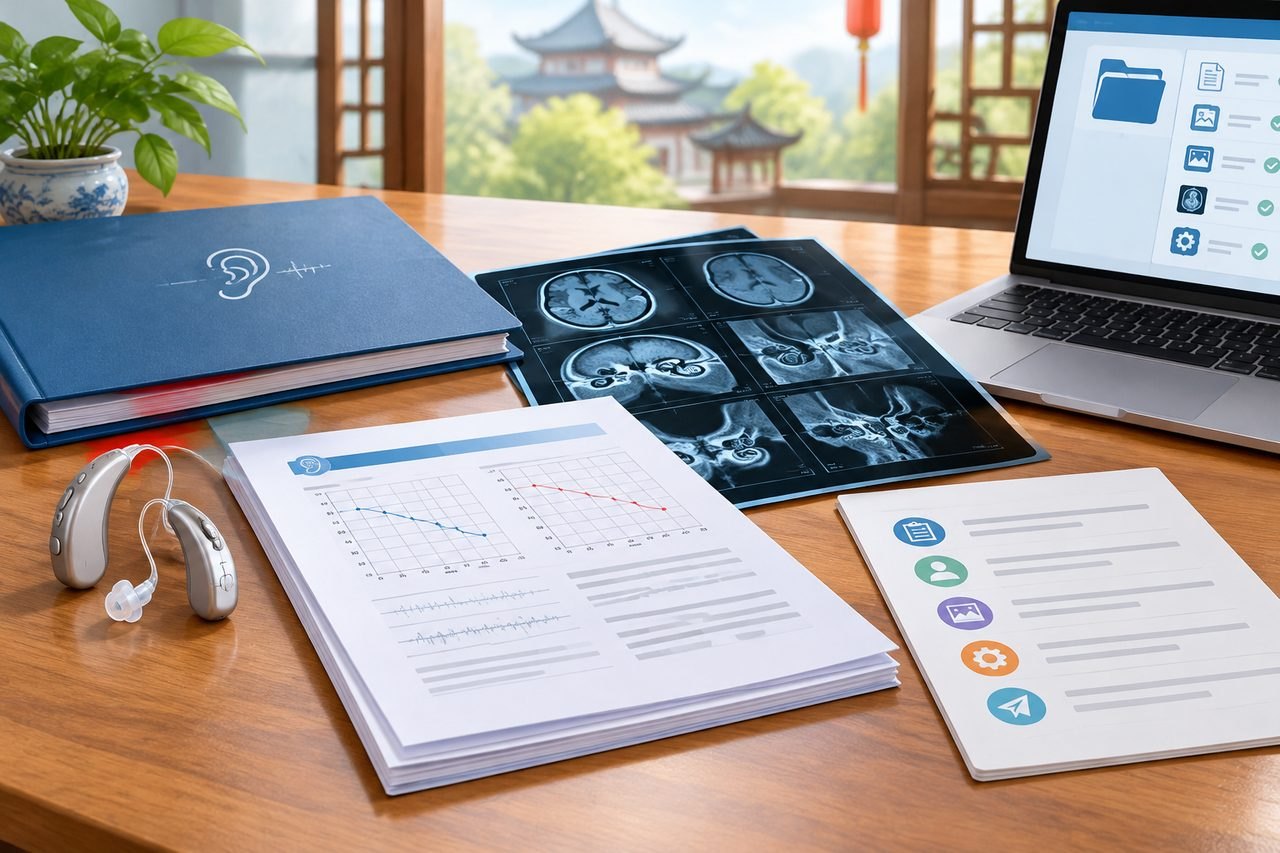
What a complete hearing-check handover actually contains
A hearing check is not one document. Depending on what the China clinician arranges, the visit may produce a pure-tone audiogram, a speech audiogram, tympanometry, otoacoustic emissions, or a report from an ENT consultation. If imaging was part of the assessment, there will also be image files and a radiologist's report. Each of these is a separate item with its own identifier, and each needs to reach your doctor at home in a usable form.
The practical test is simple: could a clinician who has never met you open the file and understand what was done, when, by whom, and what the conclusion was? If the answer depends on you explaining it verbally, the handover is incomplete. That is why the first task is not collecting everything, but knowing what the China provider will actually release and in what format.
Ask the receiving clinic in China, before or at the visit, which of these items will be issued as a printed report, which as a digital file, and which as both. Confirm whether reports are in English, Chinese, or bilingual. A Chinese-language report is not a problem if a translation is arranged, but you need to know that in advance so the translation can be prepared while you are still in contact with the issuing department.
Do not assume that every hearing check produces every document listed above. The set depends on what the clinician decides is appropriate for your situation. Treat the list as questions to put to the provider, not as a fixed package.
Why document identifiers matter more than file volume
When records arrive at your home doctor's office as a folder of scans and photographs, the first thing that gets lost is the link between a result and the test that produced it. A report without a date, a patient identifier and a test name is hard to place in a clinical timeline. A folder of images without a matching report is harder still.
Before you leave the China provider, check that each report carries the patient's full name as it appears in the passport or identity document used for the visit, the date of the test, the name of the department or clinic that issued it, and a report or accession number. If the report references images, note the image study number so the two can be matched later.
This matters because your home doctor may be comparing these results with earlier tests done elsewhere. Without dates and identifiers, that comparison becomes guesswork. A short index page that you prepare yourself — listing each document, its date, its issuing department and its file name — is often more useful than any single report.
If the China provider uses a patient portal or a release code, ask how long it stays accessible and whether you can download the original files rather than only a summary. Access arrangements differ between hospitals and are worth confirming in writing at the time of the visit.
Imaging files: what to request and what to expect
If imaging was part of the hearing assessment, the report alone may not be enough for your home doctor. Reports summarise; images show. Ask the China provider whether you can receive the original image files on a disc or through a download link, and in what format. Some departments release images routinely; others require a formal request. This is a question for the specific provider, not a general rule.
Also ask whether the images include the full study or only selected images. A report that describes findings on sequences your home doctor cannot see limits the value of the second review. If only selected images are available, note that limitation clearly when you send the records onward.
Keep the radiologist's report and the image files together. If they become separated, the report number and study number are the only reliable way to reconnect them. Store both in the same folder and name the folder with the date and the type of study.
Finally, confirm who holds the original images. If the China hospital retains the primary copy and you receive a duplicate, say so in your cover note to your home doctor. That way, if a question arises later, everyone knows where to request additional material.
Recommendations and next steps: capturing the clinician's plan in writing
A hearing check often ends with a recommendation: repeat testing after an interval, refer to a specialist, try a device, or simply monitor. These recommendations are part of the handover, but they are the part most easily lost because they may be given verbally at the end of the visit.
Ask the China clinician to include the recommendation in the written report, or to provide a short written summary if the report format does not include one. If a follow-up interval is suggested, ask for it in writing with the reason. If a referral is recommended, ask for the specialty and the question the referral is meant to answer.
Your home doctor needs to know what the China clinician concluded and what they proposed, not only what the tests showed. A report that lists results without a plan leaves your home doctor to reconstruct the reasoning. A short written plan closes that gap.
If the recommendation involves a device, a procedure or a medication, do not treat the China recommendation as a decision your home doctor must follow. Your home doctor will assess it in the context of your full history and local options. The handover should give them the information, not pre-empt their judgement.
How to send the records to your doctor at home
Once you have the documents, the handover itself needs a structure. A single email with a clear subject line, a short index and the files attached in a logical order is easier to review than multiple messages sent over several days. If the files are large, use a transfer link and include the link expiry date in the message.
Your cover note should state: where and when the tests were done, what was tested, who issued each report, what language the reports are in, and what the China clinician recommended. If any document is missing or was not released, say so explicitly. A gap that is named is easier to handle than a gap that is discovered later.
Ask your home doctor's office how they prefer to receive records — secure portal, email, or physical copies — and follow that preference. If a translation was prepared, send it alongside the original, not instead of it. The original remains the authoritative document.
Keep a copy of everything you send, including the cover note. If a question arises weeks later, you will know exactly what was shared and when.
What to confirm with the China provider before you leave
The most useful conversation happens before you leave the China provider, while the issuing department is still reachable. Ask what will be released, in what format, in what language, and how long access will remain available. Ask whether the original images are included and whether a written recommendation will be part of the report.
If you are planning a hearing check in China and want help organising the enquiry, ChinaSpecialistCare can help you describe your situation and the records you already hold, and can discuss appointment planning for a checkup. An initial enquiry is free and does not commit you to a proxy consultation or any clinical service. The hospital decides what assessment is suitable.
A brief next step: before booking, write down the three questions that matter most to your handover — what reports will be issued, whether images are included, and whether recommendations will be in writing — and send them to the provider. The answers will tell you whether the records you receive will be usable by your doctor at home.
Sources & scope of this guide
References and official service information relevant to this guide.
This is general planning information and has not been individually reviewed by a doctor. Medical decisions and personal treatment advice come from your treating clinicians.