Why the exact model is a separate question from the procedure name
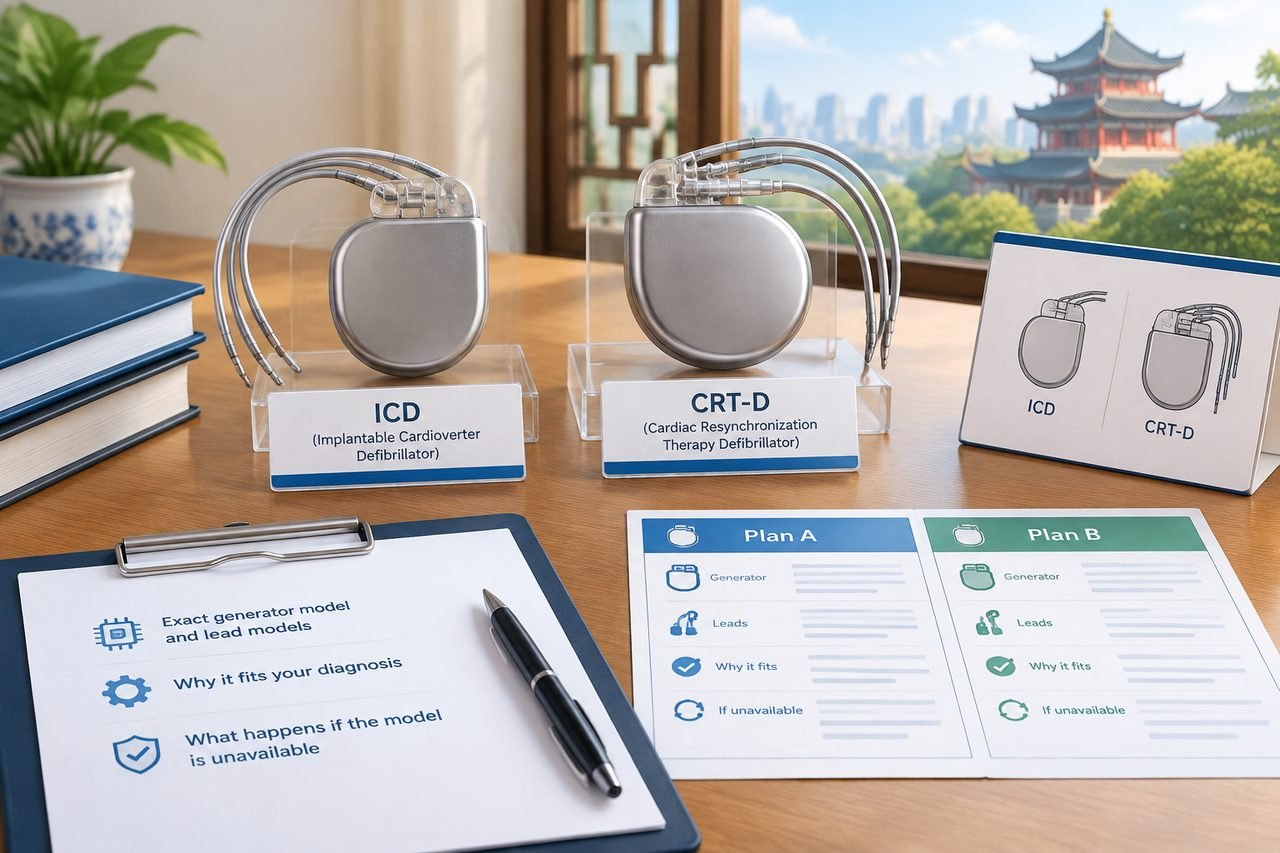
A referral may say 'ICD' or 'CRT' as if that settles the plan. It does not. The British Heart Foundation describes an implantable cardioverter defibrillator as a device that treats dangerous heart rhythms. A CRT-D combines that rhythm protection with coordinated pumping support for the lower chambers. Those two labels describe different jobs, so the model discussion starts with which job your treating team is actually trying to do.
Even within one category, the generator and the leads are separate choices. The generator is the battery-and-circuitry unit placed under the skin. The leads are the wires that carry signals between the generator and the heart. A written plan that names only 'a CRT device' leaves open which generator, how many leads, and whether the system includes defibrillation capability. Those details affect follow-up, remote monitoring options and what the device can do later.
This is not a reason to distrust a general description. It is a reason to ask for the specific configuration before you book travel, because changing a model after arrival can change the procedure, the hospital's stock requirements and the consent discussion.
Questions that change the next step
The useful questions are the ones whose answers alter what you do next. If the hospital can name the generator family and lead configuration, you can compare that against what your current cardiologist has already discussed. If it cannot, the next step is to ask whether a device selection discussion has happened at all, or whether the plan is still provisional.
Ask directly: which exact generator model and manufacturer are proposed, and which leads? Why is this configuration preferred over the alternatives for my diagnosis and heart function? Does the proposed system include defibrillation, or is it pacing-only? What remote-monitoring system, if any, is compatible with this model, and will I be able to use it from my home country? Is this device MRI-conditional, and under what conditions?
Each answer has a practical consequence. A pacing-only system is a different commitment from one that can deliver a shock. A remote-monitoring platform that does not work in your country changes your follow-up plan. An MRI-conditional label is not a blanket permission for any scan; it depends on the specific device, lead and scanning conditions, which the treating team and radiologist must confirm.
Write the answers down. A verbal 'we use a good device' is not enough to compare hospitals or to prepare your home cardiologist for follow-up.
What a written quote should separate
When you request an estimate, ask the hospital to state what the quoted scope includes, excludes, and what remains undecided until after assessment. That framing is more useful than a single total, because device implantation involves several components that may or may not appear as separate lines depending on the provider.
Ask specifically whether the quote covers the generator, the leads, the implant procedure, the initial programming and check, any remote monitor or transmitter, and the first follow-up visit. Ask what happens if a different generator or an additional lead is needed during the procedure. Ask whether a replacement or upgrade later would be quoted separately.
Do not assume that every hospital structures its bill the same way. Some may bundle components; others may list them individually. The point is not to guess which is standard, but to get this provider's written scope so you can compare like with like.
Coordination fees, hospital charges and travel costs are separate categories. Keep them separate in your own planning so that a change in one does not distort your view of the others.
A labelled planning example: comparing two written plans
This is an illustration of how to compare documents, not medical advice or a real case. Suppose Hospital A's written plan names a specific CRT-D generator, two leads, the implant procedure, initial programming and a remote monitor, and states that the first follow-up is included. Suppose Hospital B's plan says 'CRT device implantation' with a total figure and no model names, and notes that device selection will be confirmed after assessment.
The two plans are not yet comparable. Hospital A has given you a configuration to check against your diagnosis and against what your home cardiologist expects. Hospital B has given you a price for an undefined device. The next step with Hospital B is not to reject it, but to ask for the same level of detail: which generator, which leads, what is included, and what remains open.
If Hospital B later names a pacing-only system while your team has discussed defibrillation, that is a substantive difference to resolve before travel. If it names the same configuration, you can then compare the remaining scope items. The exercise is about making the documents answer the same questions.
Availability, alternatives and what to confirm in China
Device availability is hospital-specific and can change. Rather than assuming a named model is stocked, ask the hospital whether the proposed generator and leads are available for your planned dates, and what alternatives exist if they are not. Ask who makes that decision and when you would be told.
Ask how the team handles a situation where the preferred model is unavailable: would they use a different generator from the same category, delay, or discuss another approach? Ask whether the alternative would change the lead configuration, the remote-monitoring plan or the follow-up schedule. These are questions for the treating team, because the answers depend on your heart function, your rhythm problem and the hospital's stock at that time.
If you are comparing hospitals in China, ask each one the same set of questions so the answers can be placed side by side. A hospital that gives clear written answers is easier to plan with, even if its proposed model differs from another's.
You can read more about the procedure itself on the ICD and CRT implantation reference page, which covers the general assessment and implantation pathway.
Records to prepare and the limits of a remote review
A device selection discussion is only as good as the information behind it. Ask your current cardiologist which records would help a receiving team understand your rhythm problem and heart function. Typical items might include recent ECG or Holter recordings, an echocardiogram report, a stress test if one exists, a list of your current medicines, and any prior electrophysiology study or device interrogation if you already have a device.
Ask the receiving hospital which of these it needs before it can give a device-specific opinion, and in what format. Do not send a complete archive before you know what is relevant. A short summary with the key reports is usually enough for an initial review; the hospital can request more if needed.
A records-based review can clarify whether a device is appropriate in principle and which configuration the team would consider. It does not establish final eligibility, confirm that a specific model will be implanted, or replace the in-person assessment and consent discussion. The hospital decides suitability after it has seen you and the necessary tests.
If your symptoms are worsening or you have new chest pain, fainting or severe breathlessness, seek local urgent care rather than delaying for an overseas planning process.
Sources & scope of this guide
References and official service information relevant to this guide.
This is general planning information and has not been individually reviewed by a doctor. Medical decisions and personal treatment advice come from your treating clinicians.